
Polychoron (four-dimensional polytope)
A polychoron is a bounded four-dimensional polytope built from polyhedral cells. Overview, structure, classical regular examples, history, visualization methods, and mathematical significance are explained.
A polychoron is a geometric figure confined to four dimensions: the four-dimensional analogue of a polygon in two dimensions and a polyhedron in three. The term derives from Greek (many + space) and is one of several names used for these objects; alternative labels include 4-polytope and polyhedroid. For basic context in geometry see geometry and the root words in Greek etymology.
Image gallery
8 Images

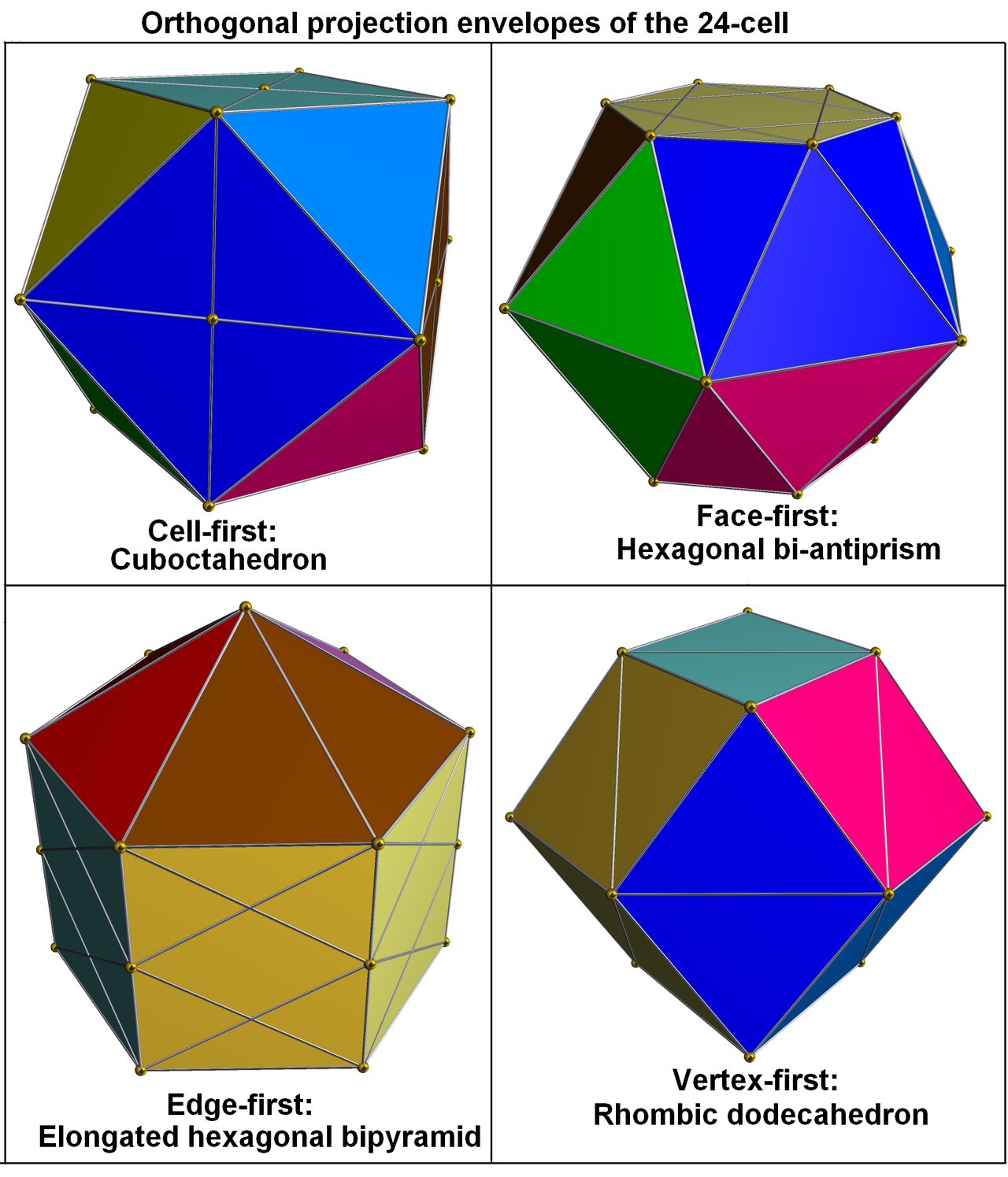
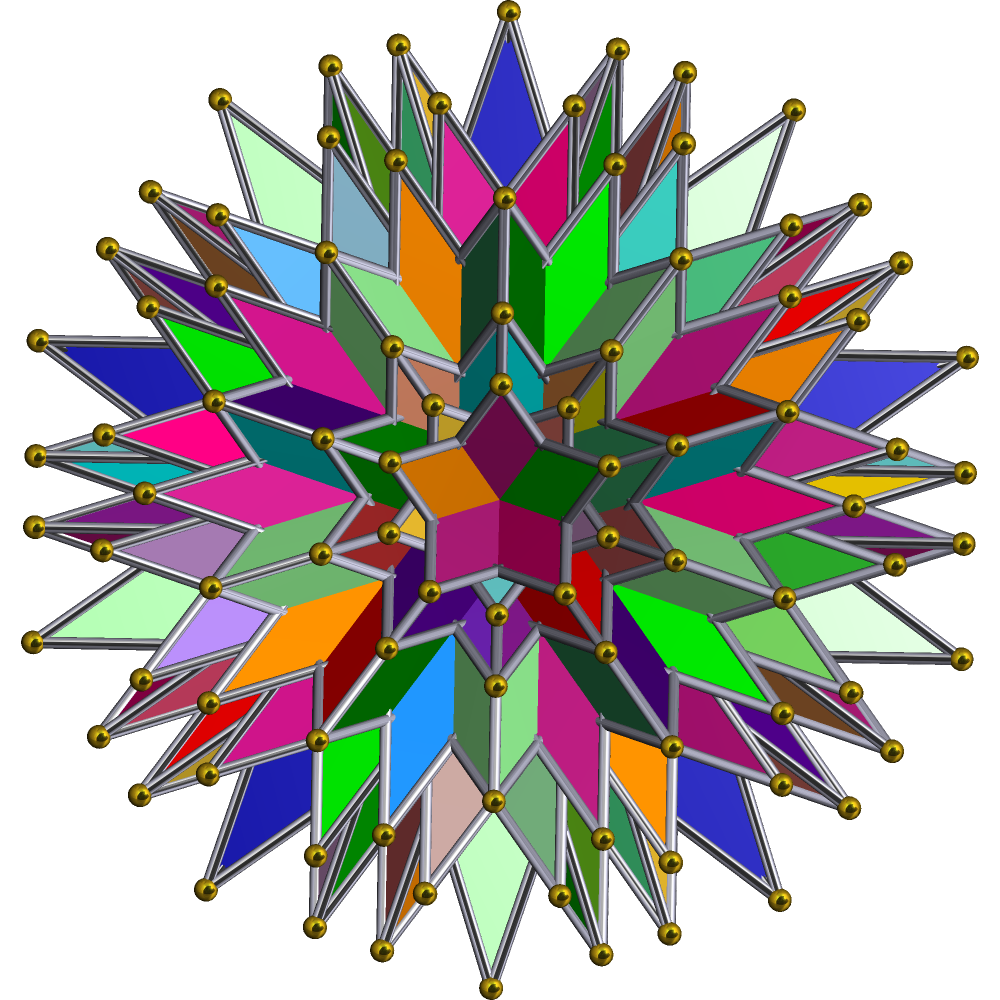

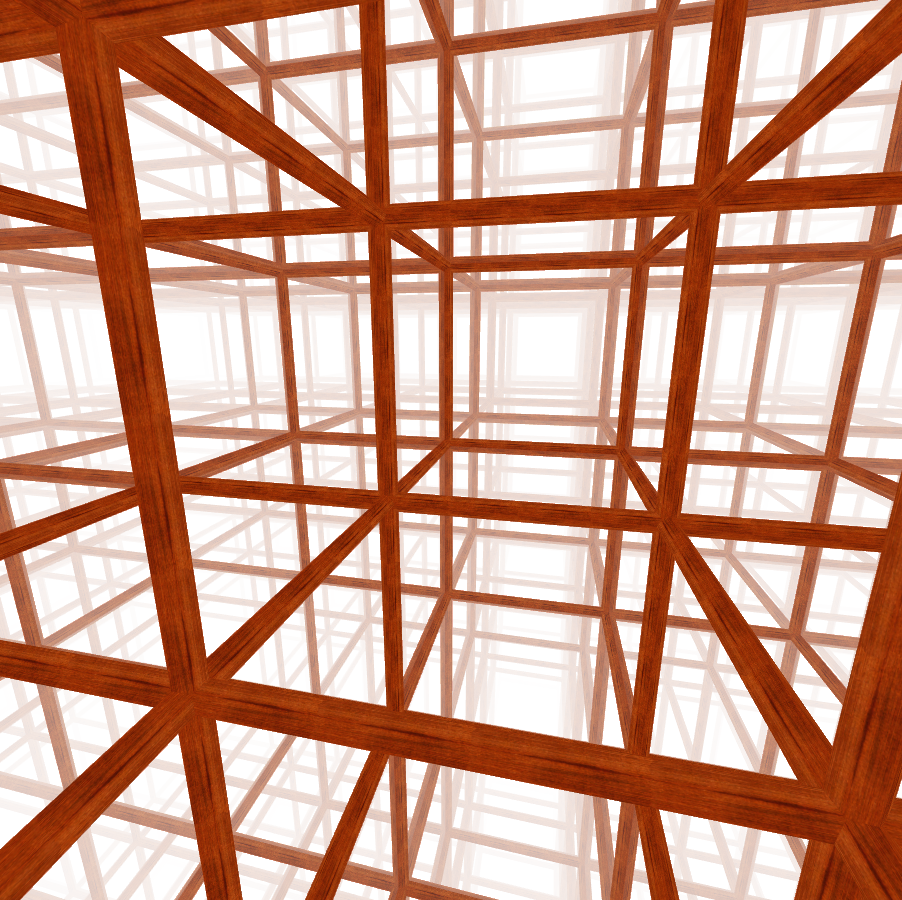

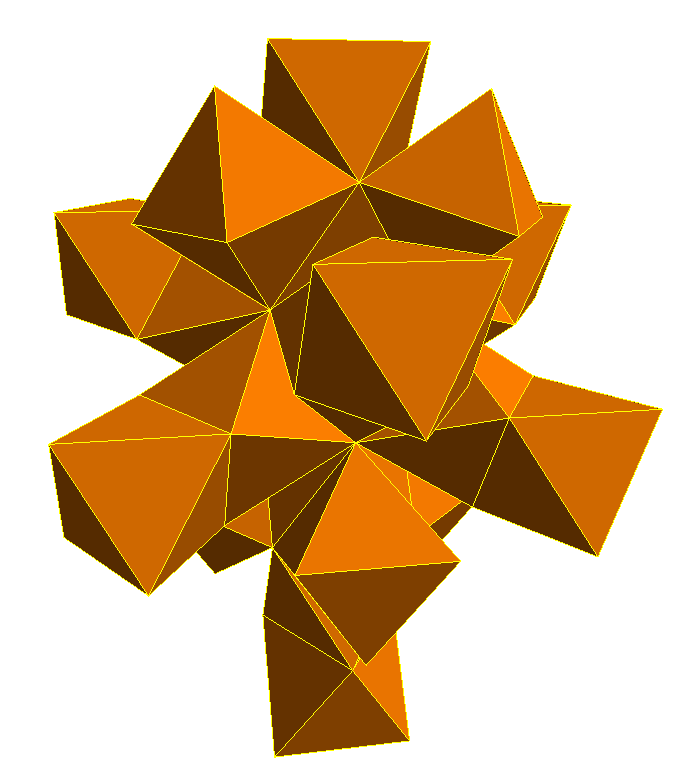
Definition and structure
Topologically a polychoron is a compact, convex (or nonconvex) shape whose boundary is tiled by three-dimensional polyhedral cells. Its elements are organized by dimension: vertices (0D), edges (1D), polygonal faces (2D), and cells (3D). The boundary of a convex 4-polytope is homeomorphic to a 3-sphere, and its combinatorial data can be encoded by incidence lists or by a Schläfli symbol of the form {p,q,r} for regular examples. The word 4-polytope is often used in formal classifications.
Classical regular polychora
There are a small number of highly symmetrical, regular convex polychora that generalize the Platonic solids. The most commonly cited examples are:
- 5-cell (4-simplex): the analogue of a tetrahedron, with tetrahedral cells.
- Tesseract (hypercube): bounded by eight cubes.
- 16-cell: dual to the tesseract and built from tetrahedral cells.
- 24-cell: a unique self-dual regular 4-polytope without a three-dimensional analogue.
- 120-cell and 600-cell: a dual pair formed from dodecahedral and tetrahedral cells respectively.
These examples illustrate duality and symmetry concepts familiar from polyhedra; for comparison with lower-dimensional relatives see polygon and polyhedron.
History and development
The systematic study of four-dimensional polytopes began in the 19th century when mathematicians extended the ideas of regular solids to higher dimensions. Work by Schläfli and later by Coxeter classified regular 4-polytopes and described their symmetry groups. Subsequent research produced additional nonconvex regular examples and catalogues of uniform and semi-regular families.
Visualization, construction, and applications
Because humans perceive only three spatial dimensions, polychora are visualized by projection and slicing. Common methods include 3D projections (Schlegel diagrams), orthogonal or perspective projections into 3-space, and 3D ‘‘nets’’ of polyhedral cells hinged into a spatial arrangement that can be folded analogously to a 2D net of a cube. Computer graphics, 3D printing, and interactive models have made these visualizations routine. In mathematics and theoretical physics polychora and their symmetry groups appear in topology, group theory, and as models for higher-dimensional phenomena; they also inspire sculptures and educational models.
Distinctions and notable facts
Unlike in three dimensions, some regular four-dimensional shapes have no direct 3D counterpart (for example the 24-cell). Duality pairs (tesseract & 16-cell, 120-cell & 600-cell) mirror the dual relationships known from polyhedra, and some boundary formulas differ because the boundary is a 3-manifold: combinatorial identities involve alternating sums of counts of vertices, edges, faces, and cells. There are also infinite families of uniform polychora and a collection of star (nonconvex) regular polychora classified later in the 19th and 20th centuries.
Questions and answers
Q: What is a polychoron?
A: A polychoron is a four-dimensional figure in geometry.
Q: What does the word "polychoron" mean?
A: The word "polychoron" comes from the Greek words "poly," meaning many, and "choros," meaning room or space.
Q: What are some other names for a polychoron?
A: Sometimes a polychoron is called a 4-polytope or a polyhedroid.
Q: What is the analogue figure for a polychoron in two dimensions?
A: The analogue figure in two dimensions is a polygon.
Q: What is the analogue figure for a polychoron in three dimensions?
A: The analogue figure in three dimensions is a polyhedron.
Q: What does the Greek root "poly" mean?
A: The Greek root "poly" means many.
Q: What does the Greek root "choros" mean?
A: The Greek root "choros" means room or space.
Related articles
Author
AlegsaOnline.com Polychoron (four-dimensional polytope) Leandro Alegsa
URL: https://en.alegsaonline.com/art/77840