
Pocket Cube (2x2 Rubik's Cube variant)
A compact twisty puzzle consisting of eight corner pieces; a 2x2 version of the Rubik's Cube popular in speedsolving and as an introduction to cube algorithms.
Overview
The Pocket Cube is a small twisty puzzle that reproduces the mechanics of a Rubik's Cube on a 2x2 face grid. Often described simply as a 2x2 cube, it retains the turning and corner-orientation challenges of larger cubes while eliminating edges and fixed centers. Its compact size and relative simplicity make it popular as both a casual brain teaser and a competitive event in speedcubing.
Image gallery
3 Images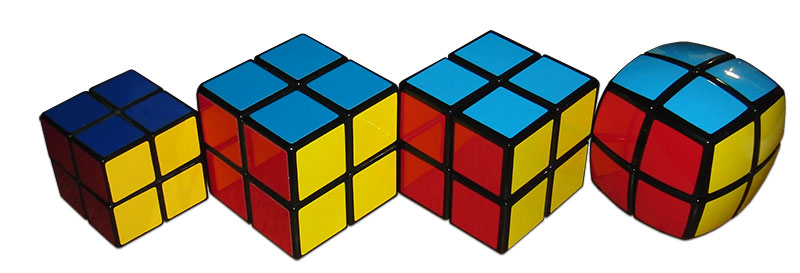

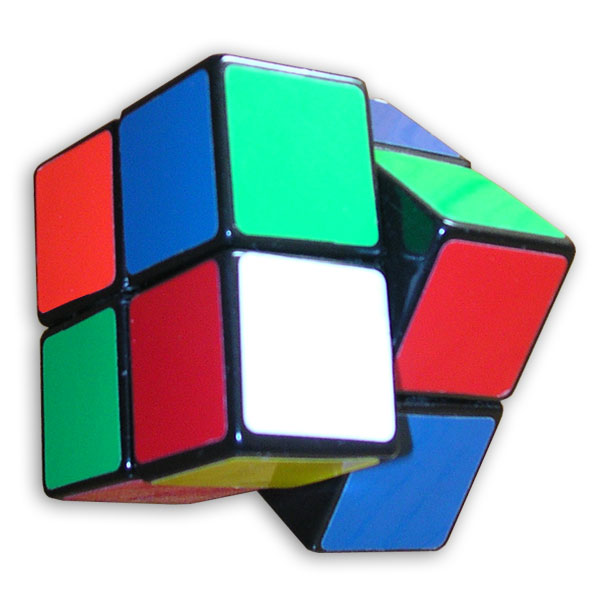
Structure and characteristics
Physically the puzzle is built from eight corner pieces that rotate around an internal mechanism. Each corner has three visible stickers (or colored plastic facets), and the solved state is defined by matching each face to a single color. Because there are no edge pieces or center pieces, the mathematical state space is smaller than that of the 3x3 cube but still large enough to provide meaningful challenge.
- Number of moving pieces: 8 corner cubies.
- Key properties: corner permutation and corner orientation.
- Typical construction: coreless or tucked internal mechanism holding corners in place.
History and development
The Pocket Cube appeared soon after the popularity of the original Rubik's Cube and has been produced under many brand names. It evolved alongside improvements in materials and turning mechanisms, which enabled faster, more reliable movement and helped establish the puzzle as a staple of the speedcubing community. The name "Pocket Cube" emphasizes its small, travel-friendly size.
Solving, methods and competition
Solving techniques range from simple layer-by-layer approaches suitable for beginners to advanced algorithms used by speedcubers. Common advanced methods focus on optimizing the orientation and permutation of corners; examples include Ortega and CLL-style approaches. In organized competitions the 2x2 event is timed separately, and top speedsolvers routinely complete the puzzle in well under a minute, with world-class times below one second.
Importance and notable facts
The Pocket Cube serves as an accessible introduction to spatial reasoning, algorithmic thinking, and the math of permutation puzzles. It is sometimes used in classrooms to illustrate group theory concepts in a hands-on way. For more information about related puzzles and the original design, see the broader article on the Rubik's Cube here.
Related articles
Author
AlegsaOnline.com Pocket Cube (2x2 Rubik's Cube variant) Leandro Alegsa
URL: https://en.alegsaonline.com/art/77568
Sources
- worldcubeassociation.org : "Results"