
Icosahedron
A polyhedron with twenty triangular faces; most familiar as the regular convex Platonic icosahedron. Covers geometry, history, variants, and common uses such as dice, architecture, and viral symmetry.
Overview
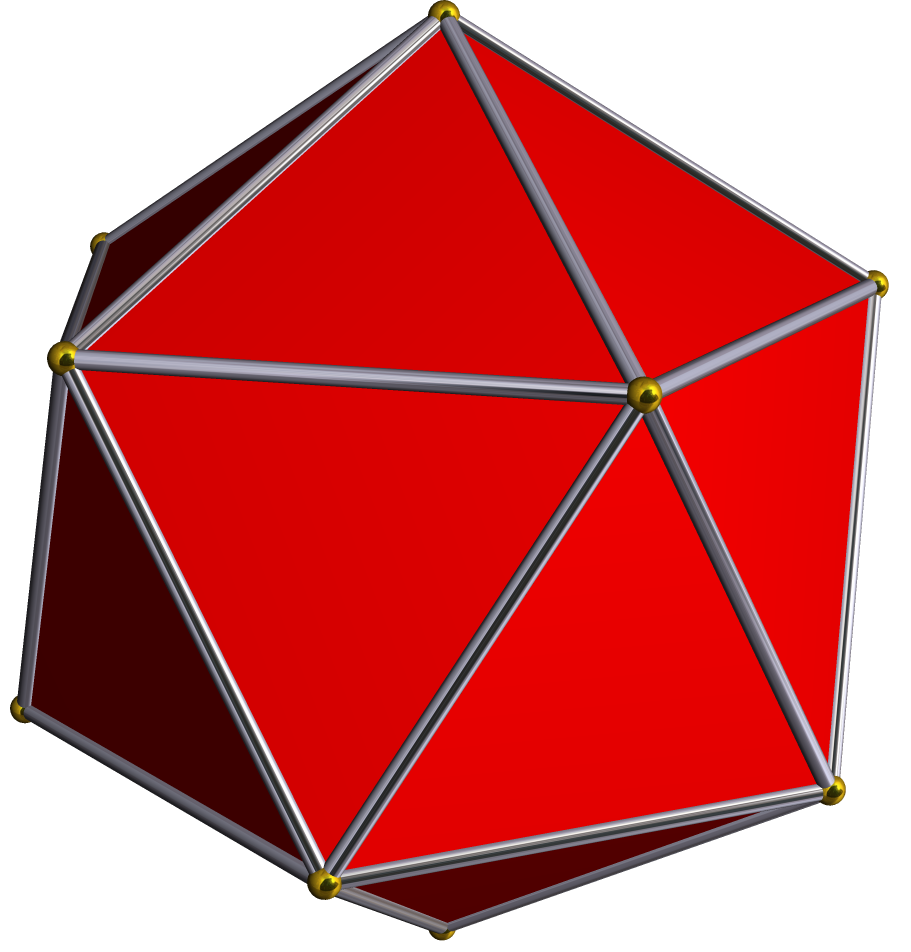
An icosahedron is a polyhedron whose surface is made up of twenty triangular faces. The most famous example is the regular convex form, one of the five classical Platonic solids. In that regular case all faces are congruent equilateral triangles, five faces meet at each vertex, and the solid is highly symmetric.
Image gallery
10 Images




Geometry and key properties
The regular icosahedron has 20 faces, 30 edges and 12 vertices; these numbers satisfy Euler's formula V − E + F = 2 (12 − 30 + 20 = 2). Its Schläfli symbol is {3,5}, indicating triangular faces with five meeting at each vertex. The regular form is dual to the regular dodecahedron, and its symmetry group is the icosahedral group (rotational order 60, full symmetry order 120).
- Faces: 20 equilateral triangles (regular icosahedron)
- Edges: 30
- Vertices: 12; five faces meet at each vertex
- Dual: regular dodecahedron ({5,3})
History and mathematical context
Study of the icosahedron goes back to ancient Greek geometry and was formalized among the Platonic solids. Later mathematicians developed analytic descriptions and coordinate models—many expressed using the golden ratio because numerically simple vertex arrangements involve that constant. The icosahedron also appears in the theory of regular polyhedra, stellations, and in modern group theory through its symmetry group.
Uses, examples, and significance
Beyond pure geometry, icosahedral symmetry appears in several applied contexts. Twenty-sided dice (d20) are common in tabletop gaming. Geodesic designs for domes and spheres often begin with an icosahedral framework that is subdivided and projected to form a nearly spherical shape. Many spherical viruses assemble protein shells with icosahedral symmetry because it allows repeating subunits to form a closed shell efficiently. In chemistry and materials science, molecules and clusters may exhibit icosahedral symmetry even when not literal icosahedra.
Variations and related solids
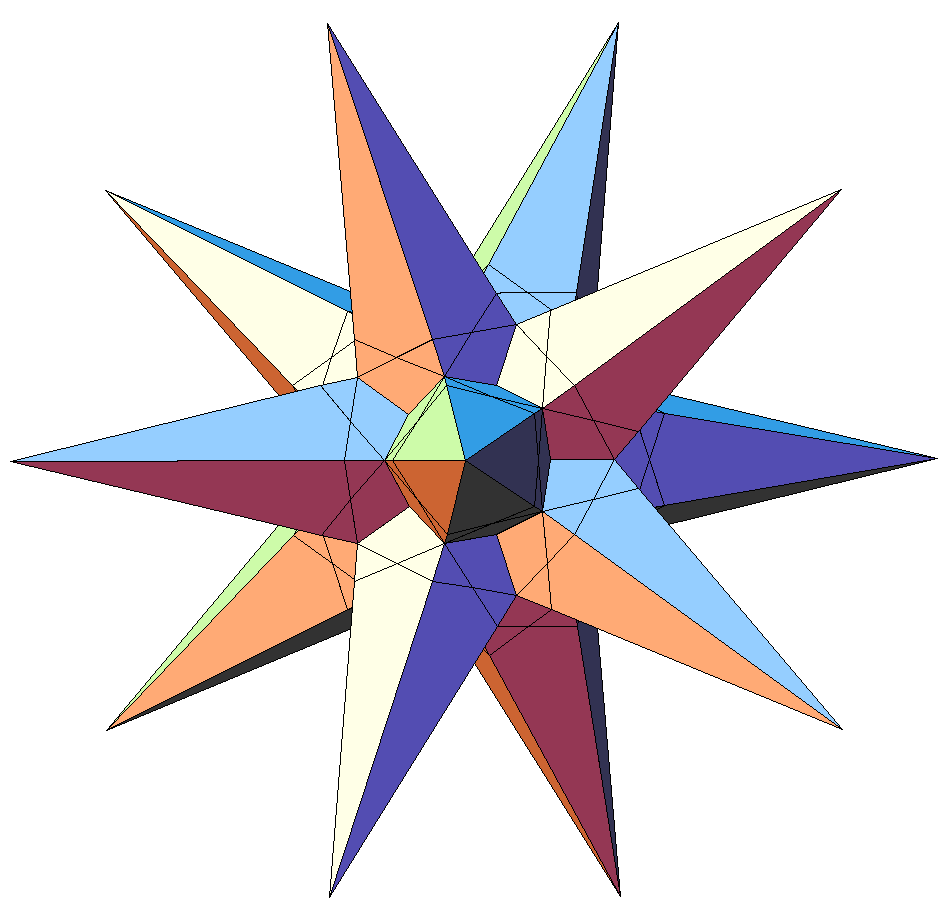
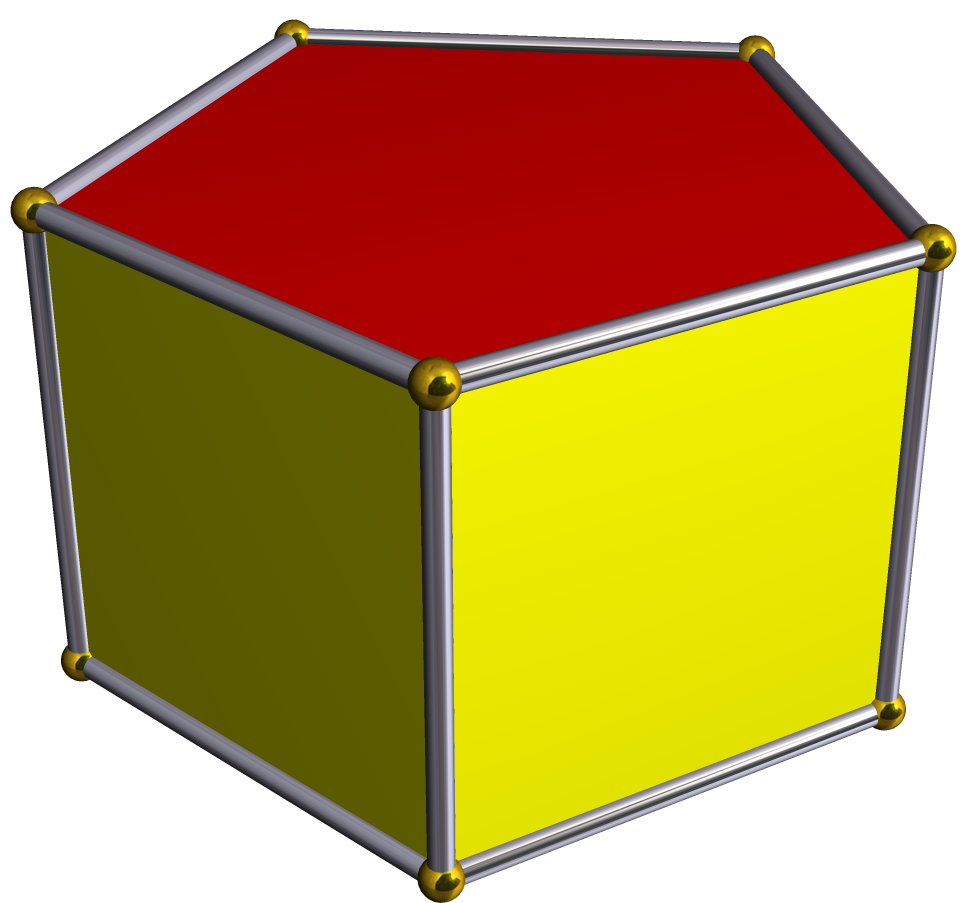
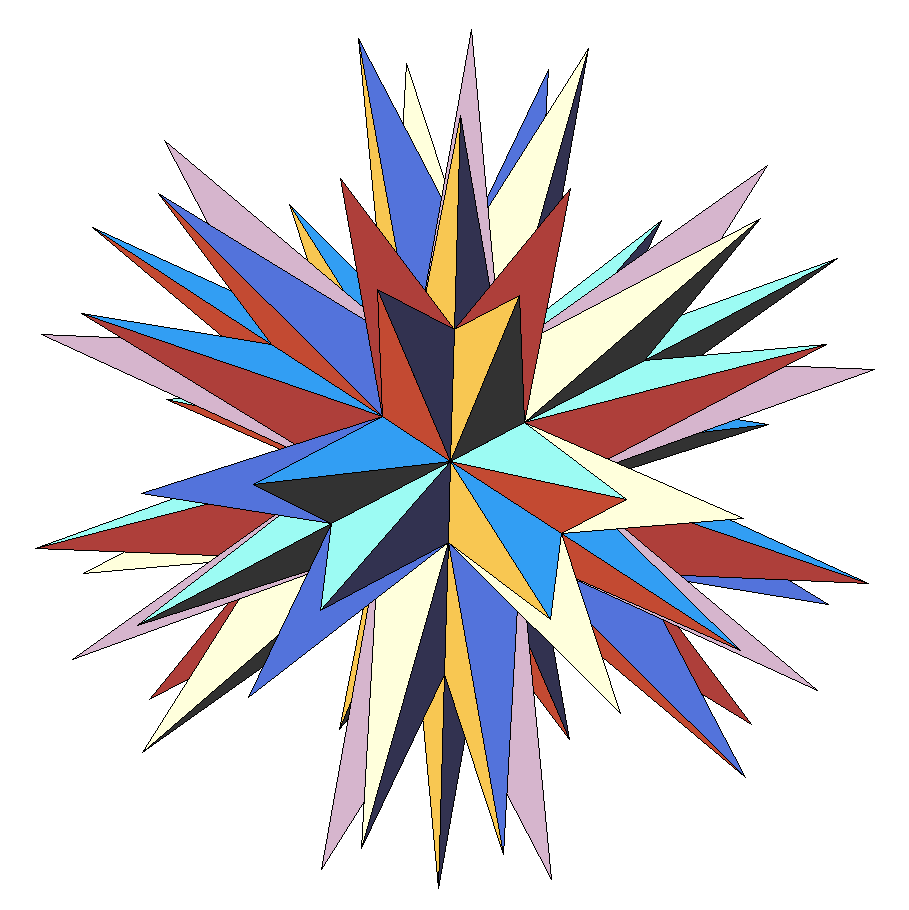
There are many shapes called icosahedra beyond the regular convex type. Some are nonconvex or stellated, such as forms in the family of Kepler–Poinsot solids (for example the great icosahedron and related stellations). Others are irregular polyhedra with twenty triangular faces but lower symmetry. The term therefore covers a broad class of twenty-faced polyhedra as well as the specific, highly symmetric Platonic example.
For further geometric background see general discussions of Platonic solids and basic triangle geometry via triangles.
Related articles
Author
AlegsaOnline.com Icosahedron Leandro Alegsa
URL: https://en.alegsaonline.com/art/46493