
Pioneer movement (youth organisations in socialist and communist contexts)
State-linked youth organisations originating in the 20th century that combined outdoor education and civic training with support for communist parties; notable for symbols like the red scarf.
The pioneer movement is a form of organised youth activity found primarily in countries influenced by communist or socialist parties. Its membership targets children and adolescents and it developed as a distinct alternative to independent scouting groups. Early pioneers combined community, recreation and education while also serving as channels for civic and political instruction. Many pioneer organisations were created, supported or recognized by ruling parties and state institutions; in some contexts membership was voluntary, while in others social pressure and official encouragement made participation widespread. For a general reference to the movement’s target demographic see children and adolescents, and for the political alignment that often shaped its aims see Communist parties and lists of socialist countries.
Image gallery
3 Images

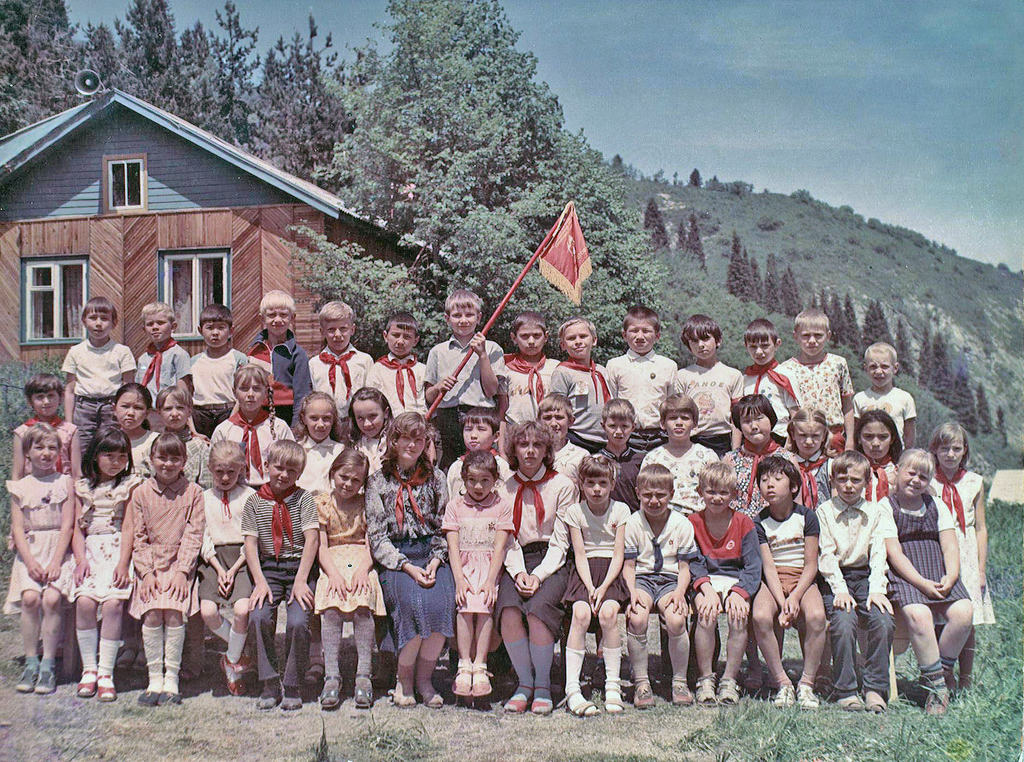
Characteristics and symbols
Pioneer organisations share several visible traits. They promote physical education, outdoor skills, teamwork and a structured programme of badges or ranks much like scout groups, but they are usually linked to state institutions or a political party rather than independent civil society. A prominent emblem is the triangular neckerchief or scarf, commonly red but sometimes light blue, worn as the defining uniform piece; readers can see a description of this item at scarf. Groups were often named for admired revolutionary figures or party leaders to provide role models and a sense of historical continuity.
History and development
The idea of organised youth associations tied to socialist movements took shape in the 20th century as new regimes and parties sought ways to involve young people in both leisure and political life. In the Soviet Union the Young Pioneer organisation became a national institution, serving as a model for similar groups elsewhere. In other countries pioneer movements adopted local names and heroes; for example, organisations were associated with figures such as Lenin in the USSR, or with national leaders in different states — in East Germany the pioneers were linked to Ernst Thälmann, while in Albania a variant was identified with Enver and his policies (Enver Hoxha). These tie-ins reinforced a political narrative and provided official role models for children.
Activities, organisation and public provision
Pioneer programmes commonly combined educational sessions with cultural and outdoor activities. Large networks ran summer camps, youth centres often called palaces, clubs, and hobby groups. In several countries these facilities were subsidised or operated by state bodies or trade unions, making them widely accessible and sometimes free to participants. Publications for young readers — newspapers and magazines produced by pioneer organisations — helped broadcast programmes and reinforce shared values. Older adolescents could move on to other youth or party-affiliated organisations if they pursued deeper involvement in political life.
Contemporary examples and geographic distribution
While some pioneer organisations dissolved or were reformed after changes of government in the late twentieth century, many have continued in various forms. Some remain explicitly political, others have been transformed into non-partisan youth services. Notable examples and present-day organisations include:
- Belarus — Belarusian Republican Pioneer Organisation
- Belgium — Pioneers associated with the Workers Party
- People’s Republic of China — Young Pioneers of China
- Cuba — José Martí Pioneer Organization (noted for environmental and educational activities; associated recognition has been reported by international bodies such as UNEP)
- Cyprus — EDON
- Finland — Democratic Union of Finnish Pioneers
- Czech Republic — Pionýr, now a non-political organisation offering organised leisure and youth programmes
- North Korea — Young Pioneer Corps
- Russia — successor and reconstituted groups tracing heritage to Soviet pioneers
- Spain — Pioneers linked to regional left-wing parties
- Tajikistan
- Syria — Baath Party affiliated pioneers
- Vietnam — Ho Chi Minh Young Pioneers
Criticism, transformation and legacy
The pioneer movement’s political associations have long attracted debate. Supporters argue these organisations provide structured youth development, civic skills, arts and sports opportunities. Critics contend that when linked closely to a ruling party or ideology they can function as instruments of political socialisation or indoctrination. After political transitions in several countries, some pioneer organisations were disbanded or reconstituted as non-political youth organisations that retained recreational and educational programmes but removed overt party instruction. The movement’s legacy remains visible in the continuing popularity of camp traditions, collective activities and the use of youth institutions to support public education and community life.
Related articles
Author
AlegsaOnline.com Pioneer movement (youth organisations in socialist and communist contexts) Leandro Alegsa
URL: https://en.alegsaonline.com/art/77031
Sources
- unep.org : "THE JOSE MARTI PIONEER ORGANIZATION OF CUBA, ONE OF 18 INDIVIDUALS AND ORGANIZATIONS, TO RECEIVE UNITED NATIONS ENVIRONMENT AWARD"
- vietnamnews.vnanet.vn : "Young Pioneers honoured on Brigade's 65th anniversary"