
Parent peak (topography)
Parent peak: the higher summit used to relate and measure a mountain's topographic prominence; different definitions exist and the choice affects how peaks are classified and compared.
Overview
In mountain geography and topography, a "parent peak" is a higher mountain that is used to relate a lower summit to the surrounding terrain. The concept helps determine a peak's prominence, which measures how much a summit rises above the lowest contour connecting it to any higher terrain. A parent is typically a nearby higher peak, but the exact choice depends on the method applied.
Image gallery
1 Image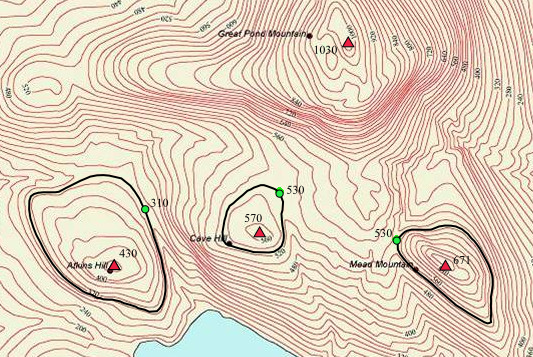
How a parent is chosen
There is no single universal definition. Several widely used approaches identify a parent by following ridgelines, saddles, or watershed boundaries until a higher summit is reached. A common idea is the "key col" (or key saddle): the lowest point on the highest ridge that connects the summit to any higher ground. The higher summit reached by crossing that key col is often called the prominence parent. Other variants include the "line parent," which follows the steepest ascent route, and the "encirclement parent," identified by enclosing contour lines.
- Prominence parent: linked by the highest key saddle and used directly in prominence calculations.
- Line parent: reached by following the highest ridge or path of ascent.
- Encirclement/island parent: based on enclosing contours or landmass boundaries.
Uses and importance
Assigning a parent peak is practical for classifying summits, building hierarchical peak lists, and understanding mountain dominance. Prominence and parent relationships help mountaineers and cartographers distinguish independent mountains from subsidiary tops. For example, the chain of parents for a summit can show how it connects across ranges and ultimately to the highest regional or global summits.
Notable facts and exceptions
Some summits have no parent under common definitions: the highest point on an island or on a continent lacks any higher land to connect to, so it is considered parentless. Likewise, the world's supreme high point has no parent because there is no higher summit. Different mapping agencies and researchers may assign different parents to the same summit depending on which method they prefer, so parentage should be cited with the definition used when precision is required.
For further reading on related concepts, see entries on prominence, topography, and discussions of peak lists and isolation. Geographic context such as an island or continent affects whether a summit has a parent and how parent chains terminate.
Different resources and databases may present parent relationships in tables or maps; when using such data, check which parent definition is being applied to ensure consistent comparisons.
Related articles
Author
AlegsaOnline.com Parent peak (topography) Leandro Alegsa
URL: https://en.alegsaonline.com/art/74620
Sources
- peaklist.org : "Section 6: Lineage Theory"
- peakbagger.com : "Glossary of Terms"