
Pennsylvanian: the Upper Carboniferous epoch in North America
The Pennsylvanian (323–299 Ma) is the Upper Carboniferous epoch marked by vast equatorial coal-forming wetlands, distinctive flora and amphibian faunas, and the buildup of coal resources.
Overview
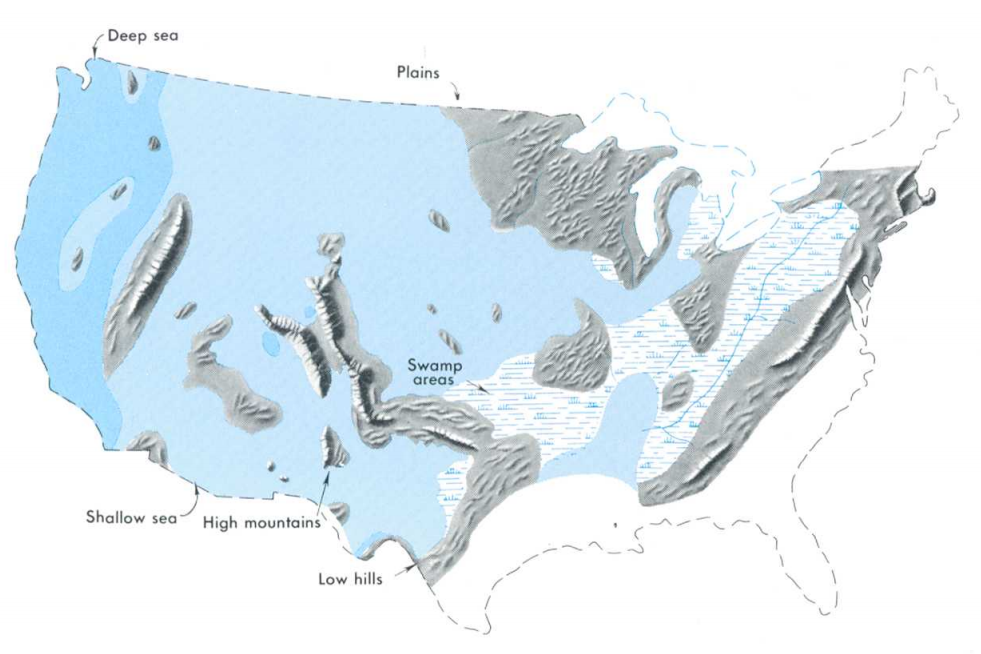
The Pennsylvanian is the name used in North American geology for the Upper Carboniferous period and specifically an epoch recognized within regional strata. It succeeds the Mississippian and precedes the Permian. The epoch spans approximately 323 to 299 million years ago, a time when large parts of what is now North America lay near the equator and supported extensive swampy landscapes.
Image gallery
3 Images

Environment and coal formation
The most famous feature of the Pennsylvanian is the formation of widespread coal beds. These coal seams formed from thick accumulations of peat in low-lying, waterlogged ecosystems often described as tropical wetland forests. Over time peat was buried, compacted, and chemically transformed into coal, creating the major coal measures that fuelled later industrial development.
Paleogeography and the Pennsylvanian basin
Continental arrangements during the Pennsylvanian placed many landmasses together in the supercontinental setting sometimes called Laurussia. Wetlands extended in an equatorial band from eastern Canada across parts of what are today Europe to areas now in China. One reconstructions describes a vast coal-bearing plain or basin stretching some 5,000 km in length and roughly 700 km across, a size larger than modern continental wetlands.
Flora, fauna and ecosystems
Pennsylvanian landscapes were dominated by tall, woody plants unlike most modern trees. Large lycopsids, commonly called giant clubmosses, including Lepidodendron, formed extensive stands. Ferns, horsetails and seed ferns were also important. The coal-forest vertebrate assemblage was rich in amphibians that thrived in the moist environments, and by the end of the epoch early amniotes (the group that led to reptiles, birds and mammals) began to appear, marking a major evolutionary development.
Key characteristics and significance
- Age: roughly 323–299 million years ago.
- Position: Upper part of the Carboniferous, after the Mississippian and before the Permian.
- Major deposits: extensive coal measures formed from peat in equatorial wetlands.
- Biota: giant lycopsids, diverse ferns, abundant amphibians, and emerging amniotes.
The Pennsylvanian is therefore notable both for its environmental extremes—vast swamp forests that rival modern wetlands in scale—and for its role in producing the coal resources that would later become economically important. Its fossil plants and animals provide crucial evidence for understanding the transition from water-dominated ecosystems to more terrestrialized faunas and the early evolution of the amniote lineage.
For further summaries and stratigraphic detail see regional and global correlations and guides: consult specialized stratigraphic charts and reviews for how the Pennsylvanian corresponds to international stages and local subdivisions.
Related topics and further reading: Carboniferous overview, epoch definitions, rock strata, North American geology, Permian transition, coal formation, peat origins, wetland ecology, forest types, European basins, Asian equivalents, Laurussia tectonics, eastern Canada records, Ukraine coalfields, Pennsylvanian basin, clubmosses, Lepidodendron fossils.
Questions and answers
Q: What is the Pennsylvanian?
A: The Pennsylvanian is the Upper Carboniferous epoch in the strata of North America.
Q: What epoch comes after the Mississippian and before the Permian?
A: The Pennsylvanian comes after (above) the Mississippian, and before the Permian.
Q: When did the Pennsylvanian start and end?
A: The Pennsylvanian started about 323 million years ago (mya), and ended about 299 mya.
Q: What are the coal measures?
A: The coal measures are the remains of peat formed by dense tropical wetland forests.
Q: When were the coal measures formed?
A: The coal measures were formed in the Pennsylvanian, from about 315–300 million years years ago.
Q: Where were the wetlands located during the Pennsylvanian epoch?
A: The wetlands were located on the equator and stretched from North America in the west, through what is now Europe to China in the east, because these continents were all together at the time (Laurussia).
Q: What were the characteristic vertebrates and plants of the coal measures?
A: The characteristic vertebrates of the coal measures were amphibia, and the plants were mostly giant clubmosses such as Lepidodendron.
Related articles
Author
AlegsaOnline.com Pennsylvanian: the Upper Carboniferous epoch in North America Leandro Alegsa
URL: https://en.alegsaonline.com/art/75597