
Mount Agung — Bali's highest mountain and active volcano
Mount Agung is a stratovolcano on Bali, Indonesia. It is the island's highest point, a sacred site for Balinese Hinduism, and has produced destructive eruptions in 1963–64 and 2017.
Overview
Mount Agung (Indonesian: Gunung Agung) is a prominent stratovolcano on the island of Bali. It rises above surrounding terrain to form the island's highest point and dominates the eastern skyline. The mountain is both a prominent geological landmark — a volcanic cone — and an important cultural symbol for the Balinese people and visitors to Bali.
Image gallery
4 Images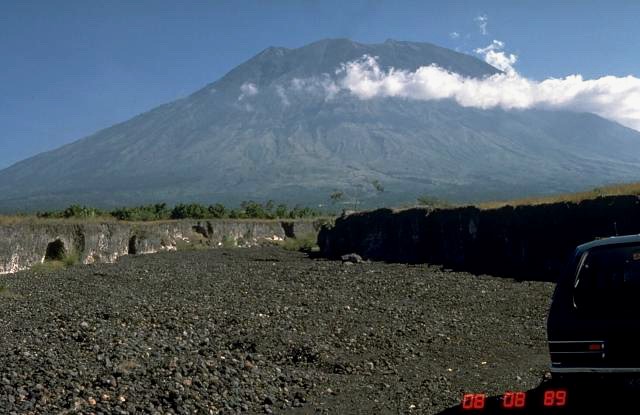


Geology and physical features
Agung is a steep-sided stratovolcano with a deep summit crater that periodically emits ash, gases and lava. Its eruptions are typically explosive, producing ash plumes and pyroclastic flows as well as lava flows that can travel down the flanks. Hydrothermal activity and fumaroles are common near the crater, and the volcano is monitored for changes in seismicity and gas emissions by Indonesian authorities and international partners.
History of eruptions
The volcano has produced several notable eruptions in recorded history. A major and deadly event occurred in 1963–1964; the eruption sent ash and pyroclastic material down valleys and caused widespread destruction, with over 1,000 fatalities and many settlements damaged or buried. Lava flows from that episode nearly reached the Besakih temple complex but did not destroy it, preserving the site on the mountain's slopes. More recently, renewed activity in 2017 prompted high alert levels, mass evacuations and disruptions to air travel as ash clouds rose from the summit during those months.
Notable eruptions and impacts
- 1963–1964: A large explosive eruption with extensive ashfall, lava flows and loss of life; surrounding villages and farms were heavily impacted.
- 2017: Periods of summit unrest, ash emissions and evacuations that affected tourism and flights; lava and ash were observed and contingency plans were activated.
Cultural significance and tourism
Mount Agung is sacred in Balinese Hinduism and hosts important temples, most notably the Mother Temple of Besakih located high on its southern slopes. The mountain's religious role means eruptions are interpreted within spiritual as well as scientific contexts; temples and pilgrimage routes remain central to local culture. At the same time, Agung attracts climbers and visitors who come for sunrise treks, panoramic views and to learn about its geology and history.
Monitoring, hazards and preparedness
Because Agung's eruptions can threaten nearby communities and regional aviation, Indonesian volcano-monitoring agencies maintain alert systems that combine seismic data, ground deformation measurements and gas sampling. Local authorities issue evacuations and land-use advisories when activity increases. Observers note that lava flows may follow valleys, ash fall can impact agriculture and health, and pyroclastic flows pose the greatest immediate danger to anyone on the slopes. Visitors and residents are advised to follow official guidance and to respect exclusion zones established around the summit for safety and conservation.
For background reading and updates, consult official monitoring agencies and scientific summaries rather than travel reports; authoritative sources provide the latest status and safety instructions regarding Mount Agung's activity and reports.
Additional context about nearby communities and the volcano's effects on settlement patterns can be found in regional studies and disaster reports that document how local populations recovered after the eruption and how land use has adapted to volcanic hazard recovery efforts and planning initiatives since 2017.
Related articles
Author
AlegsaOnline.com Mount Agung — Bali's highest mountain and active volcano Leandro Alegsa
URL: https://en.alegsaonline.com/art/66989
Sources
- bbc.com : "Bali's Mount Agung volcano erupts"