
Mount Cayley volcanic field (British Columbia)
A volcanic field on the south coast of British Columbia centered on Mount Cayley, notable for subglacial eruptions that produced tuyas, lava domes and a complex record of Quaternary activity.
Overview
The Mount Cayley volcanic field is a dispersed volcanic area located on the south coast of British Columbia in Canada. Extending roughly 31 kilometres in a north–south belt, the field contains multiple volcanic centers dominated by Mount Cayley, the largest edifice in the group. The landscape combines steep-sided table mountains and dome complexes formed during interactions between magma and ice.
Image gallery
10 Images




Characteristics and landforms
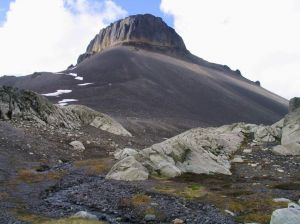
Volcanism in this field produced a variety of volcanic features. Many eruptions occurred beneath or against vast layers of glacial ice, giving rise to distinctive subglacial structures. Two common landforms are tuyas — flat-topped, steep-sided volcanoes formed when lava erupts into and is confined by ice — and lava domes, where viscous lava piles up over a vent. The field also preserves hyaloclastite deposits and lava flows that record changes in eruptive style as ice retreated.
Geologic history
Volcanic activity in the Mount Cayley field began in the Pliocene and continued into the Quaternary. The earliest eruptions are estimated to have occurred between about 5.3 and 1.6 million years ago, and geological surveys have identified at least 23 eruptive events overall. The interplay between volcanism and the last ice age is especially important: many eruptions happened while glaciers covered the region, so the resulting volcanic deposits and shapes record both volcanic processes and glacial conditions.
Distribution and notable centers
The volcanic centers are unevenly distributed along the belt. The southern sector contains the greatest concentration, with eleven recognized volcanic constructs. The central portion includes at least five centers, while the northern end has two known volcanic edifices. Mount Cayley itself is the dominant feature and is considered the most prominent and potentially active volcano in the group.
Importance, hazards and study
Although the Mount Cayley volcanic field is remote and not densely populated, it is of scientific interest for understanding subglacial volcanism and the interaction between ice and magma. The field is part of the regional volcanic province related to the Cascade volcanic arc and contributes to regional geologic hazard assessments. Potential hazards from renewed activity would include localized ashfall, lava dome growth and collapse, and meltwater floods if eruptions involve residual snow and ice. Ongoing geological mapping and monitoring aim to better constrain eruption history and contemporary risk.
Access and research
Field investigations combine mapping, petrologic sampling and radiometric dating to reconstruct eruption ages and magma composition. Researchers rely on detailed studies of volcanic deposits to interpret eruptive environments and postglacial modifications. The Mount Cayley volcanic field remains a focal area for scientists studying how glaciation shapes volcanic landforms and for monitoring the long-term behavior of volcanic systems in western Canada.
- Key features: tuyas, lava domes, hyaloclastite deposits.
- Named after: Mount Cayley, largest edifice.
- Glacial context: eruptions during and after the last ice age left unique landforms.
- Study resources: geological maps and regional volcanic assessments available through academic and government outlets (volcanic field summaries, provincial surveys).
Questions and answers
Q: What is the Mount Cayley volcanic field?
A: The Mount Cayley volcanic field is a volcanic area on the south coast of British Columbia, Canada. It is 31 kilometres (19 miles) long and gets its name from Mount Cayley, the biggest of several active volcanos in the area.
Q: How were most of the volcanoes created?
A: Most of the volcanoes in the Mount Cayley volcanic field were created when material from inside the earth spilled onto the surface.
Q: What was under layers of glacial ice from the last ice age?
A: Underneath layers of glacial ice from the last ice age were found in this area.
Q: What type of volcano can be found at this location?
A: At this location there are tuya—steep, flat-topped volcanoes—and lava domes.
Q: When did eruptions first occur at this site?
A: The first eruptions in this field occurred between 1.6 and 5.3 million years ago.
Q: How many known volcanoes are located in southern part of this field?
A: In the southern part of this field there are 11 known volcanoes.
Q: How many known volcanoes are located in both center and north parts combined?
A: In both center and north parts combined there are at least seven known volcanoes.
Related articles
Author
AlegsaOnline.com Mount Cayley volcanic field (British Columbia) Leandro Alegsa
URL: https://en.alegsaonline.com/art/67011