
Pluto’s Moon System: Charon, Nix, Hydra, Kerberos, and Styx
Overview of Pluto’s five moons—Charon, Nix, Hydra, Kerberos and Styx—including sizes, orbits, rotations, compositions, New Horizons findings, and ongoing searches for faint dust or additional fragments.
The natural satellites that orbit the dwarf planet Pluto number five in total. They range from the relatively large companion Charon to four much smaller outer moons. Observations from Earth and spacecraft have clarified their sizes, shapes, and motions while leaving some details — such as the properties of the smallest fragments and any faint dust — still under study.
Image gallery
10 Images
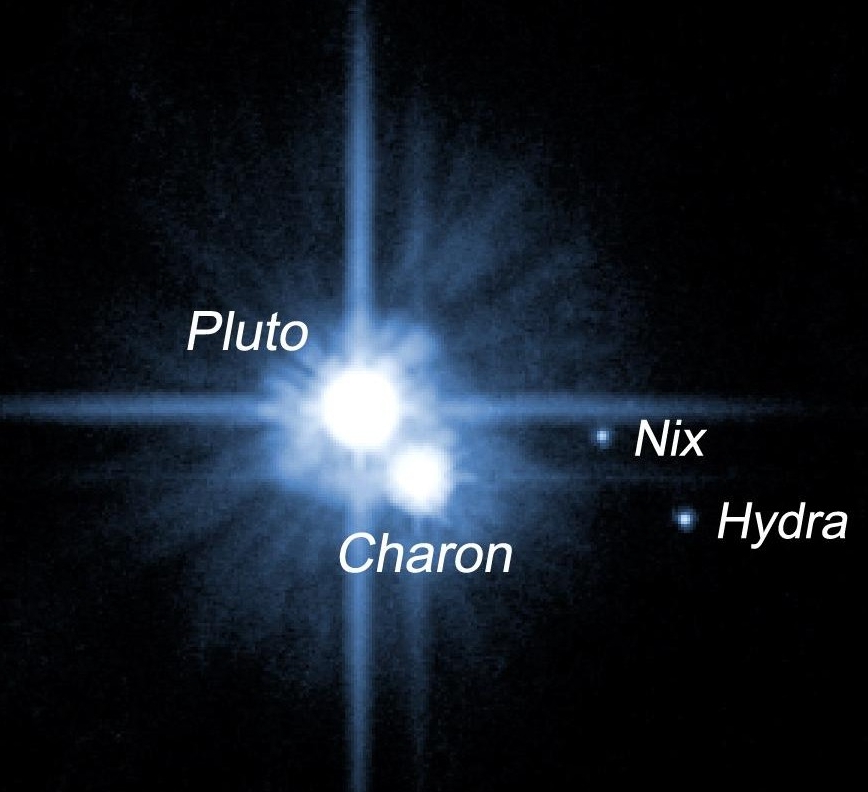



List of moons
- Charon — Pluto’s largest satellite and the first to be identified. Charon is roughly half Pluto’s diameter (about 1,200 km compared with Pluto’s ≈2,376 km) and contains a significant fraction of the system’s mass. The center of mass of the Pluto–Charon pair lies outside Pluto’s surface, which is why the pair is sometimes described as a binary or double system. Charon and Pluto are tidally locked to one another, keeping the same faces toward each other.
- Nix — A much smaller, irregularly shaped moon discovered after Charon. Imaging and spectroscopy indicate a surface with water-ice features; Nix orbits outside Charon’s path.
- Hydra — Similar in size to Nix and likewise showing signs of water ice. Hydra follows an orbit farther from Pluto than Nix.
- Kerberos — A small, faint moon found between the orbits of Nix and Hydra. It was identified in deeper searches of archival and new images.
- Styx — The innermost of the four small outer moons, located just outside Charon’s orbit. Styx is tiny and was the last of the five to be discovered.
Physical and orbital notes
Except for Charon, Pluto’s moons are much smaller, non-spherical bodies whose rotations and orientations can be complex. The smaller satellites display rapid, irregular spin states rather than the simple synchronous rotation seen for many large moons. Their orbital periods form an orderly sequence, and some pairs are near simple integer ratios, a pattern thought to reflect the system’s formation and dynamical evolution.
The Pluto system was studied up close by the New Horizons spacecraft during its 2015 flyby, which provided high-resolution images and measurements that greatly improved knowledge of the moons’ shapes, compositions, and surface features. Ground- and space-based telescopes continue to monitor the system for long-term changes and to search for any additional tiny objects or rings.
Related articles
Author
AlegsaOnline.com Pluto’s Moon System: Charon, Nix, Hydra, Kerberos, and Styx Leandro Alegsa
URL: https://en.alegsaonline.com/art/66548
Sources
- planetarynames.wr.usgs.gov : "Planetary Names: Planet and Satellite Names and Discoverers"
- pluto.jhuapl.edu : pluto.jhuapl.edu
- space.com : "Pluto Has a Fifth Moon, Hubble Telescope Reveals"