
Nix (moon) — small irregular satellite of Pluto
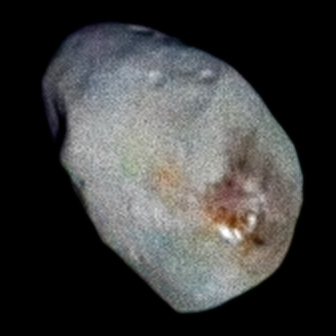
Nix is a small, irregular moon of Pluto discovered by Hubble in 2005 and imaged by New Horizons in 2015. It orbits in the plane of Charon, has a roughly 24.9-day period, and a neutral to grey, icy surface.
Overview
Nix is a small, irregularly shaped natural satellite of the dwarf planet Pluto. It is one of the minor moons that orbit the Pluto–Charon system and is substantially fainter than Pluto itself. Nix does not have sufficient mass to pull itself into a spherical shape; like many small bodies in the outer Solar System, its form is determined largely by material strength rather than self-gravity.
Image gallery
10 Images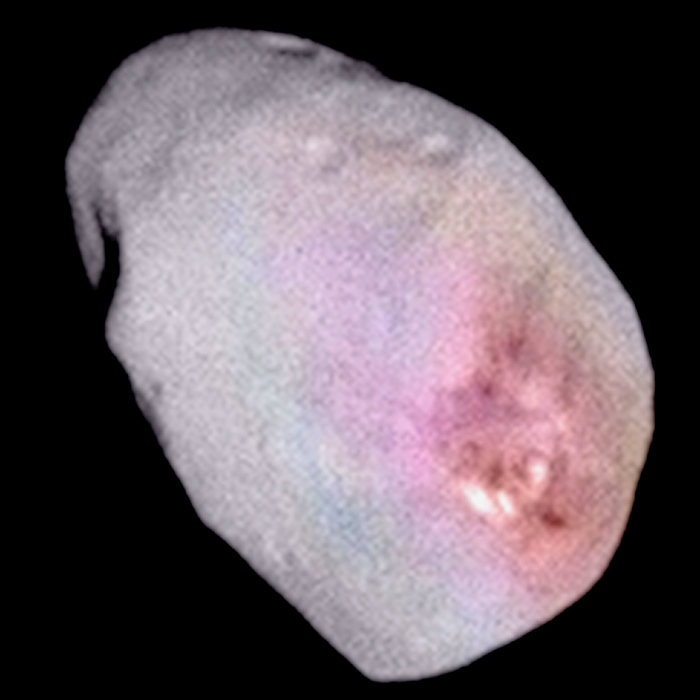






Discovery and designation
Nix was identified in 2005 from images taken with the Hubble Space Telescope during a targeted search for additional Pluto companions. The discovery images were acquired in May 2005 and the object was reported later that year after additional checks and examination of archival data. Independent measurements and analyses by team members led to the provisional designation S/2005 P 2 before an official name was adopted. Credit for the independent detections is commonly given to observers associated with the Hubble search effort.
Naming
The name Nix was formalized by the International Astronomical Union in 2006. It derives from a Latinized form of the name of the Greek goddess of night; the spelling chosen for the moon uses an alternative transliteration to avoid confusion with the asteroid 3908 Nyx. The mythological associations also link Nix with themes of night and with Charon in classical tradition.
Orbit
Nix orbits Pluto in nearly the same plane as Charon, completing a revolution in about 24.9 Earth days. Its orbit is close to circular and lies well outside Charon's orbit, within the gravitational environment controlled by the Pluto–Charon binary. The orbital arrangement of Pluto's small moons, including Hydra, suggests a common origin and presents a laboratory for studying interactions in a compact multi-body satellite system.
Physical properties
Prior to spacecraft imagery, Nix's size estimates depended strongly on assumptions about surface reflectivity (albedo). If its surface reflected light as efficiently as Charon it would be only a few tens of kilometres across; if it were as dark as some distant Kuiper belt objects it could be significantly larger. More recent measurements from a close encounter indicate that Nix is on the order of a few tens of kilometres in its largest dimension and has a relatively bright, icy surface compared with very dark outer belt bodies.
Surface, color and composition
Early photometry produced mixed indications about Nix's color, with some reports suggesting a redder tint. Data from the flyby later showed the surface to be largely neutral to grey in color, consistent with a regolith containing water ice and possibly other relatively bright ices or frost. Spectral and photometric studies from telescopes and the flyby mission indicate that water ice is a plausible major component of the surface, as is true for several other small moons of Pluto.
Rotation and dynamics
Small satellites in the Pluto system do not necessarily rotate in simple synchronous states like many larger moons. Modeling and observations indicate that Nix, along with other minor moons, may have irregular or complex rotation, influenced by torques from the Pluto–Charon binary and past collisional events. Such behavior can include rapid spin rates and tumbling or chaotic rotation, making these objects interesting test cases for rotational dynamics under multi-body gravitational influence.
Origin and scientific importance
Scientists consider the leading hypothesis for the origin of Pluto's small moons to be formation from debris generated in a giant impact that also produced the Pluto–Charon binary. In this scenario, fragments of material accreted to form the smaller satellites in or near the plane of the binary. Studying Nix provides insights into collisional processes, accretion in debris disks, and the evolution of satellites around small planets and binaries in the outer Solar System.
Exploration
The New Horizons spacecraft flew through the Pluto system in July 2015 and obtained higher-resolution images and photometric data of Nix than were previously available. Those observations refined knowledge of its shape, surface reflectivity and color, and helped place limits on its composition and internal properties. Continued telescope observations complement the spacecraft data by monitoring long-term orbital behavior and surface properties.
Summary of notable points
- Nix is a small, non-spherical moon of Pluto discovered in 2005 with Hubble.
- It has a near-circular orbit in the same plane as Charon and a period of about 24.9 days.
- Its surface appears neutral to grey and is consistent with water-ice-rich materials rather than very dark carbon-rich surfaces.
- Its probable origin is as part of a debris population formed after a giant impact that created the Pluto–Charon system.
- High-resolution data from the New Horizons flyby improved constraints on Nix's size, shape and surface properties.
Nix remains an object of interest because its characteristics shed light on satellite formation and dynamical evolution in compact multi-body systems at the edge of the Solar System. Continued analysis of both spacecraft and Earth-based observations helps refine models of its history and physical nature.
For targeted summaries, discovery details and updates on ongoing research, readers may consult archived mission reports and specialist literature accessible through observatory and mission resources (satellite, Hubble, New Horizons).
Questions and answers
Q: What is Nix?
A: Nix is a non-spherical moon of Pluto.
Q: When was Nix discovered?
A: Nix was found along with Hydra in June 2005 by the Hubble Space Telescope Pluto Companion Search Team. The discovery images were taken on May 15, 2005 and May 18, 2005; the moons were independently found by Max J. Mutchler on June 15, 2005 and Andrew J. Steffl on August 15, 2005. The discoveries were announced on October 31, 2005, after confirmation from photographs archived in 2002.
Q: How long does it take for Nix to orbit around Pluto?
A: It takes 24.9 days for Nix to circle around Pluto.
Q: What is the estimated size of Nix?
A: Before its size was directly measured, the moon was calculated to have a diameter of between 46 km if its reflectivity is similar to Charon's 35%, and 137 km if it had a reflectivity of 4%, like the darkest Kuiper belt objects.
Q: How bright is Nix compared to Pluto?
A: In the discovery image, Nix is 6300 times fainter than Pluto.
Q: What color is believed to be associated with Nix?
A: Early research appeared to show that Nix was reddish like Pluto and unlike the other moons, but more recent reports have been that it is grey like the remaining moons.
Q: When did New Horizons visitNix?
A: New Horizons mission visitedNix in 2015.
Related articles
Author
AlegsaOnline.com Nix (moon) — small irregular satellite of Pluto Leandro Alegsa
URL: https://en.alegsaonline.com/art/70397
Sources
- planetarynames.wr.usgs.gov : "Gazetteer of Planetary Nomenclature"
- arxiv.org : 1510.07704
- ui.adsabs.harvard.edu : 2015Sci...350.1815S
- doi.org : 10.1126/science.aad1815
- pubmed.ncbi.nlm.nih.gov : 26472913
- ui.adsabs.harvard.edu : 2015Natur.522...45S
- doi.org : 10.1038/nature14469
- pubmed.ncbi.nlm.nih.gov : 26040889
- livestream.com : "2016 Lunar & Planetary Science Conference by National Institute of Aerospace"
- nasa.gov : "NASA's Hubble Finds Pluto's Moons Tumbling in Absolute Chaos"
- planetary.org : "DPS 2015: Pluto's small moons Styx, Nix, Kerberos, and Hydra [UPDATED]"
- arxiv.org : Final preprint
- cfa-www.harvard.edu : IAU Circular No. 8625
- www-int.stsci.edu : IAU Circular No. 8723
- arxiv.org : astro-ph/0601018