
Hydra — outermost known moon of Pluto
Hydra is a small outer moon of Pluto discovered in 2005. This article summarizes its discovery, orbit, physical properties, exploration by New Horizons, and the origin of its name.
Overview
Hydra is the most distant known natural satellite of the Pluto system, orbiting the dwarf planet Pluto. It was discovered together with the moon Nix in 2005 in observations obtained with the Hubble Space Telescope. The initial detections were made from images taken in May 2005; following independent identifications and checks against earlier data, the discoveries were announced late that year under provisional designations such as S/2005 P 1 for Hydra.
Image gallery
10 Images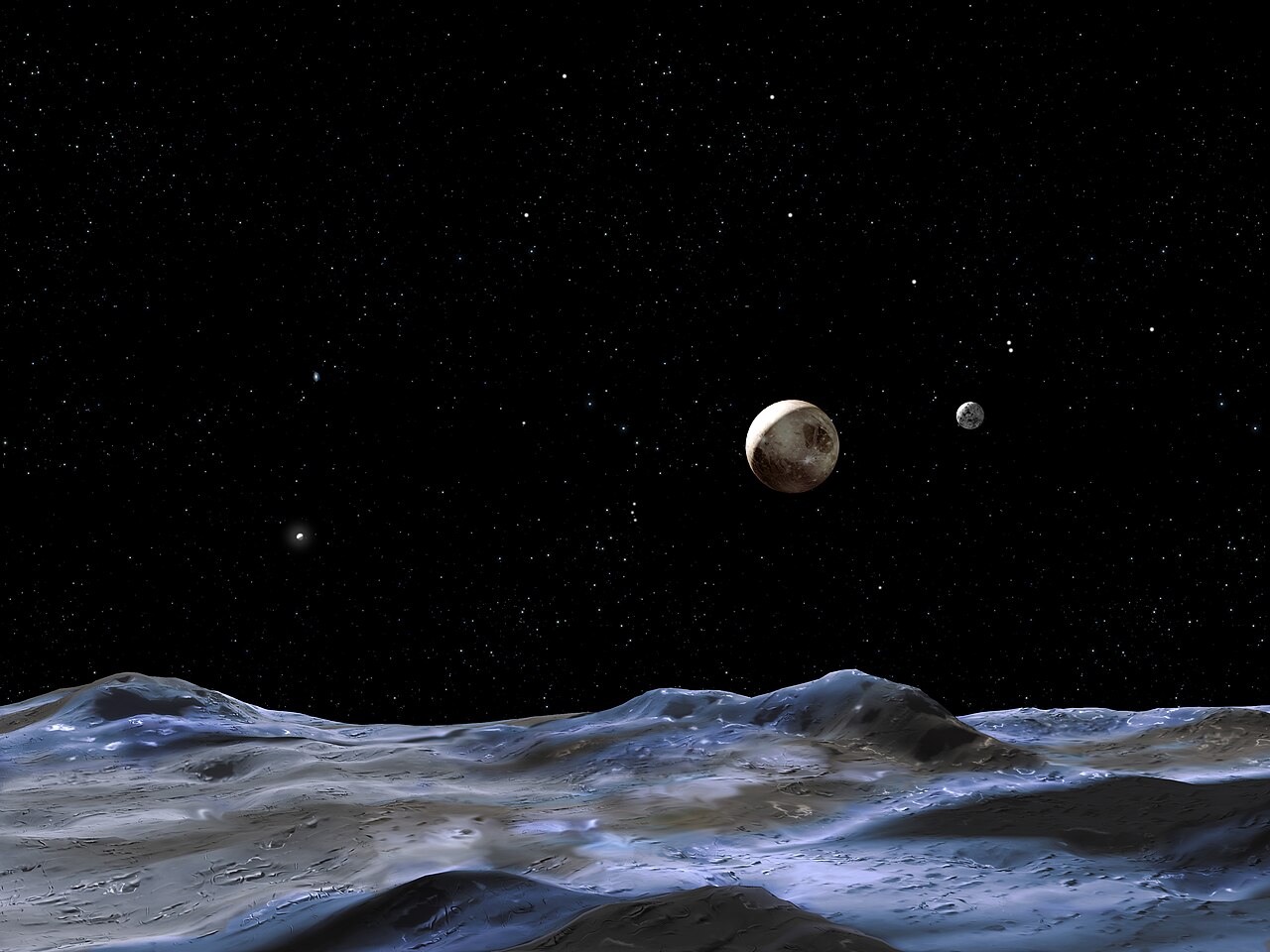







Discovery and confirmation
The objects now known as Hydra and Nix were found by a dedicated search team using Hubble images. Precovery images from 2002 helped confirm their orbits before public announcement. The discovery process relied on repeated imaging to separate faint moving points of light from background stars, and to establish that the sources followed paths consistent with orbiting Pluto's system barycenter, rather than being background objects.
Orbit and dynamical context
Hydra orbits the common barycenter of the Pluto–Charon system in nearly the same plane as Charon and Nix. Its orbit is close to circular but not perfectly so: published orbital solutions give a small eccentricity (≈ 0.0052) and an orbital period of roughly 38 days. Its average distance from the barycenter is on the order of tens of thousands of kilometers, placing it well outside Charon's orbit.
Physical characteristics
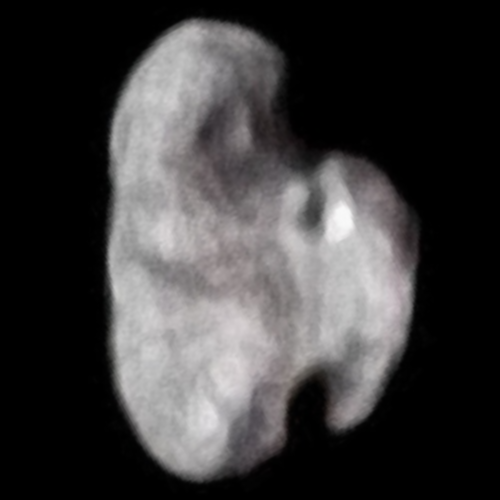
Hydra is a small, irregularly shaped moon. Because its size was inferred from brightness rather than direct imaging at discovery, its diameter estimates depend strongly on assumed surface reflectivity (albedo). If Hydra has an albedo similar to Charon (~35%), the diameter estimate is on the lower end (tens of kilometers); if it resembles the darker Kuiper belt objects with low reflectivity (~4%), the inferred diameter would be several times larger. Observations indicate a grey coloration, comparable to Nix and Charon, rather than the reddish tones seen on Pluto. The notion of surface reflectivity is commonly referred to as albedo, and it is a major source of uncertainty when converting brightness to size.
Origin hypotheses and notable facts
Several models have been proposed for the origin of Pluto's small moons. A leading idea is that they are remnants of a giant impact early in the system's history, which also produced Charon and populated the system with debris that later coalesced into smaller satellites. Hydra's nearly coplanar orbit with Charon and Nix, and its low eccentricity, are consistent with formation from a circumbinary disk or collisional debris rather than capture of an unrelated body.
Exploration and observations
Hydra and the other small moons were part of the observational planning for the New Horizons mission, which flew past Pluto in 2015. Prior to the encounter, additional Hubble imaging helped refine the moons' positions and search for potential hazards. During the flyby, the spacecraft gathered data on the system that improved knowledge of the satellites' orbits and yielded better constraints on size and rotation, although the small moons were captured at much lower resolution than Pluto and Charon.
Naming and cultural reference
The International Astronomical Union assigned the formal name Hydra (Pluto III) in 2006. The name derives from the multi-headed water serpent of classical myth: the creature Hydra, a monstrous guardian of waters in tales associated with Pluto/Hades in Greco-Roman mythology. The naming follows the convention of using figures connected with the underworld for features and satellites of Pluto; the mythological monster evokes the darker character of that realm.
Key properties at a glance
- Discovery: 2005, Hubble observations and follow-up confirmations (Hubble team).
- Provisional designation: S/2005 P 1.
- Orbital period: ~38 days; orbit near the Pluto–Charon plane.
- Size: uncertain; diameters inferred from brightness and assumed albedo range from tens to low hundreds of kilometers.
- Color: generally grey, similar to Charon and Nix.
Hydra remains an object of interest because it helps constrain models of how small satellites form and evolve in binary dwarf-planet systems. Continued analysis of telescopic and spacecraft data refines its orbit, rotation state, and surface properties, improving our broader understanding of the outer solar system.
Questions and answers
Q: What is Hydra?
A: Hydra is the farthest moon of Pluto.
Q: Who discovered Hydra?
A: Hydra was found by the Hubble Space Telescope's Pluto Companion Search Team, which is composed of Hal A. Weaver, Alan Stern, Max J. Mutchler, Andrew J. Steffl, Marc W. Buie, William J. Merline, John R. Spencer, Eliot F. Young and Leslie A. Young in June 2005.
Q: How far away from Pluto does Hydra orbit?
A: Hydra orbits the barycenter of the system in the same plane as Charon and Nix at a distance of about 65000 km from Pluto.
Q: What is the size of Hydra?
A: The size of Hydra has not been directly measured but calculations based on its brightness give it a diameter between 61 km if its reflectivity is similar to Charon's 35 percent and about 167 km if it has a reflectivity of 4 percent like the darkest Kuiper belt objects (KBOs).
Q: What color is Hydra?
A: Hydra appears to be grey like Charon and Nix though Pluto is reddish in color.
Q: When was it announced that New Horizons mission would visit both Pluto and Hydra?
A: It was announced that New Horizons mission would visit both Pluto and hydra in 2015 when they were discovered in October 2005 after confirmation by precoveries from 2002 .
Q:What was the name given to this moon ? A:The name given to this moon was 'Hydra' , named after 'Hydra',the monster who guarded waters of Hades' underworld in Greco-Roman mythology ,announced on June 21 ,2006 in IAU Circular 8723 along with formal designation 'Pluto III'.
Related articles
Author
AlegsaOnline.com Hydra — outermost known moon of Pluto Leandro Alegsa
URL: https://en.alegsaonline.com/art/46071
Sources
- arxiv.org : Final preprint
- arxiv.org : "Discovery of two new satellites of Pluto"
- doi.org : 10.1038/nature04547
- arxiv.org : Final preprint
- cfa-www.harvard.edu : IAU Circular No. 8625
- www-int.stsci.edu : IAU Circular No. 8723
- boulder.swri.edu : "Background Information Regarding Our Two Newly Discovered Satellites of Pluto"
- arxiv.org : Final preprint