
Moons of Saturn
An overview of Saturn's satellite system: counts and sizes, major moons, classification, discoveries and exploration, roles in ring dynamics, and astrobiological interest.
Overview
The planet Saturn is orbited by a diverse collection of natural satellites. Current tallies list 53 named moons and another 29 objects still under study. Many of these satellites are very small: 33 measure less than 10 km across and thirteen are under 50 km in diameter. At the same time the system includes very large worlds — most notably Titan, which is larger than the planet Mercury and supports a substantial atmosphere.
Image gallery
10 Images



Classification and orbits
Saturn's moons are commonly divided into regular and irregular groups. Regular satellites orbit relatively close to the planet on prograde, near-equatorial paths and likely formed within the circumplanetary disk that surrounded Saturn during its formation. Irregular satellites orbit farther out with more inclined or eccentric trajectories, and many move in retrograde directions; these are generally regarded as captured objects. Irregulars often fall into subgroups with similar orbital elements, suggesting past fragmentation events.
Composition and geology
Most Saturnian moons are composed largely of water ice mixed with varying amounts of rock and organic materials. Densities, surface geology and internal structures vary: some mid-sized moons show evidence of past tectonism and resurfacing, while small irregulars are heavily cratered. Several bodies are suspected to host differentiated interiors or subsurface liquid layers beneath icy shells.
Notable moons and features
- Titan: a nitrogen-rich atmosphere with organic chemistry, methane and ethane lakes, and a complex climate system make it a key object for comparative planetology.
- Enceladus: active cryovolcanic plumes eject water vapor and ice grains from fractures near the south pole; these plumes feed Saturn's diffuse E ring and imply a subsurface ocean, raising astrobiological interest.
- Mimas: a small, heavily cratered moon whose large Herschel crater gives it a memorable appearance; useful for studies of impact processes.
- Iapetus: displays a stark two-tone coloration and an equatorial ridge whose origin remains debated, offering clues to surface evolution.
- Hyperion: a sponge-like, porous body in chaotic rotation with a heavily cratered surface.
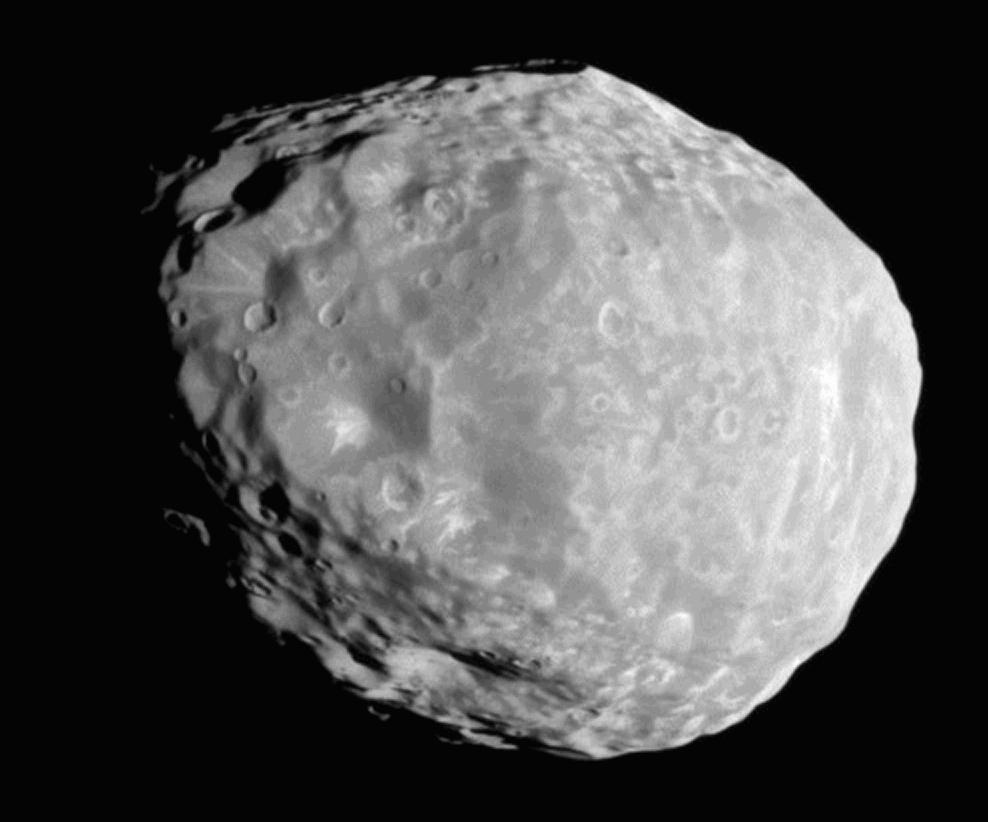
- Phoebe: an irregular, retrograde moon whose dark, primitive surface suggests an origin in the outer solar system and possible capture.
Ring interactions and shepherd moons
Small moons embedded in or near Saturn's rings act as shepherds: their gravity maintains ring edges, opens gaps, and creates waves and wakes in ring material. Well-known examples include Pan and Daphnis, whose orbital motions sculpt narrow gaps and produce distinctive edge features observable in spacecraft imagery.
Discovery, naming and exploration
Moons of Saturn were first recorded with telescopes in the 17th and 18th centuries, and many additional satellites were identified with improving detectors and surveys in the 20th and 21st centuries. Names derive from mythology and literature: many satellites are named after the Titans, Giants and other Greek and Roman figures, while recent naming has incorporated Norse, Inuit and Gallic traditions for irregular groups. Space missions have been pivotal: Voyager flybys provided initial close views, and the Cassini–Huygens mission carried out an extended survey, delivering high-resolution imagery, in situ measurements of plumes and the Huygens probe's descent to Titan.
Scientific importance and future study
Research on Saturn's moons informs models of planetary formation, satellite dynamics, and ring–moon interactions. Bodies such as Enceladus and Titan are prime targets in the search for environments that could support life, and their study guides planning for future missions. Ongoing observations from Earth-based telescopes and proposed spacecraft concepts aim to refine counts, characterize small and distant moons, probe subsurfaces, and better understand how this complex satellite system formed and evolved.
For further general reference on the planet and its satellites see Saturn and related mission pages such as the Titan study materials and comparative planetary resources that discuss Mercury and other worlds (Mercury). Historical and mythological naming conventions connect the moons to the ancient Titans, the Giants and classical Greek and Roman traditions.
Questions and answers
Q: How many named moons does Saturn have?
A: Saturn has 53 named moons.
Q: How many moons of Saturn are still being studied?
A: Saturn has another 29 moons which are still being studied.
Q: How many of Saturn's moons are less than 10km in diameter?
A: 33 of Saturn's moons are less than 10km in diameter.
Q: How many of Saturn's moons are less than 50km in diameter?
A: Thirteen moons of Saturn are less than 50km in diameter.
Q: What are some of Saturn's moons named after?
A: Many moons of Saturn are named after Titans, Giants, or minor Greek or Roman gods.
Q: Which moon of Saturn is bigger than the planet Mercury?
A: The moon Titan is bigger than the planet Mercury.
Q: What is the largest moon of Saturn?
A: The largest moon of Saturn is Titan.
Related articles
Author
AlegsaOnline.com Moons of Saturn Leandro Alegsa
URL: https://en.alegsaonline.com/art/66549
Sources
- solarsystem.nasa.gov : "Saturn: Moons"
- saturn.jpl.nasa.gov : "About Saturn & Its Moons"