
Most distant objects in the observable universe
Overview of the most distant known sources of light and matter: how distance is measured, the kinds of objects found at highest redshift, historical progress, observational methods, and why distinctions matter.
The phrase "most distant objects" typically refers to the sources of light or other radiation whose photons have traveled the longest time to reach us. In observational cosmology distance is commonly expressed by redshift (z), a dimensionless measure of how much the Universe has expanded since the light was emitted, and by light-travel distances often quoted in billions of light‑years (Gly). Different definitions of distance — lookback time, light-travel distance, proper (comoving) distance — are used for different purposes and can produce very different numeric values for the same redshift.
Image gallery
10 Images


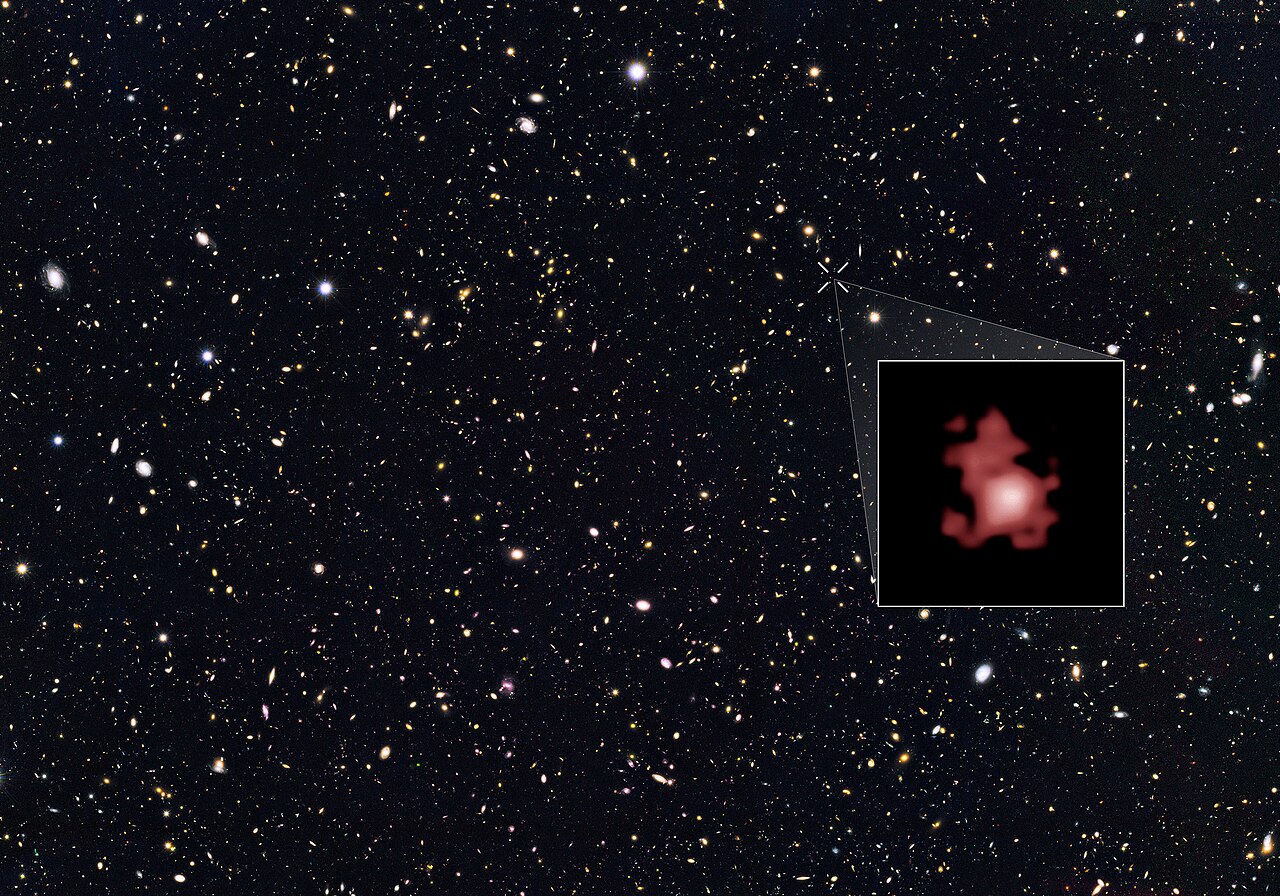
Types of most distant sources
The objects that currently occupy the extreme high-redshift records are primarily galaxies and energetic sources within galaxies: young star-forming galaxies, quasars (accreting supermassive black holes), and gamma-ray bursts (GRBs). The cosmic microwave background (CMB) represents the farthest observable radiation in time, originating at redshift z ≈ 1100, but it is a diffuse afterglow of the early plasma rather than a discrete galaxy or compact source.
Individual high-redshift examples are often cited in the literature and press. Space telescopes such as Hubble and, more recently, the James Webb Space Telescope, along with large ground-based observatories and submillimeter arrays, have pushed secure spectroscopic detections beyond z ≈ 7–11 for galaxies and to z ≈ 7–8 for quasars and some GRBs. Many additional candidate objects are identified photometrically at even higher redshifts; spectroscopic confirmation is the gold standard but is more demanding.
Observational methods include the Lyman-break (dropout) technique, narrow-band searches for strong emission lines (for example Lyman‑α), spectroscopic redshift measurements, and transient detection for GRBs. Astronomers must contend with foreground contamination, attenuation by intergalactic hydrogen, and instrumental sensitivity limits. The distinction between a "candidate" high-redshift object and a "confirmed" one often hinges on whether multiple spectral lines or features can be measured reliably.
Why the distinction matters
- Scientific interpretation: The physical inferences — age, mass, star formation rate — depend on accurate redshifts.
- Cosmic history: The highest-redshift galaxies probe the epoch of reionization when the first generations of stars and black holes transformed the intergalactic medium.
- Technique development: Better instruments and calibration reduce false positives among candidates.
For accessible overviews of methods and ongoing surveys that search for the most distant objects, see further reading. As technology advances, the frontier continues to shift: new instruments expand the sample of early galaxies and energetic sources, improving our picture of the Universe's first billion years.
Questions and answers
Q: What are the most distant things known to us?
A: The most distant things known to us are galaxies or energy sources inside galaxies.
Q: How are the distances of these objects described?
A: The distances of these objects are described in two ways – redshift (z) and billion light years (Gly).
Q: How many possible objects are there with a redshift of 8 or farther as of 2012?
A: As of 2012, there are only about 50 possible objects with a redshift of 8 or farther.
Q: How many candidates are there with a redshift of 7?
A: There are another 100 candidates with a redshift of 7.
Q: Are all candidates included in the list?
A: Not all candidates are included in the list as candidates vary in their notability.
Q: What is the definition of 1 Gly?
A: 1 Gly is defined as 1 billion light years or 109 ly.
Q: What are the units used to describe distances in this article?
A: Distances in this article are described in redshift (z) and billion light years (Gly).
Related articles
Author
AlegsaOnline.com Most distant objects in the observable universe Leandro Alegsa
URL: https://en.alegsaonline.com/art/66865
Sources
- spacetelescope.org : "Hubble pinpoints furthest protocluster of galaxies ever seen"
- firstgalaxies.org : Our latest results
- arxiv.org : 1603.00461
- ui.adsabs.harvard.edu : 2016ApJ...819..129O
- doi.org : 10.3847/0004-637X/819/2/129
- arxiv.org : 1507.02679
- ui.adsabs.harvard.edu : 2015ApJ...810L..12Z
- doi.org : 10.1088/2041-8205/810/1/L12
- science.nasa.gov : New gamma-ray burst smashes cosmic distance record
- ui.adsabs.harvard.edu : 2009Natur.461.1254T
- doi.org : 10.1038/nature08459
- pubmed.ncbi.nlm.nih.gov : 19865165
- arxiv.org : 1502.05399
- ui.adsabs.harvard.edu : 2015ApJ...804L..30O
- doi.org : 10.1088/2041-8205/804/2/L30