
Kerberos (moon)
Kerberos is a small natural satellite of the dwarf planet Pluto, discovered in 2011. This article summarizes its discovery, orbit and physical traits, naming, origin theories, and observations by New Horizons.
Overview
Kerberos is a small natural satellite that orbits the Pluto system. Initially designated S/2011 (134340) 1 and nicknamed P4, it was identified on 28 June 2011 and later given the official name Kerberos. It is one of several moons that share Pluto's gravitational environment alongside the large moon Charon and the smaller moons Nix, Hydra and Styx; the discovery added to understanding of Pluto as a miniature multi-moon system rather than a simple binary.
Image gallery
10 Images






Physical characteristics
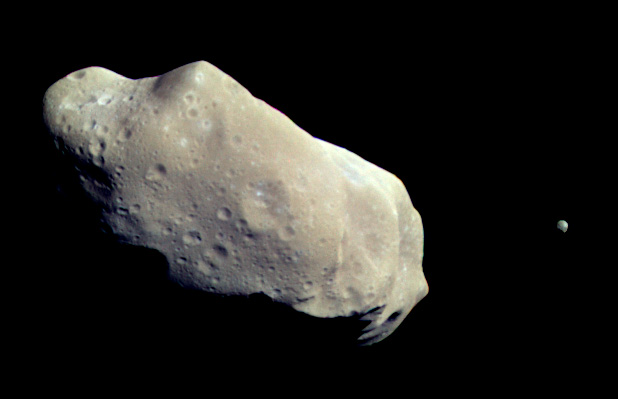
Kerberos is much smaller than Charon and is classed among Pluto's minor satellites. Its size is only loosely constrained: estimates place it on the order of a few to a few tens of kilometres across, depending on uncertain surface reflectivity (albedo). Imaging shows an irregular, non-spherical shape typical of small bodies, and its surface appears relatively dark compared with some of Pluto's other small moons. Kerberos orbits close to the plane of Pluto's satellite system and follows an approximately circular path.
Orbit and dynamical context
The moon occupies an orbit between those of two other small satellites, contributing to a compact family of co-orbital bodies around Pluto. The small moons of Pluto display near-coplanar, low-eccentricity orbits and show signs of dynamical interactions and near-resonant relationships with one another and with the barycentre dominated by Charon. These configurations are useful for tests of orbital stability in multi-body, tidally influenced systems.
Discovery and naming
Kerberos was discovered in images taken with the Hubble Space Telescope and announced in 2011. The provisional label reflected the year and the primary body (Pluto). In 2013 the International Astronomical Union approved the name Kerberos, drawn from Greek mythology, as part of a naming convention linking Pluto's satellites to underworld figures. The chosen spelling avoids duplication with existing asteroid names.
Origin and scientific importance
Most researchers consider Pluto's small moons, including Kerberos, to be remnants of a collisional event early in the system's history, in which material ejected from a giant impact coalesced into multiple satellites. Studying Kerberos helps constrain models for satellite formation around binary or near-binary primaries and provides insight into collisional processes in the outer Solar System.
Exploration, observations, and notable facts
Kerberos was observed at higher resolution during the New Horizons flyby of the Pluto system in 2015, though its small size limited the level of detail that could be obtained compared with Pluto and Charon. Ground- and space-based follow-up observations continue to refine its orbit, size estimates and surface properties. As a member of a compact and dynamically interesting satellite ensemble, Kerberos remains a subject for studies of formation, evolution and small-body properties in trans-Neptunian space.
- small moon of Pluto
- dwarf planet primary
Questions and answers
Q: What is Kerberos?
A: Kerberos is a small moon of the dwarf planet Pluto.
Q: When was Kerberos discovered?
A: Kerberos was discovered on June 28, 2011.
Q: What was Kerberos formerly known as?
A: Kerberos was formerly known as S/2011 (134340) 1 and informally as P4.
Q: How many moons of Pluto have been discovered so far?
A: Four moons of Pluto have been discovered so far - Charon, Nix, Hydra, and Styx.
Q: When was Charon discovered?
A: Charon was discovered in 1978.
Q: When were Nix and Hydra discovered?
A: Nix and Hydra were discovered in 2005.
Q: When was Styx discovered?
A: Styx was discovered in 2012.
Related articles
Author
AlegsaOnline.com Kerberos (moon) Leandro Alegsa
URL: https://en.alegsaonline.com/art/53003
Sources
- nasa.gov : "NASA's Hubble Discovers Another Moon Around Pluto"
- pluto.jhuapl.edu : "Fourth Moon Adds to Pluto's Appeal"
- cbat.eps.harvard.edu : "NEW SATELLITE OF (134340) PLUTO: S/2011 (134340) 1"
- space.com : "New Pluto Moon Foreshadows More Surprises for NASA Probe En Route"
- solarsystem.nasa.gov : "Solar System Exploration: Planets: Dwarf Planets: Pluto: Read More"
- cosmiclog.msnbc.msn.com : "Scientists spot Pluto's fourth moon"