
Mundilfari (Saturn moon)
Mundilfari is a small irregular, retrograde moon of Saturn discovered in 2000. It orbits at about 18.36 million km with a ~929-day period and is thought to be linked to Phoebe; named from Norse myth.
Mundilfari (Saturn XXV, originally designated S/2000 S 9) is a small irregular satellite of Saturn discovered in 2000 by a team led by Brett J. Gladman. It belongs to the population of distant, faint moons that orbit Saturn on inclined, retrograde paths and is commonly grouped with other members of the so-called Norse group of satellites. Mundilfari is of interest to planetary scientists because its orbit and physical properties offer clues about the capture and collisional history of Saturn's outer system.
Image gallery
4 Images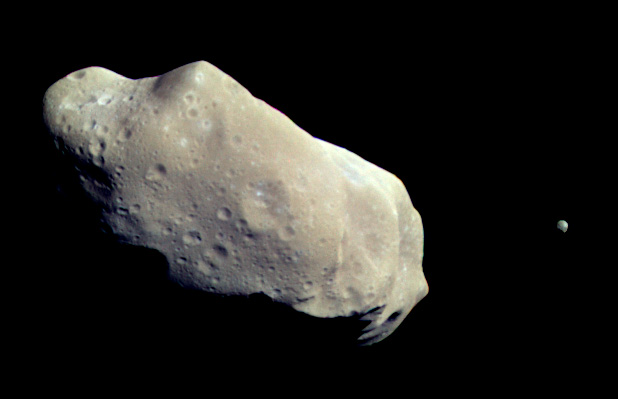


Physical and orbital characteristics
Mundilfari is very small by solar-system standards, with an estimated diameter on the order of a few kilometres (commonly cited near 5–6 km). It orbits Saturn at an average distance of roughly 18,360,000 kilometres and completes one orbit in about 928.8 days. The orbit is retrograde and highly inclined: about 170° relative to the ecliptic (approximately 150° relative to Saturn's equator). Its orbit is moderately eccentric, with an eccentricity near 0.198. These parameters indicate an irregular, non-spherical body with very low surface gravity; no resolved images exist, and physical properties such as rotation period and surface composition remain poorly constrained.
Discovery and name
Mundilfari was detected in 2000 during surveys using large ground-based telescopes and CCD imaging techniques that revealed many faint, distant satellites around the giant planets. The provisional designation S/2000 S 9 was assigned upon discovery. In August 2003 the International Astronomical Union approved the name Mundilfari, taken from Norse mythology. In myth, Mundilfari is a Jotun (giant) who is father to the personified Sun (Sól) and Moon (Máni), a naming choice consistent with the convention of giving retrograde Saturnian moons names from Norse legend.
Origin and dynamical context
Many outer irregular satellites of Saturn are thought to be captured objects or fragments produced by collisions. Mundilfari is commonly discussed as possibly originating from debris knocked off a larger outer satellite, most notably Phoebe, by one or more large impacts early in the solar system's history. The similarity of orbital elements among several Norse-group moons supports the idea of collisional families, in which a larger progenitor was shattered and its fragments settled into related orbits. Alternatively, some outer satellites may be captured heliocentric bodies that later experienced collisions and fragmentation.
Scientific significance and observation
Although Mundilfari itself is too small and faint for detailed study with current instruments, it contributes to a broader dataset used to understand capture mechanisms, the early collisional environment of the Saturn system, and processes that shape irregular satellites. Observations are limited to astrometry and photometry from ground-based facilities; these supply orbital refinements and rough brightness estimates from which size is inferred by assuming a typical dark surface albedo. Continued monitoring refines orbital stability models and helps identify possible familial relationships among the outer moons.
- Provisional designation: S/2000 S 9
- Mean distance from Saturn: ~18,360,000 km
- Orbital period: ~928.8 days (retrograde)
- Inclination: ~170° to the ecliptic
- Eccentricity: ~0.198 (orbital eccentricity data)
As part of the Norse collection of moons, Mundilfari remains a small but informative member of Saturn's complex satellite system. Future telescopic surveys and, in the longer term, spacecraft missions that examine Saturn's outer environment could yield better constraints on its composition, rotation, and relationship to larger neighbors such as Phoebe.
Further reading and data sources: see targeted survey reports and catalogues of Saturn's satellites (orbit tables, orbital elements, and discussions of collisional origin theories at regional studies and references dealing with Phoebe and Norse-group satellites). General mythological background is summarized in compendia of Norse mythology and illustrated references on Mundilfari.
Questions and answers
Q: What is Mundilfari?
A: Mundilfari is a moon of Saturn.
Q: When was Mundilfari discovered?
A: Mundilfari was discovered in 2000 by Brett J. Gladman, et al.
Q: What is the diameter of Mundilfari?
A: Mundilfari has a diameter of about 5.6 kilometers.
Q: What is the average distance of Mundilfari from Saturn?
A: Mundilfari orbits Saturn at an average distance of 18,360,000 km.
Q: What is the inclination of Mundilfari to the ecliptic?
A: Mundilfari has an inclination of 170° to the ecliptic (150° to Saturn's equator).
Q: What is the eccentricity of Mundilfari's orbit?
A: Mundilfari's orbit has an eccentricity of 0.198.
Q: How was Mundilfari named?
A: Mundilfari was named in August 2003 from Norse mythology, where it is a Jotun or giant who is the father of the goddess Sol and the god Mani.
Related articles
Author
AlegsaOnline.com Mundilfari (Saturn moon) Leandro Alegsa
URL: https://en.alegsaonline.com/art/67526
Sources
- cfa-www.harvard.edu : IAUC 7538: S/2000 S 7, S/2000 S 8, S/2000 S 9
- cfa-www.harvard.edu : MPEC 2000-Y15: S/2000 S 1, S/2000 S 2, S/2000 S 7, S/2000 S 8, S/2000 S 9
- cfa-www.harvard.edu : IAUC 8177: Satellites of Jupiter, Saturn, Uranus