
Mongol Empire — history, organization, and legacy
13th–14th century Eurasian empire founded by Genghis Khan that became the largest contiguous land empire, noted for military effectiveness, trade networks, administrative practices, and cultural exchange.
Overview
The Mongol Empire rose in the early 13th century when steppe clans were united under a single leadership and expanded rapidly to form one of the largest contiguous land empires in history. Founded by Genghis Khan in 1206, its original homeland lay north of the Great Wall and near features such as the Lake Baikal basin and ranges that include the Great Wall of China. At its greatest extent the polity connected Eastern Europe, Central Asia, the Middle East and East Asia, though political unity lasted only a century before regional divisions emerged.
Image gallery
10 Images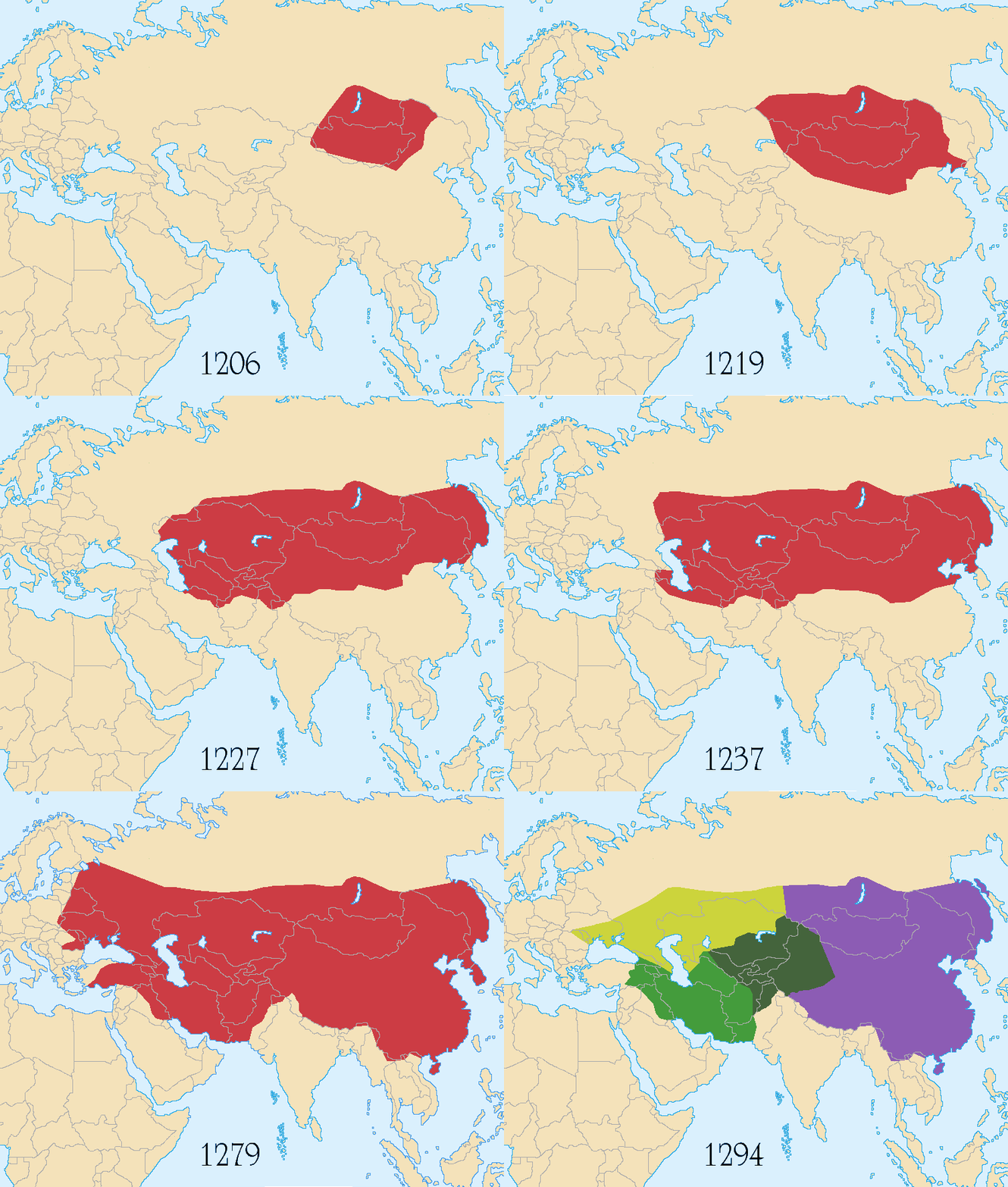



Origins and principal rulers
The state was created by alliances, military skill and political reform among Mongol and allied peoples. In 1206 Temüjin was proclaimed supreme ruler with titles commonly translated as Khagan or Great Khan. Under his leadership and that of his immediate successors the Mongols conquered large parts of Central Asia, North China and areas of Persia. Later rulers such as Kublai Khan consolidated rule in East Asia and established the Yuan dynasty that governed much of China. Conquests also incorporated many Turkic tribes and other steppe peoples into the empire’s armies and administrations.
Administration, law and communication
The Mongol polity combined steppe institutions with administrative practices adapted from conquered regions. Chiefs and commanders often relied on meritocratic promotion, written instructions, and local officials to administer diverse populations. A customary legal framework, often referred to in sources as a code or set of ordinances, guided behavior and military discipline. The empire maintained long-distance communication through a relay system of mounted couriers that facilitated governance and commerce across vast distances.
Military practices and technology
Mongol military strength rested on mobility, tactical discipline, intelligence-gathering, and flexible use of allied troops and specialists. Horse archery and coordinated maneuvers were central, while engineers and siege specialists—drawn from subjected or allied peoples—enabled the Mongols to capture fortified cities. The leadership was willing to adopt new technologies and administrative methods when effective for conquest or control.
Trade, economy and cultural exchange
By securing overland routes and offering protections and privileges for merchants, the empire stimulated long-distance commerce sometimes called the Pax Mongolica. Caravan routes and river crossings saw increased traffic in goods, ideas, artisans and technologies. Urban centers along trade corridors grew as hubs of exchange and cultural contact. The movement of people and knowledge across Eurasia had long-term effects on science, crafts and diplomatic practice.
Religion, society and demographics
Mongol rulers generally practiced religious tolerance, employing administrators and advisors from many faiths and communities. The empire’s populations were ethnically and religiously diverse, and policies favored practical governance over imposing a single official religion. Demographic changes included population movements, urban growth in some regions, and social mobility for groups that collaborated with Mongol rule.
Decline, successor states and legacy
Within about a century the empire fragmented into regional khanates—such as the Golden Horde, the Chagatai Khanate, the Ilkhanate, and the Yuan dynasty—that adapted Mongol institutions to local conditions. These successor states persisted for varying intervals before being absorbed by new powers. The Mongol period left enduring legacies in Eurasian trade, diplomatic networks, and cultural interchange, and it reshaped political boundaries and institutions in several regions.
Further reading and resources
Concise introductions and thematic studies can illuminate specific topics: titles and succession under the Khans, the life and reforms of Genghis Khan, the rule of Kublai Khan, regional studies of China, and comparative surveys of continental empires (land empires). For studies of steppe interactions consult works on Turkic tribes and Eurasian networks, and for geographic context see materials referencing landmark regions such as Lake Baikal or frontier zones near the Great Wall of China.
Related articles
Author
AlegsaOnline.com Mongol Empire — history, organization, and legacy Leandro Alegsa
URL: https://en.alegsaonline.com/art/66038