
Micronesia (Pacific region)
Micronesia is a subregion of Oceania made up of thousands of small islands and atolls in the western Pacific, with distinct cultures, languages, and a complex colonial and political history.
Overview
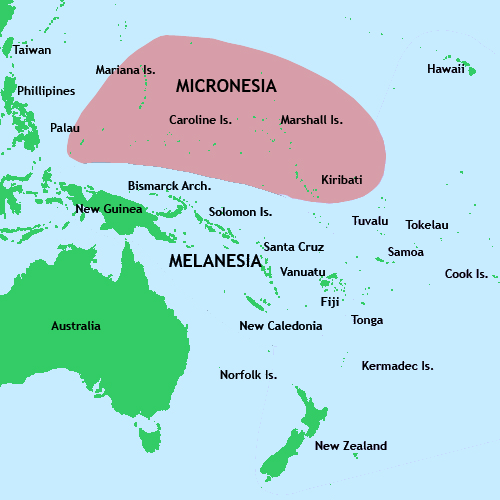
Micronesia is a geographical region of Oceania located in the western and central Pacific Ocean. The name comes from ancient Greek words meaning "small islands," which reflects the area's characteristic landscape of low coral atolls and occasional volcanic high islands. Although often described collectively, Micronesia consists of many culturally and politically distinct island groups spread across a large ocean expanse.
Image gallery
10 Images





Geography and island groups
The region comprises thousands of islands, reefs, and atolls. Major traditional groupings include the Caroline Islands, Mariana Islands, Marshall Islands, Gilbert Islands (part of Kiribati), Nauru, and the island state often formally called the Federated States of Micronesia. Most landforms are small; many are ring-shaped coral atolls, while others are volcanic with higher elevations supporting denser vegetation and freshwater.
Neighbors and location
Micronesia lies across the western Pacific and is bounded by several larger island regions and countries. To the west is the Philippines. Southward lie parts of Indonesia, Papua New Guinea, and the broader region of Melanesia. To the east the island chains give way toward Polynesia. The surrounding sea is generally referred to as the Pacific Ocean, and ocean currents and winds historically shaped settlement and navigation across these waters.
History and culture
People settled Micronesia thousands of years ago, principally by Austronesian-speaking voyagers who developed skilled navigation and seafaring traditions. Over centuries distinct languages and cultural practices evolved, with local chiefs, clan systems, and art forms adapted to island life. European exploration and later colonial administrations by powers such as Spain, Germany, Japan and the United States brought significant change, including new trade networks, missions, and administrative divisions.
Ecology, economy, and modern significance
Micronesian islands support specialized ecosystems that include coral reefs, seabird colonies, and tropical coastal habitats. Economies are generally small and rely on a mix of subsistence agriculture, fishing, limited tourism, and external assistance or compact arrangements with larger states. Contemporary concerns include sea-level rise, resource management, and the preservation of languages and traditional knowledge. Micronesia remains important for studies of island biogeography, navigation history, and cultural resilience.
Notable distinctions
- Micronesia is a cultural-geographic region, not a single political entity; several sovereign states and territories fall within it.
- The region contrasts with nearby Melanesia and Polynesia in language families, island types, and historical trajectories.
- Traditional navigation and canoe-building are celebrated aspects of Micronesian intangible heritage.
Related articles
Author
AlegsaOnline.com Micronesia (Pacific region) Leandro Alegsa
URL: https://en.alegsaonline.com/art/64605