
Microcontroller (MCU) — compact embedded single‑chip computers
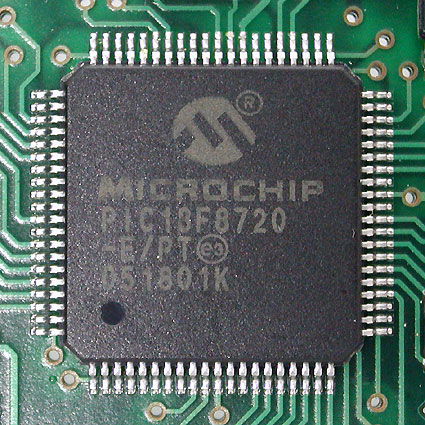
A microcontroller (MCU) is a compact integrated computer on a single chip that combines a processor, memory, and programmable input/output for controlling electronic systems.
Overview
A microcontroller, commonly abbreviated MCU, is a small integrated computer designed to perform dedicated control tasks within an electronic system. Often implemented as a system on a chip, a microcontroller typically integrates a central processing unit with on‑chip memory and programmable input/output to interact directly with sensors, switches and actuators. Unlike a general‑purpose microprocessor that focuses on raw CPU performance, an MCU is optimized for cost, simplicity, low power consumption and real‑time responsiveness.
Image gallery
9 Images


Core components and characteristics
A typical microcontroller includes several key elements that together provide a self‑contained control solution:
- Processor core: an instruction set and execution unit derived from simple CPU designs for embedded use.
- On‑chip memory: small amounts of volatile RAM for data and nonvolatile storage such as read‑only memory or writable flash memory for program code and persistent data.
- Peripherals: timers, analog‑to‑digital converters, communication interfaces (SPI, I2C, UART), pulse‑width modulators and general‑purpose I/O pins for external control.
- Low power modes and clock control: options to run at very low clock rates (down to tens of kilohertz) to save energy in battery‑powered systems.
Microcontrollers also combine the usual arithmetic and logic elements of processors with integrated peripheral circuits so that a single chip can manage a complete control loop without external support chips.
History and development
The idea of integrating processor, memory and I/O into a single package emerged in the late 1960s and early 1970s. Early commercial parts appeared after pioneering semiconductor companies such as Intel produced compact controllers and processors. As semiconductor manufacturing and design matured, costs dropped and feature sets expanded: on‑chip nonvolatile storage, richer peripheral sets and lower power consumption enabled MCUs to move from specialized industrial use into consumer products. Since the 1990s and 2000s, the rapid growth of embedded electronics has made microcontrollers ubiquitous.
Performance, power and design trade‑offs
Microcontrollers generally run at much lower clock speeds and deliver lower raw throughput than processors used in a smartphone or personal computer. That design choice is intentional: many embedded applications need predictable timing, minimal energy draw and small form factors rather than high computational throughput. Designers choose an MCU by balancing core speed, peripheral requirements, memory sizes, package type and power consumption. Low‑end controllers may operate from a coin cell for years, while higher‑end MCUs support real‑time operating systems and networked communications.
Typical applications and examples
Microcontrollers are used across a broad range of everyday and industrial systems. Examples include automotive control modules that manage engine functions and safety features, household appliances, portable tools and power tools, remote controls for consumer electronics, and control logic inside manufacturing machines. They also appear in medical devices, energy‑harvesting sensors, and networked embedded nodes. In embedded consumer products such as remote controls and other small devices, the MCU often provides the entire intelligence of the product.
- Common use cases: sensor reading, motor control, user interface handling, communication bridging and timing.
- Typical peripherals: ADCs for sensors, PWM for motors, and serial ports for external modules.
Manufacturing, variants and notable distinctions
Microcontrollers are fabricated using standard integrated circuit techniques: photolithographic masks, exposure to ultraviolet light and layered processing on substrates such as silicon. Process geometries and feature density have advanced steadily, allowing more logic and memory on each die while reducing cost. Variations include 8‑, 16‑ and 32‑bit cores, ultra‑low‑power parts, and integrated wireless or multimedia subsystems. Because an MCU packages both control logic and supporting circuits, it is often referred to as an embedded system or embedded controller. Practical designs frequently pair an MCU with external components and sensors (sensors and actuators) to implement complete systems.
Related articles
Author
AlegsaOnline.com Microcontroller (MCU) — compact embedded single‑chip computers Leandro Alegsa
URL: https://en.alegsaonline.com/art/64595
Sources
- electronics.howstuffworks.com : "How Microcontrollers Work"
- webopedia.com : "What is Microcontroller? Webopedia Definition"
- mikroe.com : "Architecture and programming of 8051 MCUs (Ebook) 1.1"
- engineersgarage.com : "Difference between Microprocessor and Microcontroller"
- ti.com : ti.com/microcontrollers-mcus-processors/microcontrollers/overview.html