
Malays: an Austronesian people of Maritime Southeast Asia
Malays are an Austronesian ethnic group indigenous to Maritime Southeast Asia, sharing related languages, cultural traditions and history across parts of Indonesia, Malaysia, Brunei, Singapore, Thailand and the Philippines.
Overview
The Malays are an Austronesian-speaking ethnolinguistic group historically associated with the coastal and island regions of Maritime Southeast Asia. Their identity is based on related languages, cultural practices, and historical ties to trading networks, sultanates and Islamic institutions that developed across the archipelago. Though often linked to a broad cultural sphere, the term "Malay" can refer to both a specific ethnic group and to a wider cultural-linguistic community.
Image gallery
10 Images





Names, language and classification
Many self-designations and external names exist: in English the people are commonly called "Malays" while their language is referred to as Malay and in neighboring contexts variant names appear (for example Indonesian and Filipino usage). Linguistically they belong to the Austronesian family, and are recognized as an ethnic group within the broader region of Southeast Asia. Modern Malay varieties include standard forms used in media and government as well as numerous local dialects.
Geographic distribution
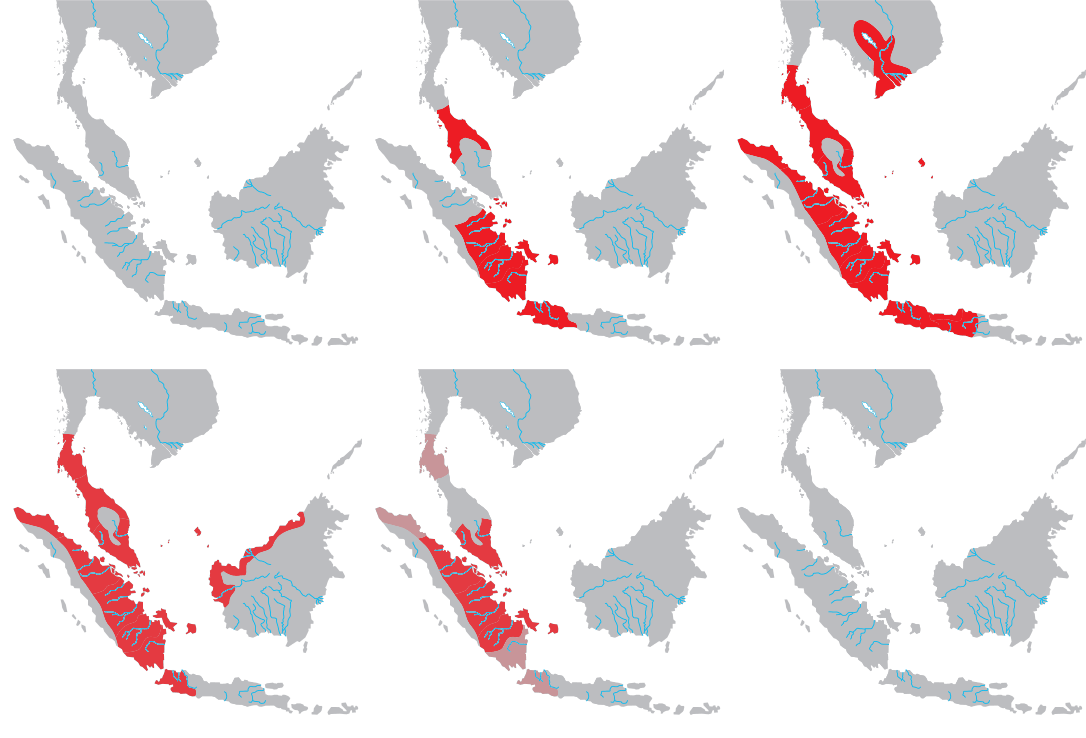
Malays are concentrated across the maritime belt of Southeast Asia. Their traditional homelands and major population centers include parts of the Malay Archipelago such as the Indonesian archipelago and the Philippine archipelago. Significant communities live on the island of Sumatra, in the Riau Islands, in the city-state of Singapore, on Kalimantan and in the sovereign state of Brunei, as well as in parts of southern Thailand and the southern Philippines.
History and cultural development
Over many centuries Malay-speaking polities were shaped by maritime trade, Indianized kingdoms, the spread of Islam and later European colonial rule. Sultanates such as Malacca and Johor played central roles in regional commerce and the diffusion of language and law. Colonial era boundaries and modern nation-states altered earlier patterns of movement and affiliation, producing diverse Malay communities with distinct local traditions today.
Society, religion and cultural life
Islam is the dominant religion among most Malay communities and is an important component of customary law, ritual life and social identity. Malay material culture includes boat-building, rice cultivation in some coastal zones, textile arts such as songket and batik, and oral literature including folk tales and poetry. Contemporary Malays participate in national politics, urban economies and diasporic networks while maintaining regional customs.
Distinctive features and contemporary relevance
Because "Malay" can describe ethnicity, language, or a broader cultural zone, its meaning depends on context: legal definitions in some countries differ from anthropological usage. Present-day issues for Malay societies include language standardization, preservation of local customs, and balancing religious and civic life within multicultural states. For further background on language and regional history see introductory resources at Malay and comparative studies of Austronesian peoples.
- Terms and usage vary between countries: see the Malay language standards in different states (Indonesia, Malaysia, Singapore).
- Major historical centers: Sumatra, the Straits region and Borneo (Kalimantan, Brunei).
- Contemporary distribution includes island and coastal communities across the Malay Archipelago and parts of mainland Southeast Asia.
Related articles
Author
AlegsaOnline.com Malays: an Austronesian people of Maritime Southeast Asia Leandro Alegsa
URL: https://en.alegsaonline.com/art/60969
Sources
- epu.gov.my : EPU – Population by sex, ethnic group and age, Malaysia,2010
- cia.gov : CIA – The World Factbook – Brunei
- bps.go.id : "Hasil Sensus Penduduk 2010 Data Agregat per Provinsi"
- cia.gov : CIA – World Factbook – Thailand
- minorityrights.org : World Directory of Minorities – Malays
- cia.gov : CIA – World Factbook – Singapore
- singstat.gov.sg : Singapore: Population Size and Growth