
Austronesian peoples: distribution, origins, and cultural legacy
Austronesian peoples are speakers of the Austronesian language family who settled islands across Southeast Asia, Oceania and Madagascar; notable for maritime expansion, diverse cultures and shared linguistic roots.
Overview
The term Austronesian peoples denotes groups across Southeast Asia, Oceania and Madagascar who speak languages of the Austronesian family. This broad label covers mainland and island communities from coastal Southeast Asia to the far Pacific and the western Indian Ocean. Their identity is defined primarily by linguistic ties and related cultural traits rather than a single ethnicity.
Image gallery
1 Image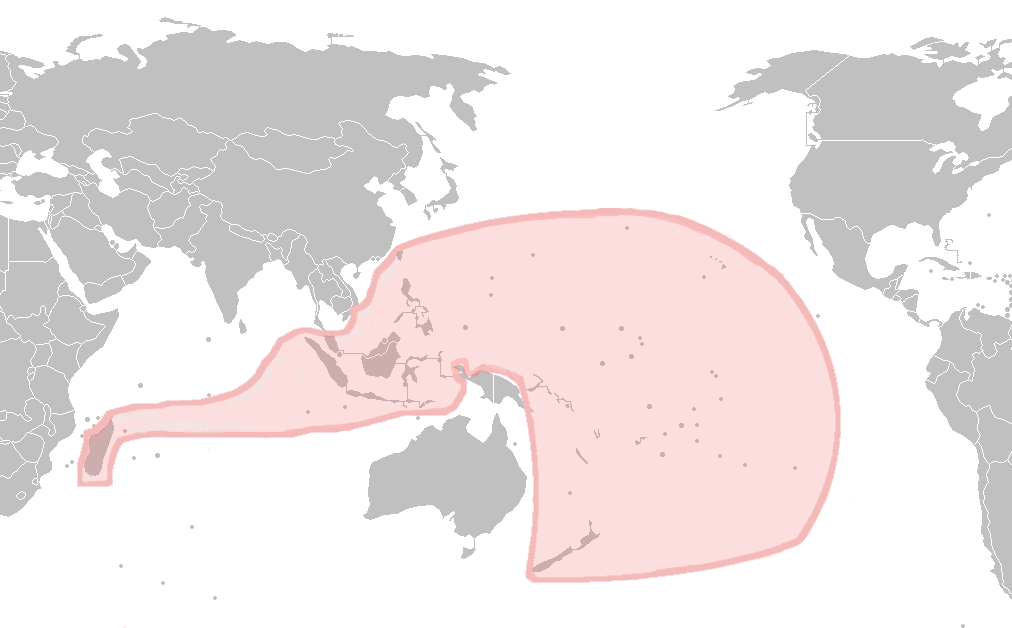
Origins and expansion
Most scholars favor an "Out of Taiwan" model that traces the initial dispersal to peoples associated with the indigenous populations of Taiwan. Beginning several millennia ago, seafaring groups moved south and east, carrying crops, boat technology and new settlement patterns. Over centuries these movements produced distinct regional branches and long-distance colonization of Remote Oceania and Madagascar.
Culture and technology
Austronesian societies are renowned for maritime skills: outrigger canoes, sophisticated navigation by stars and winds, and long-distance voyaging. Their subsistence combined horticulture (root crops, breadfruit, taro), domesticated animals (chickens, pigs) and fishing. Archaeological markers such as Lapita pottery in the Pacific record stages of island settlement and cultural transmission.
Languages and diversity
The Austronesian language family, represented by many modern tongues, splits into Formosan languages on Taiwan and the widespread Malayo-Polynesian branch found elsewhere. Languages such as Malay, Tagalog, Javanese, Malagasy, Māori and Hawaiian illustrate the family’s geographical range and internal diversity. Taiwan retains unusually high linguistic variety, supporting models of an early homeland.
Legacy and significance
Austronesian-speaking populations today number in the tens of millions across islands and coastal regions, shaping national cultures from Indonesia and the Philippines to Madagascar and Pacific nations. Studies in archaeology, linguistics and genetics continue to refine our understanding of migration routes and interactions with other indigenous groups. The Austronesian expansion remains a key example of prehistoric maritime colonization and cultural adaptability.
Further reading and resources: see regional overviews and comparative studies for details on social organization, material culture and modern language revitalization efforts (research links: indigenous contexts, regional surveys, Pacific studies, Madagascar case studies, linguistic databases, Taiwanese research).
Tags
Related articles
Author
AlegsaOnline.com Austronesian peoples: distribution, origins, and cultural legacy Leandro Alegsa
URL: https://en.alegsaonline.com/art/7555