
Malay Archipelago
The Malay Archipelago is the vast island region between mainland Southeast Asia and Australia, encompassing thousands of islands, rich biodiversity, and a complex human and colonial history.
Overview
The Malay Archipelago is the large island region that lies between mainland Southeast Asia and Australia. It has been known by several names over time, including the East Indies, the Indo‑Australian Archipelago and the Indonesian Archipelago. The area occupies the maritime zone between the Indian Ocean and the Pacific Ocean, and is made up of more than 25,000 islands scattered across seas and straits. The region is often described as one of the world’s largest archipelagos by area and island count (ranked among the largest).
Image gallery
5 Images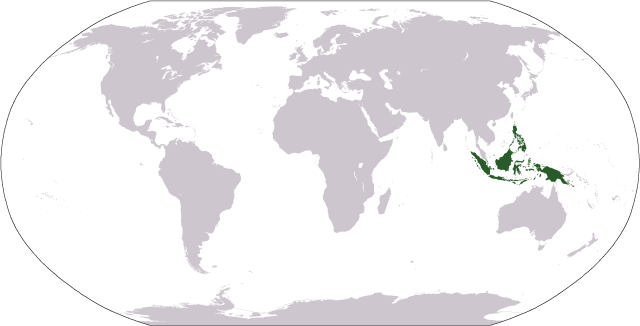


Geography and political composition
The archipelago stretches from the Andaman and Nicobar margins in the west to the islands that approach northern Australia in the south. Major islands include Borneo, Sumatra, Java, Sulawesi and, depending on the definition used, New Guinea. Politically the region is divided among several states; prominent ones are Indonesia, the Philippines, Singapore, Brunei, parts of Malaysia (East Malaysia) and Timor‑Leste (East Timor). The island of New Guinea and the independent country of Papua New Guinea are included in some definitions and omitted in others, reflecting different scientific and political conventions.
Natural regions and biodiversity
The Malay Archipelago contains a mosaic of ecosystems — tropical rainforests, mangroves, montane forests and extensive coral reef systems. It includes a transitional biogeographic zone known as Wallacea, where Asian and Australasian flora and fauna intermingle across biogeographic boundaries. This mixing has produced high levels of endemism among plants, mammals, birds and marine species. Coral reefs and seagrass beds around many islands support some of the planet’s richest marine biodiversity, making the region globally important for conservation.
History, culture and economy
Humans have occupied the archipelago for many millennia. The area was central to early seafaring and trade networks, including the historic spice trade that drew European interest and colonial competition. Waves of Austronesian seafarers spread languages and agricultural techniques across the islands, shaping the diverse linguistic and cultural landscape seen today. Economically the region has long been important for commodities (spices, timber, minerals), fisheries, and, in modern times, tourism and maritime shipping.
Notable distinctions, challenges and conservation
The Malay Archipelago stands out for its cultural and biological diversity and for the complexity of its political geography. Conservation challenges include deforestation, habitat fragmentation, overfishing and the impacts of development and climate change on coastal communities and coral reefs. Efforts to balance economic development with biodiversity protection take many forms, from protected areas and international agreements to community-based resource management. For further regional reference maps and resources consult general geographic and country-specific sources (map index). Additional reading on islands, biodiversity and national contexts is available via regional portals and scientific literature (Southeast Asia resources, Australasian studies, Indian Ocean research, Pacific Ocean surveys).
- Principal countries: Indonesia, Philippines, Singapore, Brunei, Malaysia (East), Timor‑Leste.
- Key geographic notes: >25,000 islands (island count), situated between the Indian and Pacific Oceans.
- Taxonomic and political exceptions: New Guinea and Papua New Guinea are sometimes treated separately in different regional schemes.
Questions and answers
Q: What is the Malay Archipelago?
A: The Malay Archipelago is the archipelago located between mainland Southeastern Asia and Australia.
Q: What are some other names that the Malay Archipelago has been called?
A: The Malay Archipelago has also been called the East Indies, the Indo-Australian Archipelago, Indonesian Archipelago, and other names over time.
Q: Where is the Malay Archipelago located?
A: The Malay Archipelago is located between the Indian and Pacific Oceans.
Q: How many islands are in the Malay Archipelago?
A: The Malay Archipelago has over 25,000 islands.
Q: Is the Malay Archipelago the largest archipelago in the world?
A: Yes, the Malay Archipelago is the largest archipelago in the world by area.
Q: Which countries are included in the Malay Archipelago?
A: The Malay Archipelago includes Indonesia, the Philippines, Singapore, Brunei, East Malaysia, and East Timor.
Q: Are Papua New Guinea and New Guinea included in the Malay Archipelago?
A: The island of New Guinea or islands of Papua New Guinea are not always included in definitions of the Malay Archipelago, but the Indonesian Moluccas are included.
Related articles
Author
AlegsaOnline.com Malay Archipelago Leandro Alegsa
URL: https://en.alegsaonline.com/art/60954
Sources
- un.org : World Population prospects, table A.2
- books.google.com : Encyclopedia of European and Asian regional geology
- britannica.com : Malay Archipelago
- worldworx.tv : Maritime Southeast Asia