
Indonesian language (Bahasa Indonesia): origins, features, and usage
Bahasa Indonesia is the standardized form of Malay and the official language of Indonesia. Coverage includes its history, grammar traits, vocabulary influences, scripts, social role, and distinctions from regional varieties.
Bahasa Indonesia is the official language of the Republic of Indonesia and the standardized register of the Malay language used across the Indonesian archipelago. It functions as a unifying lingua franca in a country with hundreds of local languages and wide cultural diversity. While closely related to Malay varieties spoken in Malaysia, Brunei and parts of Singapore, Indonesian has its own standardized vocabulary, orthography and public functions.
As a spoken and written system, Indonesian is notable for its relatively simple inflectional morphology and productive use of derivation and reduplication. Nouns have no grammatical gender and there is no obligatory verb conjugation for person or tense; temporal and aspectual distinctions are usually marked by particles or time adverbs (for example, sudah for completed action, sedang for progressive). Affixation (prefixes, suffixes, circumfixes) builds verbs, nouns and adjectives: base makan ‘eat’, derived memakan ‘to eat (transitive)’, makanan ‘food’. Reduplication can indicate plurality or intensity (buku-buku ‘books’). Colloquial Indonesian also uses particles such as lah and dong to modify tone.
Vocabulary reflects centuries of contact with traders, colonizers and neighboring cultures. The core lexicon derives from Austronesian roots, while substantial loanwords come from Sanskrit (religion and governance), Arabic (religion, law), Chinese (trade, cuisine), Portuguese (early European contact), Dutch (colonial administration, technology) and, more recently, English (science, technology, global culture). Indonesian is written primarily in the Latin alphabet; an Arabic-derived script called Jawi was used historically in some areas. Modern orthography was standardized in the 20th century with spelling reforms culminating in the "Perfected Spelling" system introduced in the 1970s, which aligned several conventions across the region.
Historically, Malay served as a regional lingua franca throughout maritime Southeast Asia long before modern nation-states emerged. In the colonial era the Malay language continued as a contact language; Indonesian as a standard variety gained political prominence during the nationalist movement. The 1928 Youth Pledge (Sumpah Pemuda) affirmed a single national language for the emerging Indonesian nation, and after independence Bahasa Indonesia was promoted in education, government and mass media as a symbol of unity. Standardization and expansion of vocabulary accompanied its adoption for modern administration and schooling.
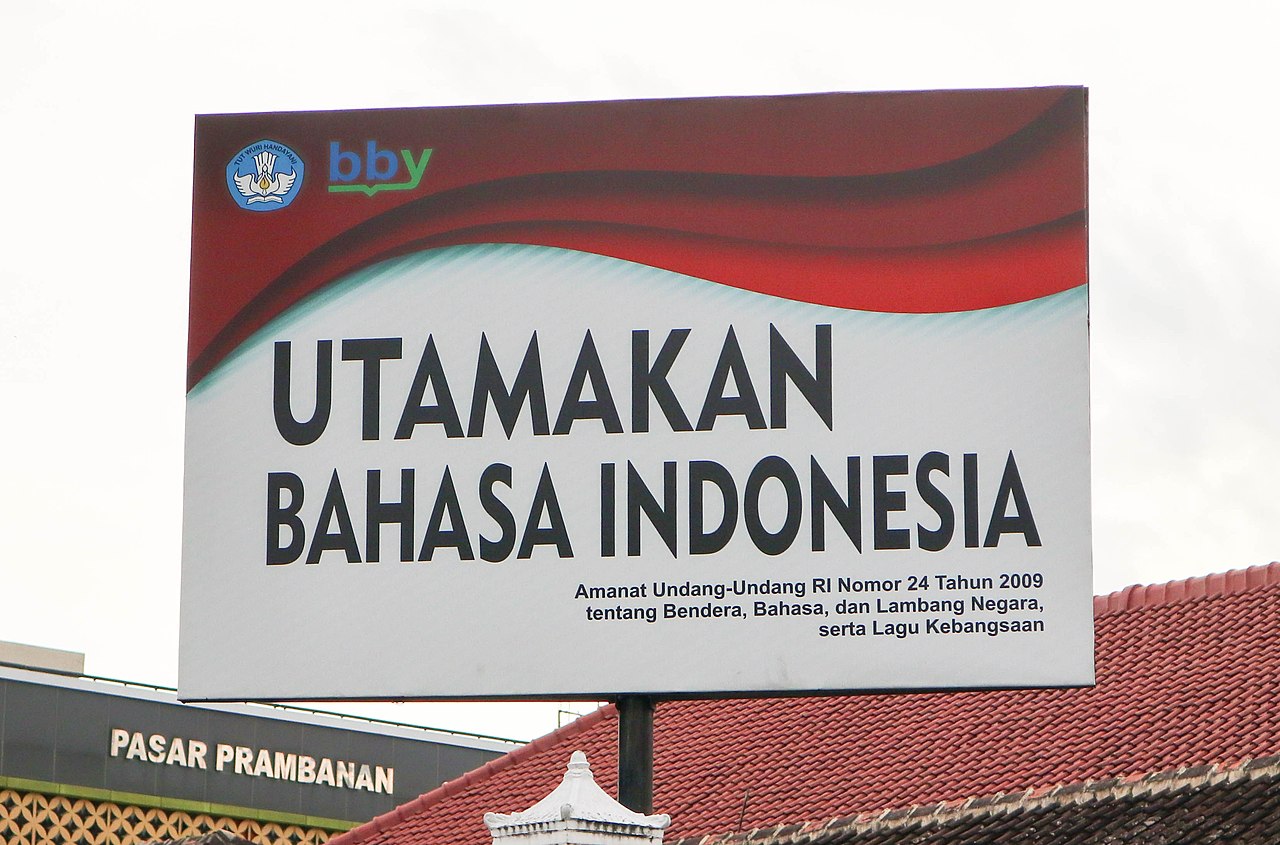
Today Indonesian is used in government, law, education, national radio and television, print and digital media. It coexists with regional languages such as Javanese, Sundanese and Minangkabau, which remain important for local identity and everyday communication. Many Indonesians are multilingual, using a local mother tongue at home and Indonesian in wider social, official and inter-ethnic settings. Outside Indonesia, Indonesian is taught and studied in universities and language programs around the world and is used by diaspora communities.
Distinctions between Indonesian and Malaysian Malay are matters of vocabulary, pronunciation and some idiomatic uses rather than mutual unintelligibility: speakers of both varieties generally understand each other with little difficulty, though differences may appear in official terminology and loanword preferences. Registers range from formal, standard Indonesian used in official documents to informal colloquial varieties found in urban speech and online. Common everyday expressions include selamat pagi (good morning), terima kasih (thank you) and apa kabar? (how are you?).
Image gallery
10 Images




Further reading and resources
- Official institutional overview
- Relation to Malay
- Javanese influence and contact
- Teaching Indonesian abroad (example programs)
- Historical ties with the Netherlands
- Language learning resources in Japan
- Korean university courses
- Usage and study in Timor-Leste
- Southeast Asian regional studies
- Academic programs in Taiwan
- Indonesian language initiatives in the UK
- European historical connections
- Dutch loanwords and influence
- English loanwords and modern vocabulary
- Catalogue of loanwords in Indonesian
- Portuguese lexical contributions
- Spanish and Iberian-era contacts
- Chinese communities and loanwords
- Arabic influences and Islamic literature
Note: This article provides a concise overview rather than an exhaustive grammar or dictionary. For in-depth study consult dedicated grammars, corpora and language teaching materials.
Questions and answers
Q: What language is the national and official language of Indonesia?
A: The national and official language of Indonesia is Indonesian (Bahasa Indonesia).
Q: How is Indonesian related to Malay?
A: Indonesian is a form of the Malay language.
Q: What other languages are commonly spoken in Indonesia?
A: The most widely spoken languages in Indonesia are Javanese and Sundanese, which have had a large influence on the Indonesian language.
Q: Where else is Indonesian taught or used?
A: Indonesian is officially taught and used in schools, universities, and institutions worldwide, especially in Australia, Netherlands, Japan, South Korea, Timor Leste, Vietnam, Taiwan, United States of America, United Kingdom etc.
Q: What European languages have influenced Indonesian?
A: Dutch and English have had the most influence on Indonesian due to long-established historical ties between Europe and Indonesia since colonial times. There are also loanwords derived from Portuguese Spanish as well as Dutch Portuguese Spanish and English.
Q: Are there any other sources for loanwords in the Indonesian language?
A: Yes; there are also loanwords derived from Sanskrit Chinese Arabic which diffused into the language due to trade activities within the region since ancient times.
Related articles
Author
AlegsaOnline.com Indonesian language (Bahasa Indonesia): origins, features, and usage Leandro Alegsa
URL: https://en.alegsaonline.com/art/47204
Sources
- ethnologue.org : Indonesian