
Loop Current (Gulf of Mexico): overview, behavior and significance
The Loop Current is a warm, seawater current in the Gulf of Mexico that feeds the Florida Current and Gulf Stream. It produces large warm-core eddies and influences weather, ecosystems and human activities.
Overview
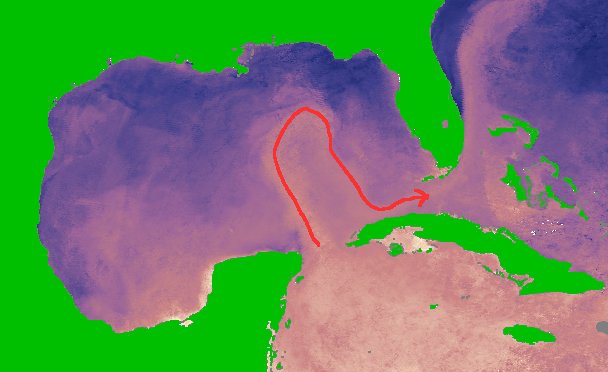
The Loop Current is a major warm ocean current that flows through the Gulf of Mexico and forms the southern limb of the North Atlantic western boundary system linked to the Gulf Stream. It enters the Gulf between the island of Cuba and the Yucatán Peninsula, extends northward into the basin, turns westward and then loops southward before exiting eastward through the Florida Straits. The feature is persistent but highly variable in shape and extent, alternately bulging north into the central Gulf and retracting toward the Yucatán channel.
Image gallery
4 Images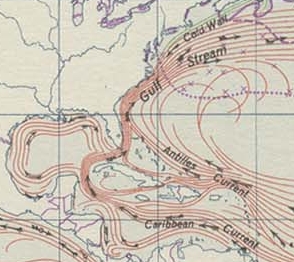
Characteristics and dynamics
The Loop Current carries warm, salty water from the Caribbean Sea into the Gulf and contributes to the northward transport of heat and mass that eventually feeds the Florida Current and the broader Gulf Stream system. It commonly develops large, warm-core rings — coherent, spinning eddies that detach from the Loop Current and move westward across the Gulf. These rings can be very large (measuring on the order of hundreds of kilometers across), extend deep into the ocean, and persist for many months.
- Temperature and structure: warmer than surrounding waters and vertically deep, producing elevated ocean heat content.
- Transport role: a conduit between the Caribbean and the Atlantic via the Florida Current and Gulf Stream.
- Eddy formation: episodic shedding of warm-core rings that alter local circulation and sea-surface height.
Detection and measurement
Scientists monitor the Loop Current and its eddies using satellite altimetry, sea-surface temperature imagery, moored instruments and drifting buoys. Sea-surface height anomalies reveal the presence of the Loop and rings because the warm, deeper water raises the surface relative to surrounding sea level. For example, remote sensing observed sea level anomalies associated with the Loop and its eddies on September 21, 2005 that were as much as 60 centimetres higher than nearby waters (about 24 inches), indicating substantial warm water volume beneath the surface.
History and variability
Earlier work in the mid-20th century suggested the Loop Current might follow a simple seasonal cycle, extending farther north in summer and retracting in winter. More extensive observations since the 1970s and satellite records have shown that its northward excursions and the timing of eddy shedding are not strictly annual. Instead, extension and ring separation occur irregularly — intervals between major shedding events vary from several months to more than a year — and are influenced by a combination of upstream Caribbean flow, basin circulation and transient atmospheric forcing.
Importance and impacts
The Loop Current and its warm-core rings have important physical and practical consequences. Because they concentrate heat at depth, they can provide energy for rapid intensification of tropical cyclones that pass over them. They also influence regional marine ecosystems and fisheries by modifying water temperature, nutrient distributions and currents. In addition, their variability affects offshore engineering, oil and gas operations, and coastal forecasting. Ongoing monitoring and research aim to improve forecasts of Loop Current behavior because of these societal and environmental impacts.
Notable distinctions
Although related to the Gulf Stream system, the Loop Current is a distinct feature confined to the Gulf of Mexico and characterized by a pronounced looping path and episodic detachment of warm-core rings. Its irregular variability, deep warm core, and strong influence on sea-surface height make it an object of sustained observation and modeling in physical oceanography. For further technical information and operational products, see regional oceanographic services and research portals linked to monitoring programs (Gulf Stream overview, Gulf monitoring).
Related articles
Author
AlegsaOnline.com Loop Current (Gulf of Mexico): overview, behavior and significance Leandro Alegsa
URL: https://en.alegsaonline.com/art/59178
Sources
- colorado.edu : colorado.edu