
Loom (weaving machine and textile tool)
An overview of looms: devices that interlace warp and weft to make cloth, covering structure, main types from hand to power looms, historical development, cultural practices, and contemporary uses.
A loom is a device that holds threads under tension so they can be interlaced to form fabric. At its simplest a loom is a frame that keeps the lengthwise threads (warp) steady while crosswise threads (weft) are passed through them; at its most complex a loom is a mechanized system that controls many sets of threads and patterns automatically. The word is often used for both small, manual frames used in craft contexts and for large industrial machines used to produce textiles on a commercial scale. machine and weaving are commonly associated terms when describing different kinds of looms.
Image gallery
10 Images


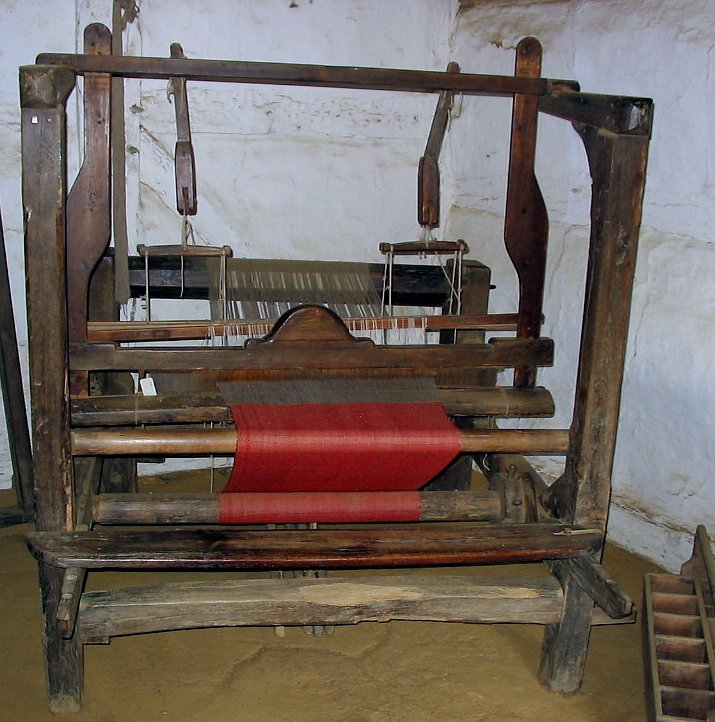
How a loom works and its main parts
Most looms rely on the same basic principle: separate the warp yarns into two or more sheds (openings), pass the weft through a shed, then beat the weft into place. Typical components include:
- Warp beam: holds the lengthwise yarns under tension.
- Heddles or harnesses: control which warp threads rise or fall to create sheds.
- Shuttle or projectile: carries the weft yarn through the shed.
- Reed and beater: spaces warp threads and packs the weft into the cloth.
- Cloth beam: winds the finished textile away from the weaving area.
Different mechanisms—foot pedals, hand levers, punched cards, or electronic controllers—operate these parts to produce plain weaves, twill, satin, or more elaborate patterned fabrics. The material used for the warp and weft—thread, yarn, or specialized fibers—affects the strength, drape, and appearance of the finished textile; see yarn resources for terminology and types.
Types and forms of looms
Looms vary in size and complexity. Common categories include frame looms and tapestry looms used for small pieces, backstrap looms that are portable and tied to the weaver’s body, floor looms and table looms for larger hand-operated work, and mechanized looms for large-scale production. The introduction of the power loom and later automated systems transformed production methods; inventors such as Edmund Cartwright are associated with early powered designs that contributed to industrial-scale weaving. Innovations continued through the 19th and 20th centuries during the Industrial Revolution and beyond.

History, craft traditions, and cultural significance
Weaving is one of the oldest textile technologies, with hand looms developed independently by many societies. Distinct weaving traditions remain important culturally and artistically: Navajo upright looms are central to Southwestern Native American textiles and are represented in museum collections; see the model example at Navajo loom. East Asian, Central American, Indian, and European forms of handloom weaving each have characteristic techniques—Japanese multi-heddle looms, backstrap looms used by Mayan groups such as the Jakaltek, and the varied handloom traditions of India are notable examples. Illustrations of regional practice appear in many ethnographic collections and modern craft exhibitions.

Uses, modern practice, and preservation
Looms are used for practical clothing and household fabrics, for artistic textile production, and for industrial purposes such as technical textiles. While mechanized looms dominate mass production, there has been renewed interest in handloom and artisanal weaving for sustainable, locally produced, and culturally significant textiles. Workshops, cooperative studios, and museums teach traditional techniques and maintain older looms for demonstration. Examples of continuing craft practice include community weavers in Oaxaca and exhibition weavers in India and Eastern Europe. 

Notable distinctions and further reading
Beyond size and power source, important distinctions include patterning capability (simple sheds versus programmable pattern control), portability (backstrap versus floor looms), and intended output (artisanal fabric versus industrial roll goods). Specific community practices—such as Old Believer homestead looms in Latvia or historic croft looms in Poland—illustrate how technology and local culture interact. For visual examples and technical descriptions, museum collections and craft organizations provide images and inventories; related references may be found through institutional pages and specialist publications. Japanese loom example, Hjerl Hede, Old Believer sites and Slutiški-region documentation expand on regional details.


Related articles
Author
AlegsaOnline.com Loom (weaving machine and textile tool) Leandro Alegsa
URL: https://en.alegsaonline.com/art/59175