
Lowrey organ: history, design, and cultural impact
An overview of the Lowrey organ: its origins, design features, major models, and role in homes, churches and popular music from the mid-20th century onward.
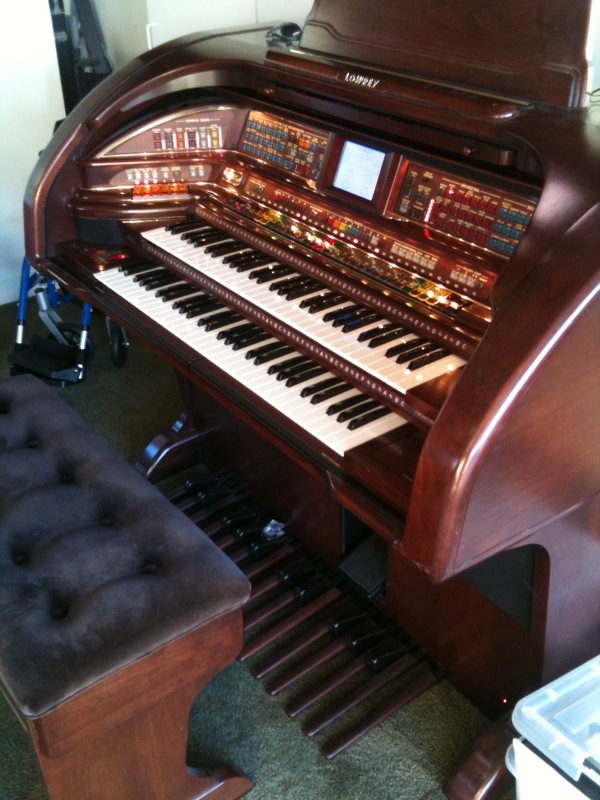
The Lowrey organ is an electronic keyboard instrument developed and produced by the Lowrey Organ Company, named after its founder Frederick C. Lowrey. Emerging in the mid-20th century, Lowrey organs became synonymous with domestic and institutional home entertainment, notable for compact spinet and console designs as well as integrated automatic accompaniment features. While sharing the broader market for electronic organs with competitors such as Hammond, Lowrey established a distinct identity through products aimed at ease of use for amateur musicians and home entertainers.
Image gallery
6 Images


History and development
Frederick Lowrey began experimenting with electronic add-ons for the piano in the 1940s. In 1949 the company sold an attachment called the Organo, which provided electronic organ tones across a 60-note range while preserving normal piano function. The first fully realized Lowrey electronic organ that achieved widespread commercial success appeared in 1955, sold under names such as the Model S Spinet and the Berkshire. Over the following decades the firm expanded production and distribution: during the 1960s and 1970s Lowrey was one of the world’s largest manufacturers of electronic organs. By 1989 the company reported producing its one-millionth organ. Production in the United States continued for many years from facilities in LaGrange Park, Illinois; in 2011 some manufacturing was shifted overseas.
Design, parts, and characteristic features
Lowrey instruments are electronic organs rather than pipe organs; their sound generation uses electronic oscillators and later solid-state circuitry. Common design elements include compact spinet and larger console formats, multiple stops or voice selections, and integrated rhythm and accompaniment systems that allow a single player to produce chordal backing patterns and percussion beats. Distinguishing characteristics often emphasized accessibility and a broad palette of preset sounds, making the instrument appealing to hobbyists and families as well as to small venues.
Typical features and controls
- Multiple voicings: preset tones that emulate organ ranks, strings, or orchestral colors.
- Automatic accompaniment: systems that produce rhythm patterns and chordal backing, useful for solo performance.
- Compact form factors: spinets and portable models for domestic use.
- Pedalboards or bass pedals on larger consoles for fuller bass lines.
Models, variations and market position
Lowrey produced a wide range of models over the years, from home-style spinets to larger church and theater consoles. Some instruments targeted beginners with simplified controls and built-in lessons, while higher-end models offered more manual voices and expanded accompaniment options. The company’s combination of user-friendly features and mass-market availability helped it achieve a dominant role in the home organ market in the mid-20th century.
Uses and cultural impact
Lowrey organs have been used in private homes, churches, community halls and small clubs. Their automatic accompaniments and preset tones made them especially popular for family entertainment, education, and worship settings where a compact, affordable keyboard could serve as a substitute for larger instruments. Though their sound differs from that of traditional pipe organs and the Hammond tonewheel organs favored in jazz and rock contexts, Lowrey instruments contributed to the palette of mid-20th-century popular music and domestic musical life. They remain collectible among enthusiasts and are valued for their period character and vintage electronic timbres.
Notable facts: Lowrey’s early Organo attachment (1949) competed with other small electronic keyboards of the era, and the company’s 1955 full-sized spinet marked its first major commercial breakthrough. By focusing on ease of use and built-in accompaniment functions, Lowrey carved out a distinctive niche in the history of electronic keyboard instruments.
Questions and answers
Q: Who developed the Lowrey organ?
A: The Lowrey organ was developed by Frederick C. Lowrey, a Chicago-based industrialist and entrepreneur.
Q: When was the Model S Spinet or Berkshire first commercially successful?
A: The Model S Spinet or Berkshire was first commercially successful in 1955, the year that Frederick C. Lowrey died.
Q: What did Lowrey develop before the Model S Spinet or Berkshire?
A: Before the Model S Spinet or Berkshire, Lowrey had developed an attachment for a piano called the Organo which added electronic organ stops on 60 notes while keeping the piano functionality. It was first sold in 1949.
Q: How did it compare to other organs at that time?
A: The Organo was a successful competitor to the Hammond Solovox at that time.
Q: When did Lowrey become the largest manufacturer of electronic organs in the world?
A: During the 1960s and 1970s, Lowrey became the largest manufacturer of electronic organs in the world.
Q: What milestone did they reach in 1989?
A: In 1989, they produced their 1,000,000th organ.
Q: Where were most of their organs built up until 2011?
A: Up until 2011, most of their organs were built in LaGrange Park, Illinois.
Related articles
Author
AlegsaOnline.com Lowrey organ: history, design, and cultural impact Leandro Alegsa
URL: https://en.alegsaonline.com/art/59617
Sources
- theatreorgans.com : "LOWREY ORGANS"
- theatreorgans.com : Fig. 2
- mitatechs.com : "Organ Tradenames"
- oxfordmusiconline.com : "Organo"
- allbusiness.com : "Music Trades"
- soundonsound.com : "The History Of The Hammond" · web.archive.org
- thewho.net : "Lowrey Berkshire Deluxe TBO-1 organ: Baba O'Riley/Won't Get Fooled Again 'synthesizer' sound"
- drownedinsound.com : "Planet Gear: Gotye on the Lowrey Cotillion organ and Making Mirrors"
- newspapers.com : "Lowrey New Model Premiere organ advertisement (1977)"
- kawai-global.com : kawai-global.com/company/history/
- lowreyorgan.uk : lowreyorgan.uk/an-end-of-an-era-for-lowrey-organs/