
Low-level programming language
A programming language whose instructions map closely to hardware operations, offering fine-grained control, high performance, and platform-specific behavior used in kernels, drivers, embedded systems, and boot code.
Overview
A low-level programming language is a language whose constructs correspond closely to the basic operations provided by a computer's hardware. At the lowest end this includes raw machine code (binary opcodes) and slightly higher-level symbolic forms such as assembly language. Programs written in such languages express operations like arithmetic on registers, direct memory reads and writes, and control over instruction sequencing. Because their abstractions lie near the machine, low-level languages give programmers fine-grained control over behavior and performance.
Image gallery
1 Image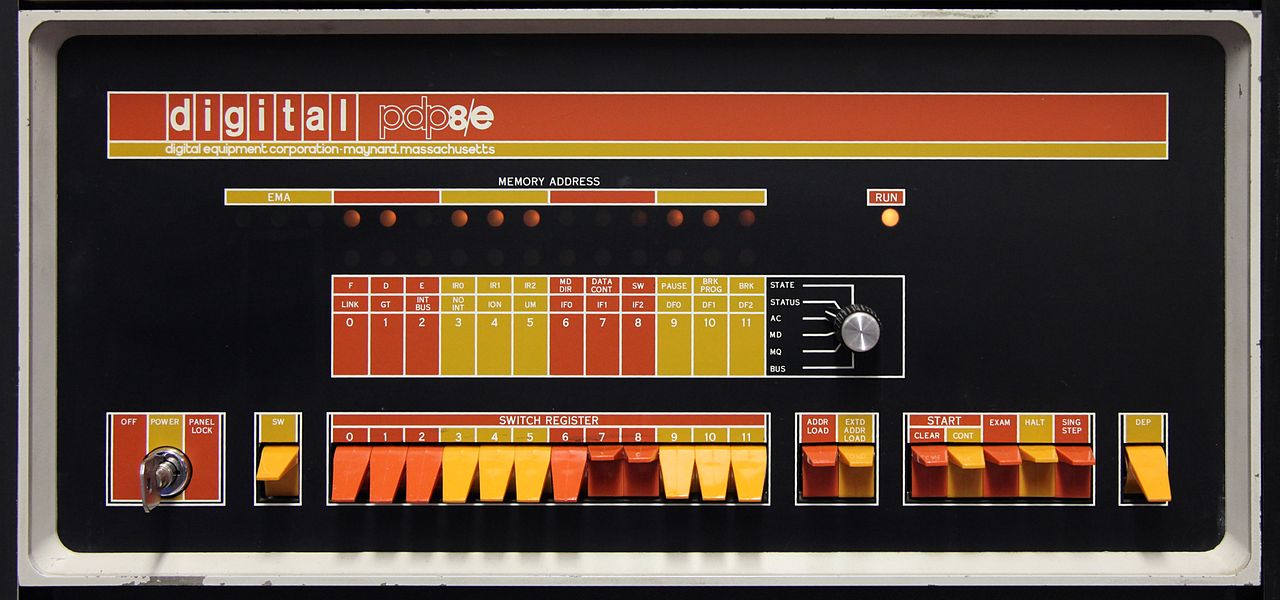
Key characteristics
- Hardware proximity: Instructions often map directly to processor instructions or hardware signals.
- Minimal abstraction: Few or no automatic memory management, limited runtime libraries, and explicit handling of resources.
- Performance and determinism: Predictable timing and low overhead make them suitable where efficiency matters.
- Platform specificity: Code frequently depends on a particular CPU architecture or system design.
- Translation tools: Assemblers, linkers, and compilers convert human-readable low-level source into machine code; see interpreter and translation tools for contrasts.
History and development
Early computing used machine code—direct sequences of binary values fed to hardware. To simplify programming, symbolic assembly languages were introduced in the mid-20th century, together with assemblers that translated symbols to numeric opcodes. Over time higher-level languages emerged to increase programmer productivity, but low-level languages remained essential for parts of systems that require direct hardware manipulation. The evolution of processor families and instruction sets has kept low-level programming relevant, as each architecture defines its own operations and constraints.
Uses and examples
Low-level programming is commonly used where close control of hardware is required. Typical domains include operating system kernels, device drivers, embedded firmware, boot loaders, real-time control systems, and certain performance-sensitive libraries. Examples of low-level forms are raw machine code and assembly languages for architectures such as x86, ARM, or RISC-V. Many projects mix languages: performance-critical routines or startup code may be written in assembly while the rest uses higher-level languages. For practical comparisons and additional resources see further reading on hardware-level programming and hardware architecture guides.
Distinctions, trade-offs and notable facts
The main trade-off when choosing low-level code is control versus portability and developer productivity. Low-level code can be faster and smaller, but it is typically more error-prone and harder to maintain. Modern compiler technology often narrows the performance gap by generating efficient machine code from higher-level languages, and many languages provide mechanisms such as inline assembly to combine approaches. The description "low-level" is relative: languages like C are sometimes called "low-level" because they expose pointers and direct memory access, yet C is higher-level than assembly. For a concise comparison of low- and high-level approaches consult language abstraction comparisons.
Further notes
Learning low-level programming encourages understanding of CPU registers, memory layout, calling conventions, and the system boot process. This knowledge helps developers write safer, faster, and more predictable software even when they primarily use higher-level languages. Tutorials, reference manuals, and hardware documentation are valuable complements to practical experimentation; authoritative resources and tool references can be found via introductory guides and the other linked placeholders above.
Related articles
Author
AlegsaOnline.com Low-level programming language Leandro Alegsa
URL: https://en.alegsaonline.com/art/59578