
Lō'ihi Seamount
An active submarine volcano southeast of the island of Hawaiʻi, Lō'ihi is the youngest member of the Hawaiian–Emperor seamount chain and a key site for studying submarine volcanism and hydrothermal ecosystems.
Overview
Lō'ihi Seamount is an active submarine volcano located on the flank of the Island of Hawaiʻi. It is the youngest volcano in the Hawaiian–Emperor seamount chain, rising from the floor of the Pacific Ocean toward the southeast coast of the island of Hawaii. Because it remains below sea level it is commonly described as a submarine volcano or seamount, and it provides a visible example of how ocean islands begin life on a deep-ocean foundation.
Image gallery
6 Images




Characteristics and structure
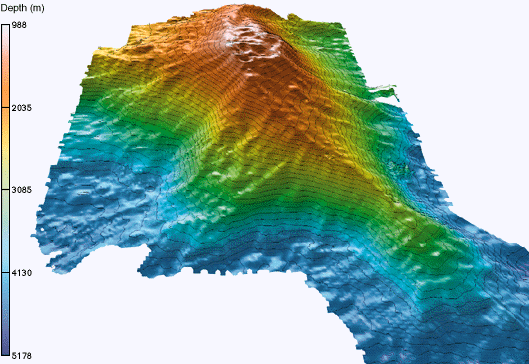
Lō'ihi has a summit area with pit-like depressions and rift zones that channel magma away from the central vent. The summit lies roughly a kilometer beneath sea level, and its slopes are marked by lava flows, fault scarps and hydrothermal vent fields. These vents emit warm, mineral-rich fluids that alter the seafloor and create deposits of iron, manganese and sulfur minerals.
Origins and activity
Formed by the Hawaiian mantle plume, Lō'ihi represents the earliest submarine stage of island growth as the Pacific Plate moves northwest over the hotspot. It is geologically active: scientists have recorded earthquake swarms and seafloor changes, most notably in the 1990s, which revealed recent eruptive and collapsible features at the summit. Continued eruptions and accumulation of lava will eventually lift the volcano above sea level given enough time.
Scientific importance and biology
Researchers study Lō'ihi to learn how hot-spot volcanism builds islands and how early-stage submarine eruptions differ from subaerial volcanoes. Its hydrothermal systems host chemosynthetic microbial communities that thrive on chemical energy rather than sunlight, making the site important for microbiology and biogeochemistry studies. Expeditions using submersibles and remotely operated vehicles have explored vents, sampled rocks and documented fauna.
Notable facts and monitoring
- Lō'ihi is monitored by oceanographic institutions and volcanic observatories for seismicity and deformation.
- Its seafloor vents alter local chemistry and support specialized life forms uncommon on nearby islands.
- The seamount illustrates an early stage in the life cycle of Hawaiian volcanoes: submarine growth, emergence, and eventual erosion.
Because Lō'ihi lies underwater, direct observation requires ships, submersibles and technical mapping; those tools continue to refine our understanding of submarine volcanism and the long-term evolution of the Hawaiian island chain. For broader context on submarine volcanoes and seamounts see resources on submarine volcanism and the geological setting of the Hawaiian–Emperor chain. Additional regional information may be found through oceanographic portals and local observatory pages (Pacific Ocean studies, Hawaiʻi resources).
Related articles
Author
AlegsaOnline.com Lō'ihi Seamount Leandro Alegsa
URL: https://en.alegsaonline.com/art/58899
Sources
- soest.hawaii.edu : "Active Volcanoes Summary"
- unstats.un.org : "Working Paper No. 82, "U.S Board on Geographic Names: Collection and Dissemination of Indigenous Names,"
- geonames.usgs.gov : GNIS
- gsa.confex.com : Using GIS to estimate the total volume of Mauna Loa Volcano, Hawaii
- oar.noaa.gov : "Loihi submarine volcano: a unique, natural extremophile laboratory"