
Lead–acid battery: construction, operation, types, uses and safety
Common rechargeable battery using lead and lead dioxide plates in sulfuric acid electrolyte. Covers construction, electrochemistry, variants (flooded, VRLA, AGM, gel), operation, maintenance, hazards and recycling.
Overview
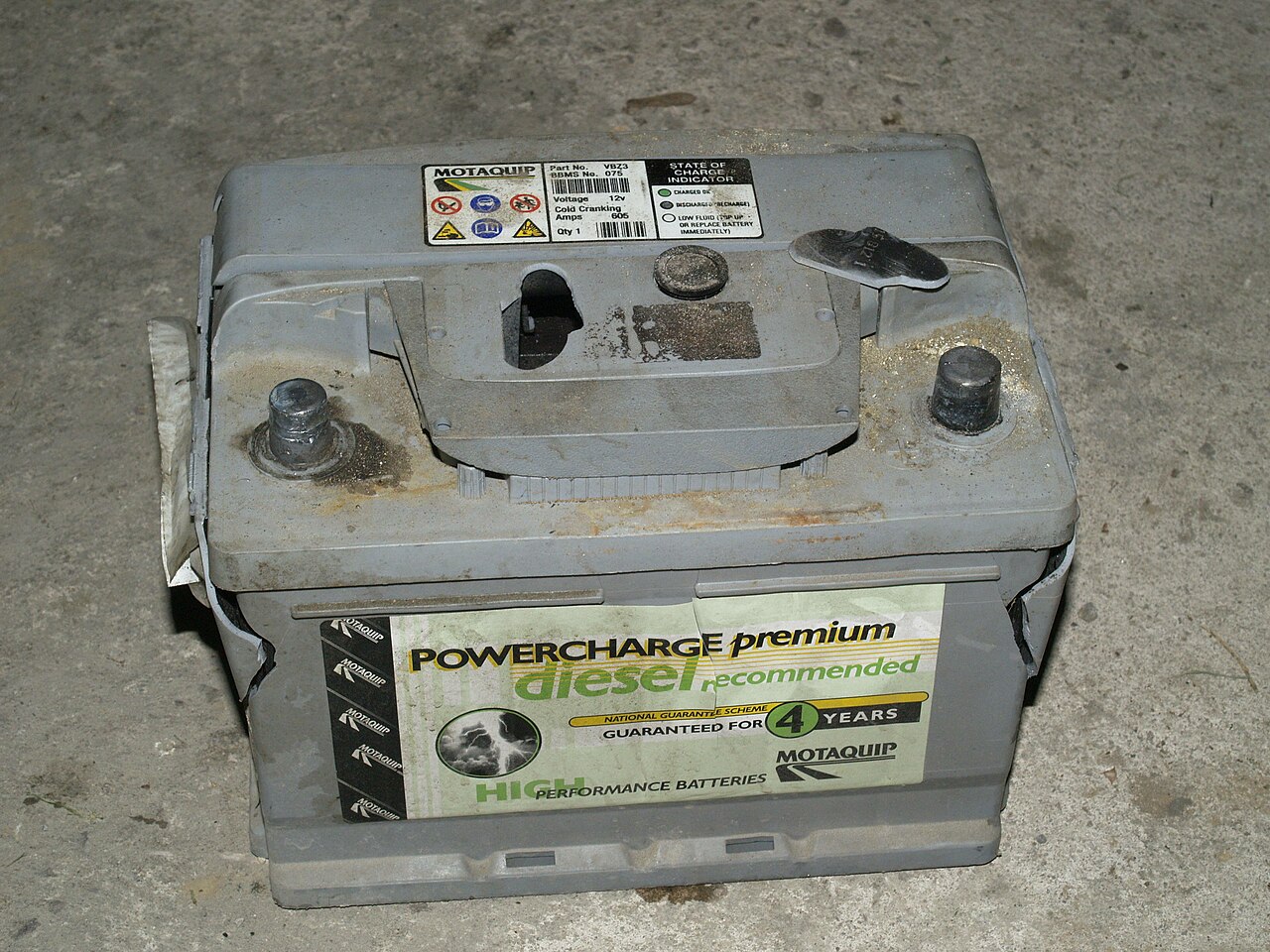
A lead–acid battery is a rechargeable electrochemical cell widely used for starting engines, standby power and stationary storage. It is a secondary cell because its chemical reactions are reversible by applying an external current. The technology is familiar from automotive systems and many backup-power installations; see automotive applications for common roles and contexts.
Image gallery
9 Images




Construction and chemistry
Each cell contains two electrodes: a negative plate made of metallic lead and a positive plate carrying lead dioxide (lead(IV) oxide). The electrolyte is an aqueous solution of sulfuric acid. During discharge, both active materials are converted to lead sulfate and water is produced, which lowers acid concentration and produces electric current. Charging reverses these changes, restoring the original active materials and acid concentration. For details on the principal materials see lead plates, lead dioxide and the electrolyte sulfuric acid.
Electrochemical reactions
The overall reversible reaction commonly written for a lead–acid cell is: Pb + PbO2 + 2H2SO4 ↔ 2PbSO4 + 2H2O. During discharge, lead at the negative plate and lead dioxide at the positive plate are converted to lead sulfate; charging drives the reaction in the opposite direction. These simplified equations are useful as a conceptual summary; more detailed half‑cell descriptions are used in technical discussions—see reaction reversal for a basic note.
Types and design variants
Designs vary to meet different requirements:
- Flooded (wet) cells: contain free liquid electrolyte that must be maintained and kept upright; common in starter and deep‑cycle formats and further explained at wet cell.
- Sealed or valve‑regulated lead–acid (VRLA): fitted with a pressure‑relief valve and internal recombination mechanisms that reduce water loss; generally labeled sealed lead‑acid.
- AGM (absorbent glass mat) and gel variants: AGM immobilizes the electrolyte in glass fiber mats for low internal resistance and good high‑current delivery, while gel batteries use a silica gel to immobilize the acid and are often chosen for vibration resistance and deep‑cycle use; see gel batteries for the gel type.
Performance and applications
Lead–acid batteries deliver high surge currents, which makes them well suited to engine starting and uninterruptible power supplies. They are relatively inexpensive and robust, but have lower energy density than many modern chemistries. Within the family there are starting designs optimized for short high‑current bursts and deep‑cycle types built for repeated sustained discharge and recharge.
Charging, monitoring and maintenance
Charging is typically performed in stages (bulk, absorption and float) to restore capacity and limit overcharge. State of charge can be estimated from open‑circuit voltage or, for flooded cells, by measuring electrolyte specific gravity. Routine maintenance for flooded cells includes topping up with distilled water and equalization charging when recommended; sealed and VRLA designs require less maintenance but still need correct charging regimes to avoid damage.
Degradation mechanisms
Common failure modes include sulfation (formation of hard lead sulfate on plates after prolonged discharge), grid corrosion, and loss of active material. Overcharging causes excess gassing and water loss; deep discharges and high temperatures accelerate capacity fade. Proper charging, temperature control and avoiding long periods of low state of charge help extend service life.
Safety, transport and recycling
Lead and sulfuric acid are hazardous. Charging can generate hydrogen gas, creating an explosion risk if ventilation is poor. Acid can cause chemical burns and corrode materials; appropriate personal protection and spill controls are important. Because of the environmental and health impacts of lead, lead–acid batteries are subject to extensive recycling programs and regulations; for disposal and recovery options consult local recycling information. More on cost and comparative performance is available at cost and performance.
Operational guidance and best practices
- Select battery type to match duty: starting vs deep‑cycle, flooded vs sealed.
- Follow manufacturer charging profiles and avoid prolonged overcharge or deep discharge.
- Ensure good ventilation during charging to disperse hydrogen and oxygen evolved in small amounts, and use spill containment for flooded types.
- When transporting or storing, comply with local rules for hazardous materials and use upright positioning for flooded batteries.
Historical and practical notes
The lead–acid battery is one of the oldest rechargeable battery types and remains widely used because it combines mature manufacturing, recyclability and reliable high‑current capability. Despite the emergence of newer chemistries for mobile and high‑energy applications, lead–acid technology continues to play a major role where cost, surge capability and established recycling infrastructure are decisive factors. For background on specific uses and technical comparison visit automotive applications or specialist references on cost and performance.
Further details on design variants and maintenance are summarized in dedicated overviews of wet cell construction, the mechanics of sealed lead‑acid valves, and the behavior of gel batteries and AGM types. Technical readers may consult service literature and standards for charging voltages, cell balancing and safe handling procedures—see also basic notes on reaction reversal and material data for lead plates, lead dioxide and sulfuric acid.
Related articles
Author
AlegsaOnline.com Lead–acid battery: construction, operation, types, uses and safety Leandro Alegsa
URL: https://en.alegsaonline.com/art/56722