
Lao script
Writing system used for the Lao language; an Indic-derived abugida related to Khmer and Thai, with unique curvilinear letters, tone marks, and a compact set of consonants and vowels.
Overview
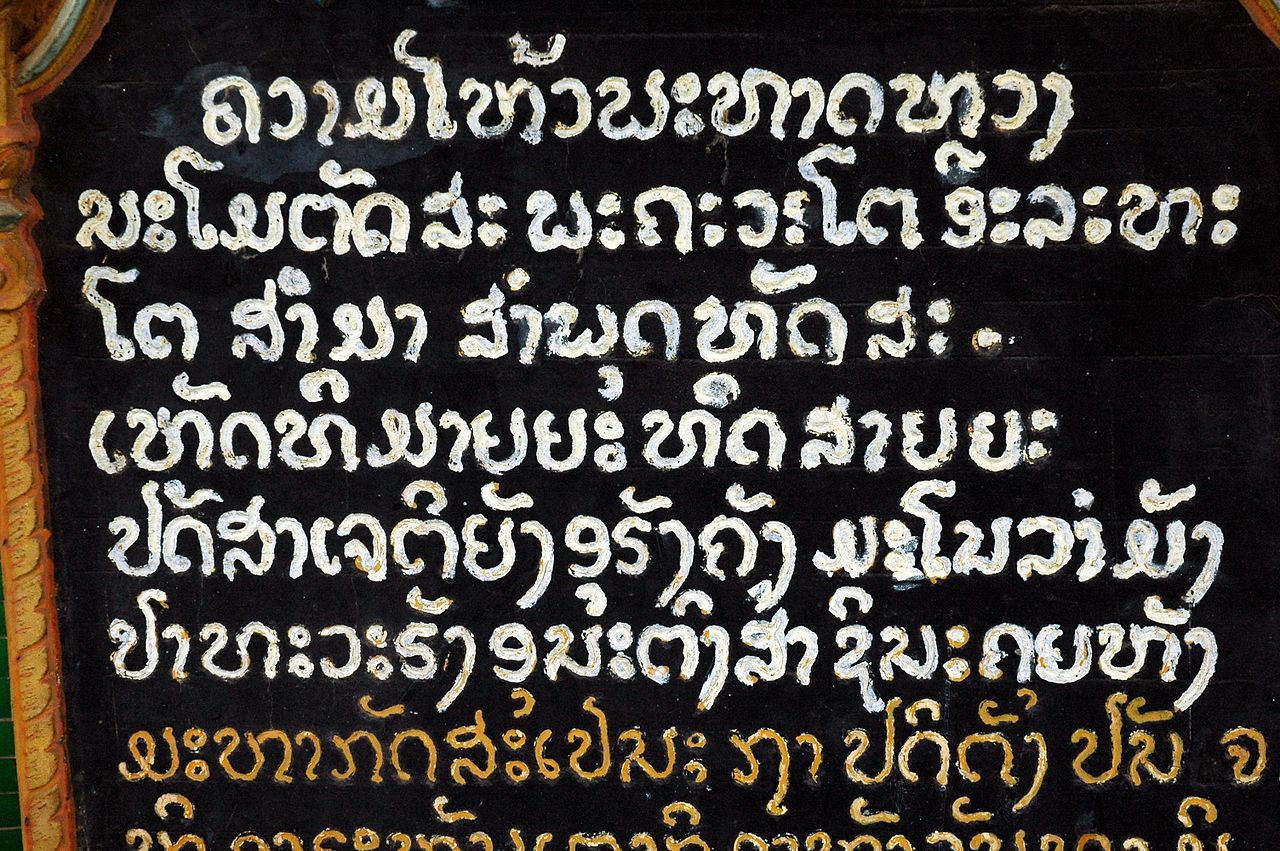
The Lao script is the primary writing system for the Lao language and several minority languages of Laos. It belongs to the family of southern Brahmic scripts through descent from the Khmer script, and therefore shows a clear relationship with the Thai script. Visually, Lao letters tend to be curvilinear; structurally, the script is an abugida in which consonant signs carry an inherent vowel and vowel sounds are indicated by additional marks.
Image gallery
3 Images

Characteristics
Lao writing uses diacritics to represent vowel qualities and a small set of graphic tone signs to indicate lexical tone. In general descriptions the script is noted for its system of tone markers combined with consonant classes and syllable structure to determine phonological tone. Compared with its close neighbor, it employs fewer consonants, which simplifies some spelling contrasts found in Thai. The script also lacks the additional historical letters sometimes retained in Thai for writing words of Indic origin; these extra letters relate to older loans from Sanskrit and Pali.
History and development
Lao script developed as part of the broader spread of Brahmic writing systems into mainland Southeast Asia. The Khmer script acted as an intermediary, transmitting shapes and orthographic ideas into the Lao-speaking region. Over time the writing habits of the Lao-speaking kingdoms diverged from Khmer and from neighboring Thai, producing the present-day set of letters and diacritics. During the modern era governments and language planners simplified and standardized the inventory and spelling conventions, reducing redundant letters and codifying how tones and vowels are written.
Writing system and orthography
As an abugida, each consonant character normally implies an inherent vowel (often a mid central or a short vowel) and explicit vowel marks modify or replace that vowel. Vowel signs may appear before, after, above or below a consonant, which can be unfamiliar to readers who use left-to-right alphabetic scripts. Lao traditionally does not mark spaces between every word the way English does; instead, spaces and punctuation mark phrase or sentence boundaries in many modern texts. The script's set of vowel diacritics is commonly discussed as including dozens of distinct vowel forms and combinations, for example a commonly cited inventory of vowel markers used to represent short and long, simple and diphthongal vowels.
Uses and modern context
Lao script is used in official documents, education, newspapers, signage and digital communication throughout Laos and in Lao-speaking communities abroad. It is encoded in Unicode and supported by modern fonts and keyboards, which has enabled its use on the web and in mobile devices. The script is also encountered in cultural and religious contexts, though liturgical and historical manuscripts may use related scripts or orthographies that preserve older conventions.
Distinctive facts and comparisons
- Lao letters are generally rounder and more flowing than the often more angular Thai forms derived from the same ancestor.
- Traditional descriptions list a compact consonant inventory and several consonant ligatures used for specific clusters or historical spellings.
- The interaction of consonant class, vowel length, final consonant, and tone marks yields the spoken tone of a syllable; learning those interactions is central to literacy in Lao.
- Although closely related, Lao and Thai writing show clear orthographic choices reflecting different historical developments and language policies.
Further reading and resources: Overview of Lao script, Lao language, Khmer script background, Thai script comparison, Abugida systems, Tone marking, Consonant inventory, Extra letters and Sanskrit/Pali, Sanskrit, Pali, Vowel markers.
Related articles
Author
AlegsaOnline.com Lao script Leandro Alegsa
URL: https://en.alegsaonline.com/art/55968