
Vowel (speech sound)
A vowel is a speech sound produced with an open vocal tract and serves as the core of syllables; letters that represent vowels vary by language and writing system.
A vowel is a class of speech sound produced with relatively open configuration of the vocal tract, so that airflow is not blocked by the tongue, teeth, or lips. In phonetics and everyday description this concept of a speech sound contrasts with consonants, which involve a stronger obstruction. Vowels typically form the nucleus of a syllable and carry much of a word's pitch, length and loudness.
Image gallery
5 Images



Physical and phonetic characteristics
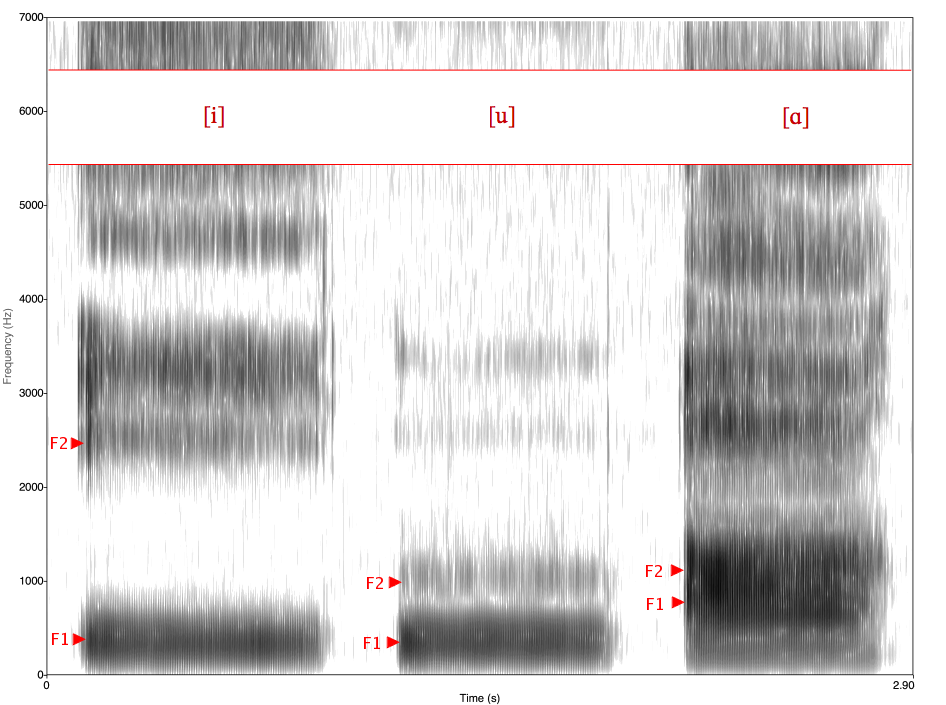
Vowels are distinguished by several articulatory and acoustic dimensions. The most important are tongue height (high, mid, low), tongue backness (front, central, back), and lip rounding (rounded or unrounded). Other relevant properties include tenseness (often called tense vs. lax), length or duration, nasalization, and whether a sound is a single target (a monophthong) or a glide between targets (a diphthong or triphthong). These characteristics are defined with reference to the shape of the upper vocal tract and the tongue's position inside the mouth.
Vowels in writing and English examples
Different writing systems represent vowels in different ways. Alphabetic systems like English use vowel letters, while abjad systems may leave some vowels unmarked. In English spelling the five primary vowel letters are represented by A, E, I, O, and U. In addition the letters Y and W sometimes represent vowel sounds or participate in diphthongs. For example, Y behaves as a vowel in words like "my" and "myth" but as a consonant in "yes"; W appears as a consonant in "when" but contributes to vowel clusters in "cow" and "how." Some languages use W as a full vowel letter, as in Welsh.
- Common English vowel examples: cat (low front), see (high front), law (low back), boot (high back), about (reduced schwa in unstressed syllable).
- Diphthongs: sounds that move from one vowel target to another, e.g. the vowel in "eye" or "cow."
Historical and cross-linguistic notes
Vowel inventories differ widely among languages: some have just three vowels (commonly /i, a, u/), while others have a rich set of front/back and rounded/unrounded contrasts. Historical sound changes can create new vowels or merge existing ones; vowel quality is often central in distinguishing related languages and dialects. Writing traditions also vary: some alphabets derive vowel letters from very old symbol sets, whereas other scripts indicate vowels with diacritics or omit them except where needed for clarity.
Functions, variation and notable facts
Vowels play several functional roles. They create syllable structure, enable rhymes and meter in poetry, and often carry grammatical distinctions such as tense, number, or aspect in some languages. Phonological phenomena that involve vowels include vowel harmony (a coherence of vowel features across a word), reduction to schwa in unstressed positions, and length contrasts. For practical learning, it is important to separate the notion of a vowel as a sound from the letters that represent vowels: English uses its limited set of letters to spell a larger inventory of vowel sounds, which is why spelling and pronunciation do not always match.
For further reading about related sound classes and orthographies, see discussions of consonants, alphabetic systems, and language-specific examples such as Welsh words like cwm that illustrate unusual vowel-letter correspondences. Additional resources on vowel qualities and classification can be found at general phonetics guides and language-specific descriptions linked in academic summaries.
Vowels are fundamental to spoken language: understanding their physical basis, phonological role, and representation in writing helps clarify why languages sound and are written the ways they do.
Questions and answers
Q: What is a vowel?
A: A vowel is a particular kind of speech sound made by changing the shape of the upper vocal tract, or the area in the mouth above the tongue.
Q: How many vowel letters are there in English?
A: There are five vowel letters in the English alphabet - A, E, I, O, U and sometimes W and Y.
Q: When does Y represent a consonant sound?
A: Y can be used as a consonant sound at the beginning of words such as when, where and wet.
Q: What is meant by "Y is sometimes a vowel"?
A: This means that Y can represent both vowel and consonant sounds depending on its usage within a word. For example, in words like cry, sky, fly, my and why letter Y represents the vowel sound /aɪ/. In words like myth and synchronize it represents /ɪ/, while in only quickly and folly it represents /i/.
Q: How often does W represent a consonant sound?
A: The letter W can be used as a consonant about 2.5% of the time.
Q: Does English spelling help us figure out what English sounds are?
A: No - there are many more vowel sounds than letters in the English alphabet so this makes it difficult to accurately determine which sounds each letter should make.
Related articles
Author
AlegsaOnline.com Vowel (speech sound) Leandro Alegsa
URL: https://en.alegsaonline.com/art/105961
Sources
- ginsengenglish.com : "...And Sometimes Y?"