
Lao language (Laotian)
Lao (Laotian) is the principal language of Laos and a major Tai language of mainland Southeast Asia, with several regional varieties and a distinct alphabet derived from Indic scripts.
Overview
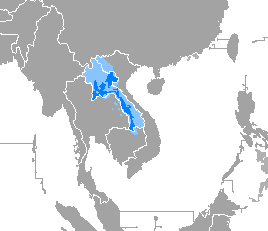
The Lao language, often called Laotian in English, is the principal language of Laos and is widely spoken across the country in government, education and everyday life. It is also the dominant vernacular of the greater northeastern region of Thailand, where local varieties form part of the continuum between Lao and Thai. Among the Lao dialects, the Vientiane dialect is commonly regarded as the standard for formal speech and media in Laos.
Image gallery
7 Images




Classification and relations
Lao belongs to the Tai branch of the larger Tai–Kadai family of languages and shares many grammatical and lexical features with neighbouring Tai languages. It has a close historical and structural relationship with Central Thai; speakers of some northern Thai dialects and Lao varieties report a high degree of mutual understanding, though intelligibility varies by region and register. Linguists often describe this situation as a dialect continuum rather than completely separate languages (Tai languages, mutual intelligibility).
Writing system
Lao is written with the Lao script, an abugida-style writing system in which basic characters represent consonants and vowel signs attach to them. The script is descended from Old Khmer and, ultimately, the Brahmic family of Indic scripts; it encodes consonant shapes, diacritics and vowel markers rather than purely alphabetic letters. The written tradition supports both formal registers found in literature and administrative texts and a range of colloquial forms used in newspapers and online communication. Abugida
Phonology and dialects
Phonetically, Lao is a tonal language: pitch differences distinguish meaning between otherwise similar syllables. Its syllable structure, vowel inventory and tone patterns vary across regions, producing noticeable dialectal differences. Rural and upland varieties may preserve older sounds or distinct vocabulary, while urban speech shows influences from media and neighboring languages. The Vientiane standard tends to be less divergent and serves as the basis for broadcasting and formal education.
History, contact and development
The modern Lao language developed from the languages spoken by Tai migrant groups that moved into the Mekong valley centuries ago, interacting with Mon–Khmer and Indic cultural spheres. Over time Lao absorbed loanwords from Khmer, Pali and Sanskrit through religion and learning, and later from French during the colonial period. In Thailand, Lao-related varieties—commonly called Isan—have been subject to language policy and script changes; many speakers use Thai for official domains while maintaining Lao as a home language.
Uses, importance and notable facts
- Education and media: Lao is the primary medium of instruction in most schools in Laos and is used in radio, television and print media.
- Religious and literary use: Buddhist texts, traditional songs and oral literature preserve classical vocabulary and forms.
- Cross-border communication: The closeness to Thai varieties facilitates commerce and social ties across the border with Thailand, though scripts and formal registers differ.
- Standardization: The Vientiane form is promoted for national cohesion, while regional varieties remain important markers of identity (Vientiane).
Lao continues to evolve under internal regional dynamics and external influences. For further linguistic description and resources, consult specialized references and language surveys provided by regional research centres and academic institutions (Laos, northeast, abugida, Tai languages, mutual intelligibility).
Questions and answers
Q: What is Lao language?
A: Lao or Laotian is a language and the official language of Laos, also spoken in the northeast part of Thailand.
Q: What writing system is used for Lao language?
A: Lao, like the other languages of Laos, is written in an abugida writing system.
Q: Which dialect of Lao is considered the standard written form?
A: The Vientiane dialect is considered the standard written form of Lao.
Q: What is the relationship between Lao and Thai languages?
A: Lao and Thai are both Tai languages and are very similar to each other.
Q: Can speakers of northern Thai dialects understand Lao?
A: Yes, speakers of northern Thai dialects and Lao claim that they can largely understand each other, making the dialects mutually intelligible.
Q: Where else is Lao spoken aside from Laos?
A: Lao is also spoken in the northeast part of Thailand.
Q: What is the significance of the fact that Lao and Thai are mutually intelligible?
A: The fact that Lao and Thai are mutually intelligible means that they have many similarities and that the people who speak them can easily communicate with each other.
Related articles
Author
AlegsaOnline.com Lao language (Laotian) Leandro Alegsa
URL: https://en.alegsaonline.com/art/55966
Sources
- laos-guide-999.com : "Lao Language"
- thailao.net : "Facts about Lao"
- effectivelanguagelearning.com : "Lao Language"