
Infrared spectroscopy: principles, methods, and applications
Overview of infrared (IR) spectroscopy: how it detects molecular vibrations, common instruments and sampling methods, major uses in chemistry and materials analysis, and its relation to Raman techniques.
Overview
Infrared spectroscopy is an analytical technique that probes how molecules absorb infrared light to reveal information about their chemical bonds and molecular structure. When a molecule absorbs infrared radiation, specific vibrational modes are excited; the pattern of absorbed frequencies produces a spectrum that can act as a fingerprint for functional groups and, in many cases, whole molecules. Modern instruments most often operate in the mid-infrared region (commonly reported as 4000–400 cm−1) and use interferometric methods to record spectra quickly and with high signal-to-noise.
Image gallery
10 Images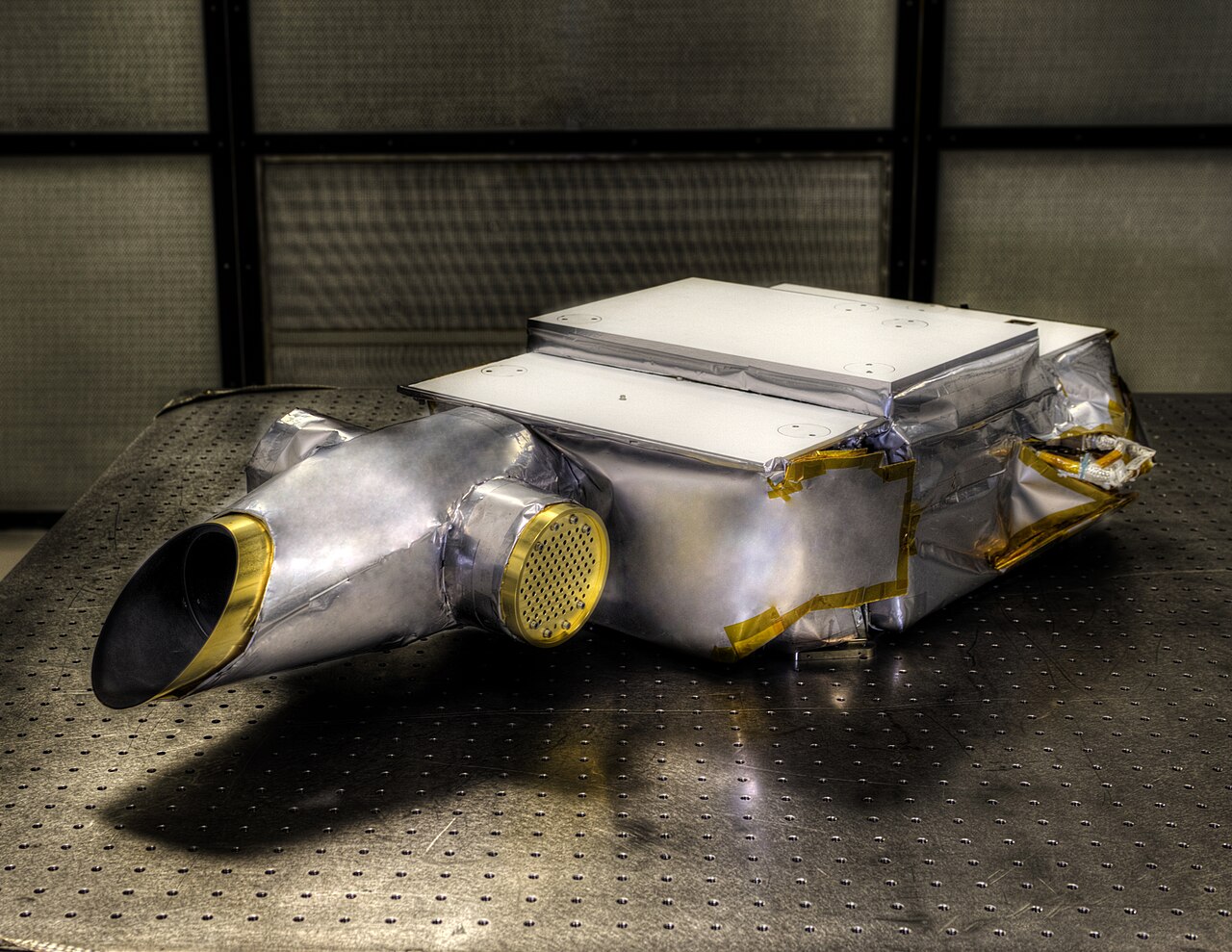



Basic principles
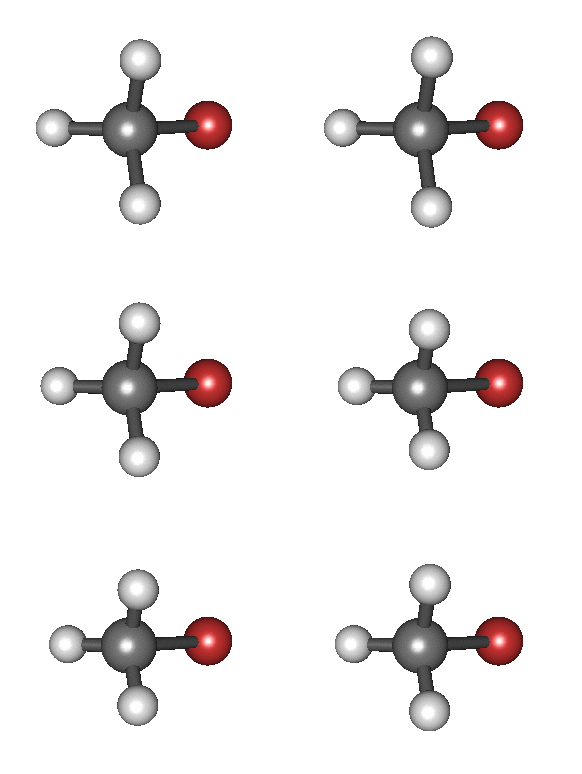
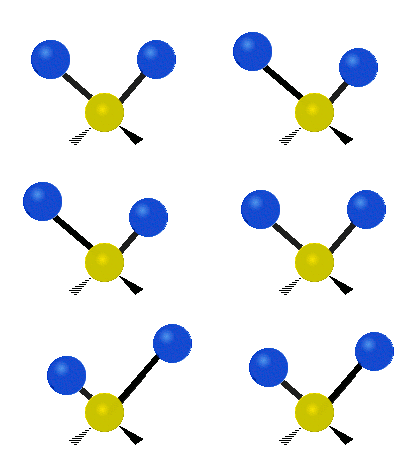
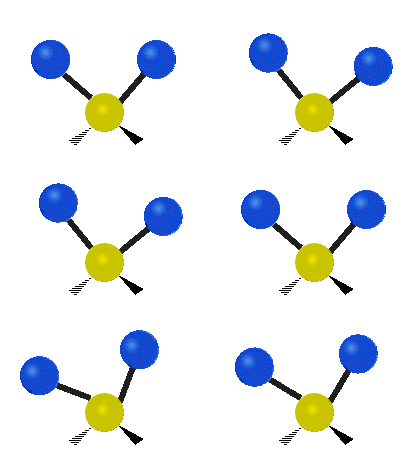
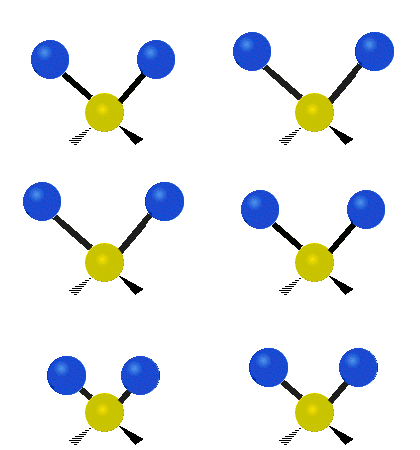
Molecular vibrations—stretching, bending, twisting and other motions of bonded atoms—occur at characteristic frequencies. For an IR transition to be observed, the vibration must change the dipole moment of the molecule; vibrations that do not change dipole are weak or inactive in the IR spectrum. A spectrometer measures how much light at each frequency is absorbed by a sample. Quantitative measurements follow principles similar to Beer–Lambert behavior for homogeneous samples, while qualitative analysis relies on matching observed bands to known functional-group frequencies.
Instrumentation and sampling methods
The dominant instrument architecture today is Fourier transform infrared (FTIR) spectroscopy, which uses an interferometer and Fourier transform mathematics to convert raw interferograms into spectra. Older dispersive instruments, which scan one wavelength at a time, are less common. Typical sampling modes include transmission through thin films or KBr pellets, diffuse reflectance for powders, and attenuated total reflectance (ATR) for solids, liquids, and biological samples. ATR has become popular because it requires little sample preparation and can analyze surfaces directly.
Applications and examples
Infrared spectroscopy is widely used in organic chemistry, polymer science, environmental monitoring, pharmaceuticals, food analysis, and forensic identification. Common diagnostic bands include broad O–H stretches (often near ~3200 cm−1 for hydrogen-bonded alcohols and water) and strong C=O carbonyl absorptions (around ~1700 cm−1) among others. In routine practice, IR spectra help confirm the presence or absence of functional groups, assess sample purity, follow reaction progress, and provide evidence for structural proposals created from other techniques.
Comparisons, strengths, and limitations
IR spectroscopy complements other vibrational techniques such as Raman spectroscopy; Raman is sensitive to polarizability changes while IR is sensitive to dipole changes, so the two methods often provide complementary information. Limitations of IR include weak or absent signals for entirely symmetric vibrations and difficulties analyzing complex mixtures without separation. Surface-sensitive and microscale variants help address some limitations by improving spatial resolution and sample handling.
History and development
The use of infrared radiation to study matter dates to early 20th-century spectroscopic work; advances in optics, detectors, and computing led to FTIR becoming the practical standard in the late 20th century. Incremental improvements in sources, detector materials, and sampling accessories have broadened utility across research and industry. Continued developments focus on portable instruments, higher sensitivity detectors, and combined techniques that integrate IR with microscopy or chromatography.
Practical considerations and notable facts
- IR spectra are usually plotted as absorbance or transmittance versus wavenumber (cm−1).
- Interpretation often relies on libraries of reference spectra and pattern recognition software for routine identification.
- Careful sample preparation and awareness of common interferences (water, CO2) improve data quality.
- Because IR and Raman probe different selection rules, using both can give a more complete vibrational picture.
Further resources
- Fundamental principles and textbooks
- Spectral interpretation guides
- Mid- and near-IR spectral ranges
- Wavenumber and wavelength conventions
- Fourier transform methods
- Instrumentation and accessories
- Vibrational mode descriptions
- Sampling techniques and best practices
- Selection rules and dipole changes
- Photon–molecule interactions
- Applications in organic analysis
Related articles
Author
AlegsaOnline.com Infrared spectroscopy: principles, methods, and applications Leandro Alegsa
URL: https://en.alegsaonline.com/art/47316