
Dipole: electric and magnetic dipoles, dipole moment and applications
Overview of dipoles in physics: definitions of electric and magnetic dipoles, dipole moment, field behavior, typical examples (molecules, current loops, magnets), applications and important distinctions.
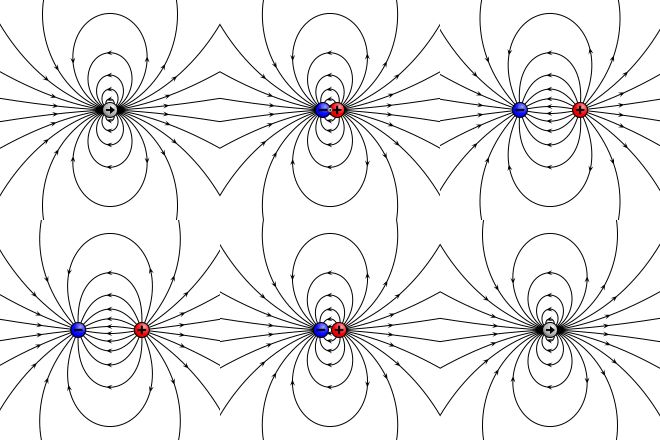
A dipole in physics usually refers to a system with two equal and opposite sources of a field separated in space. The term covers both the electric dipole formed by separated electric charges and the magnetic dipole produced by circulating currents or intrinsic magnetic moments. More generally, a dipole is characterized by a vector quantity called the dipole moment, which captures the strength and orientation of the source as seen at distances larger than the object itself. For concise introductions to related ideas see entries on the general dipole concept and on how opposite positive and negative charges generate electric dipoles.
Image gallery
2 Images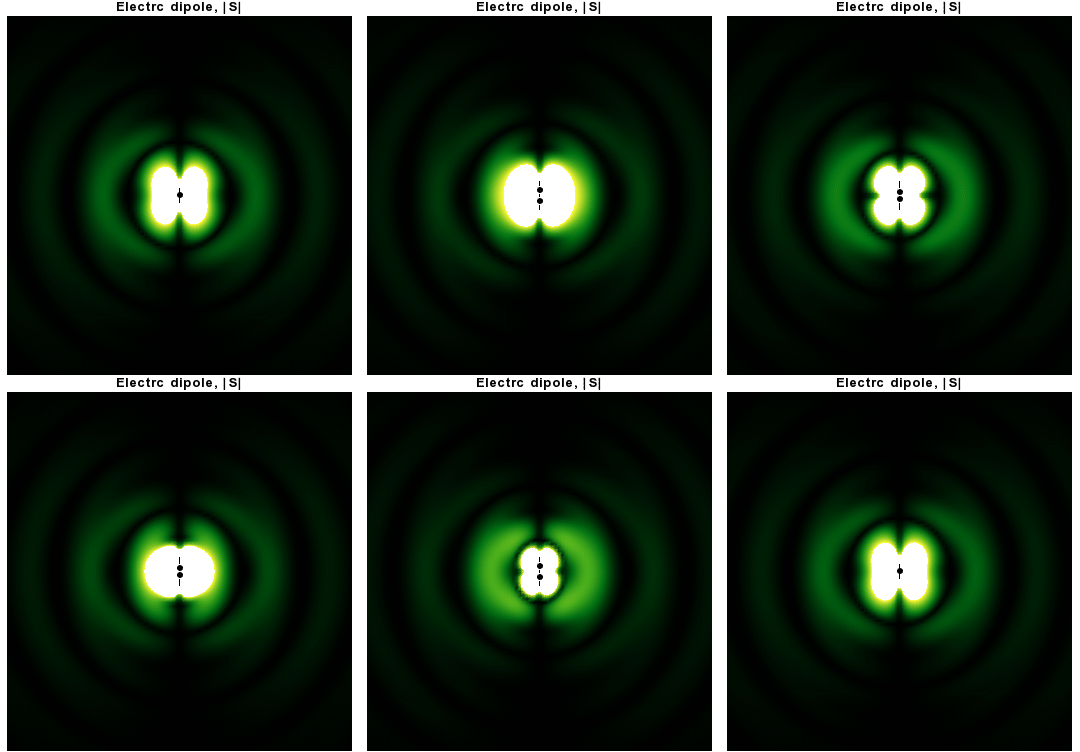
Dipole moment and field behavior
The dipole moment is a vector: for a simple electric pair it is given by p = q d, where q is the charge magnitude and d is the displacement from the negative to the positive charge. The magnitude of this vector equals the product of charge and separation; the direction conventionally points from negative to positive. For a small current loop the magnetic dipole moment is μ = I A, the current times the area of the loop, with orientation given by the right-hand rule relating current circulation to a vector through the loop.
Fields produced by a localized dipole fall off rapidly with distance: the electric or magnetic field of an ideal point dipole decreases roughly as 1/r^3 at large r, while the scalar potential behaves approximately like 1/r^2 in many typical geometries. Dipoles in an external uniform field experience a torque τ = p × E (for electric dipoles) that tends to align the dipole moment with the applied field, and a potential energy −p·E that depends on orientation.
Electric dipoles
An electric dipole can be realized by two opposite charges of equal magnitude separated by a short distance. Many molecules are electric dipoles: for example, the geometry and charge distribution of a water molecule give it a permanent dipole moment that strongly influences solvent behavior, dielectric response, and intermolecular forces. In materials, microscopic dipoles produced by charges or induced polarization determine macroscopic properties such as permittivity and polarization under applied fields. The basic physics of alignment, energy, and torque described above governs behavior of electric dipoles in capacitors, molecular assemblies, and dielectrics.
Magnetic dipoles
Magnetic dipoles arise from loops of electric current or from intrinsic electron magnetic moments (spin and orbital motion). A simple laboratory example is a single circular loop of wire carrying current; this closed current loop produces a magnetic dipole moment whose magnitude equals current times area and whose direction follows the right-hand rule. Common permanent magnets, such as a bar magnet, behave effectively like dipoles at distances large compared with their size. Because isolated magnetic monopoles have not been observed, magnetic fields at large distances are dominated by dipole and higher multipole contributions rather than single isolated poles.
Applications, examples and practical importance
- In chemistry and biology, electric dipoles determine intermolecular forces, solvation, and the behavior of polar molecules in electric fields.
- In communications, the term "dipole antenna" refers to antennas whose radiation pattern approximates that of an oscillating electric dipole.
- Magnetic dipoles are central to technologies such as magnetic resonance imaging (MRI) and nuclear magnetic resonance (NMR), where nuclei or electrons act like tiny magnetic dipoles that align and precess in applied fields.
- Planetary and stellar magnetic fields are often approximated by a large-scale dipole component; the Earth's magnetic field resembles that of a tilted dipole to first order.
Distinctions and notable facts
It is useful to distinguish a physical dipole (two separated charges or a finite current loop) from the ideal point dipole used in theoretical treatments. The point dipole is a limiting model that captures far-field behavior but ignores finite-size effects and higher multipole moments. The vectors p (electric) and μ (magnetic) play analogous roles in torque and energy equations, yet their microscopic origins differ: electric dipoles come from separated charges or shifted electron clouds, while magnetic dipoles arise from currents and quantum mechanical spin. For further reading on related formalism and examples consult linked resources on basic multipole expansion and both practical instances of dipole phenomena and the separate topics of electric dipoles and magnetic dipoles.
Related articles
Author
AlegsaOnline.com Dipole: electric and magnetic dipoles, dipole moment and applications Leandro Alegsa
URL: https://en.alegsaonline.com/art/27572