
Hydrogenation: adding hydrogen to unsaturated molecules
Hydrogenation is the chemical addition of hydrogen to unsaturated organic molecules. It is widely used in food, petrochemical and pharmaceutical industries and normally requires a catalyst and hydrogen gas.
Overview
Hydrogenation is the chemical hydrogenation process in which molecular hydrogen is added across multiple bonds of organic molecules. The most common transformations convert carbon–carbon double bonds into single bonds, turning unsaturated compounds into more saturated, often more stable, products. This class of reactions is fundamental in both laboratory synthesis and large-scale manufacturing.
Image gallery
10 Images




How it works and common catalysts
At its simplest, hydrogenation proceeds by transfer of hydrogen atoms to an unsaturated site. Most practical reactions use a catalyst to activate hydrogen and the substrate; typical heterogeneous catalysts include palladium, platinum and nickel. There are also homogeneous catalysts based on soluble transition-metal complexes. Specialized catalysts, such as Lindlar catalysts, allow selective partial hydrogenation (for example converting alkynes to alkenes without going all the way to saturated products).
Applications and examples
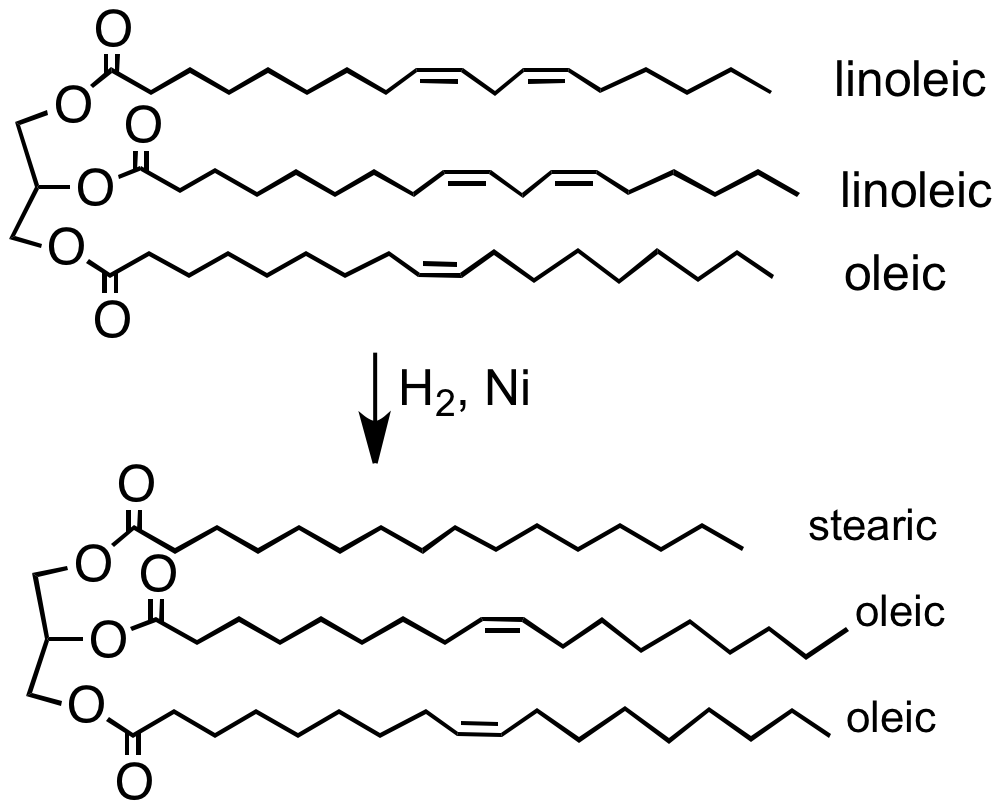
Hydrogenation has many industrial uses. In food processing, hydrogenation of vegetable oils increases solidity and shelf life: manufacturers of shortening or spreads convert unsaturated fats into more saturated alkanes or saturated fats to achieve desired textures. Partial hydrogenation was historically used to make products such as margarine, but it can produce unwanted trans fats through isomerization of double bonds.
Other industrial contexts
Beyond edible fats, hydrogenation is used in petroleum refining to remove unsaturated impurities, in the synthesis of pharmaceuticals and agrochemicals to reduce functional groups, and in production of specialty chemicals. In another major industrial process, nitrogen is combined with hydrogen under high pressure conditions and elevated temperature to produce ammonia; that process uses different catalysts and conditions but relies on the same principle of adding hydrogen to form new chemical bonds.
Variants, selectivity and safety
- Partial hydrogenation: selectively reduces some bonds while leaving others intact; used when only limited saturation is wanted.
- Hydrogen transfer reactions: use a hydrogen donor molecule instead of H2 gas for safer or more convenient lab-scale reductions.
- Hydrogenolysis: cleaves bonds by addition of hydrogen, useful for deprotecting groups in synthesis.
Safety and environmental notes: hydrogenation often involves flammable hydrogen gas, high pressures, and metal catalysts; industrial practice emphasizes containment, proper catalyst handling, and monitoring of by-products such as trans isomers in foods.
Historical and practical significance
Developments in catalytic hydrogenation in the 19th and 20th centuries enabled large-scale hydrogen-based transformations, revolutionizing food technology, fuels and chemical manufacture. Modern research continues to improve catalyst efficiency, selectivity and sustainability, for example by designing catalysts that reduce the formation of undesirable isomers or that operate under milder conditions.
For further technical background and practical guidance, consult detailed resources on catalytic hydrogenation and industrial processes such as the Haber–Bosch synthesis of ammonia.
Related articles
Author
AlegsaOnline.com Hydrogenation: adding hydrogen to unsaturated molecules Leandro Alegsa
URL: https://en.alegsaonline.com/art/46109