
Hornwort (non-vascular bryophyte)
Hornworts are small, non-vascular plants distinguished by a hornlike sporophyte. This article summarizes their form, life cycle, ecology, taxonomy, and ecological importance.
Hornworts are a group of small, green land plants traditionally treated with mosses and liverworts as bryophytes. The common name refers to the elongated, horn-shaped sporophyte — the spore-producing phase — that rises from a flattened, thalloid gametophyte. Although often overlooked because many species form inconspicuous cushions or thin patches, hornworts occupy a distinctive place in plant diversity because of their simple structure, physiology and life history. See general background on bryophytes and the broader category of non-vascular plants.
Image gallery
2 Images
Form and distinguishing features
Hornwort gametophytes are typically a single, flattened sheet of tissue with a green, photosynthetic surface. They lack true roots and vascular tissues; water and nutrients move by cell-to-cell transport and along the surface. The sporophyte grows as a slender, often cylindrical "horn" that continues to elongate from a persistent basal meristem, releasing spores from a longitudinal slit. Hornwort cells often contain a single large chloroplast per cell (in many species), and some harbor cyanobacteria in specialized cavities that fix atmospheric nitrogen, making them important in nutrient-poor habitats.
Life cycle and reproduction
Hornworts exhibit alternation of generations, alternating between a haploid gametophyte and a diploid sporophyte. The dominant, photosynthetic stage is the gametophyte; it produces gametes by mitosis. After fertilization, a sporophyte arises and generates spores by meiosis. For a concise overview of this process see alternation of generations. Terms used in plant life cycles, such as haploid, are central to understanding how a single plant lineage produces genetically varied spores. Hornworts disperse spores (see spores) and can also spread vegetatively.
Habitat and distribution
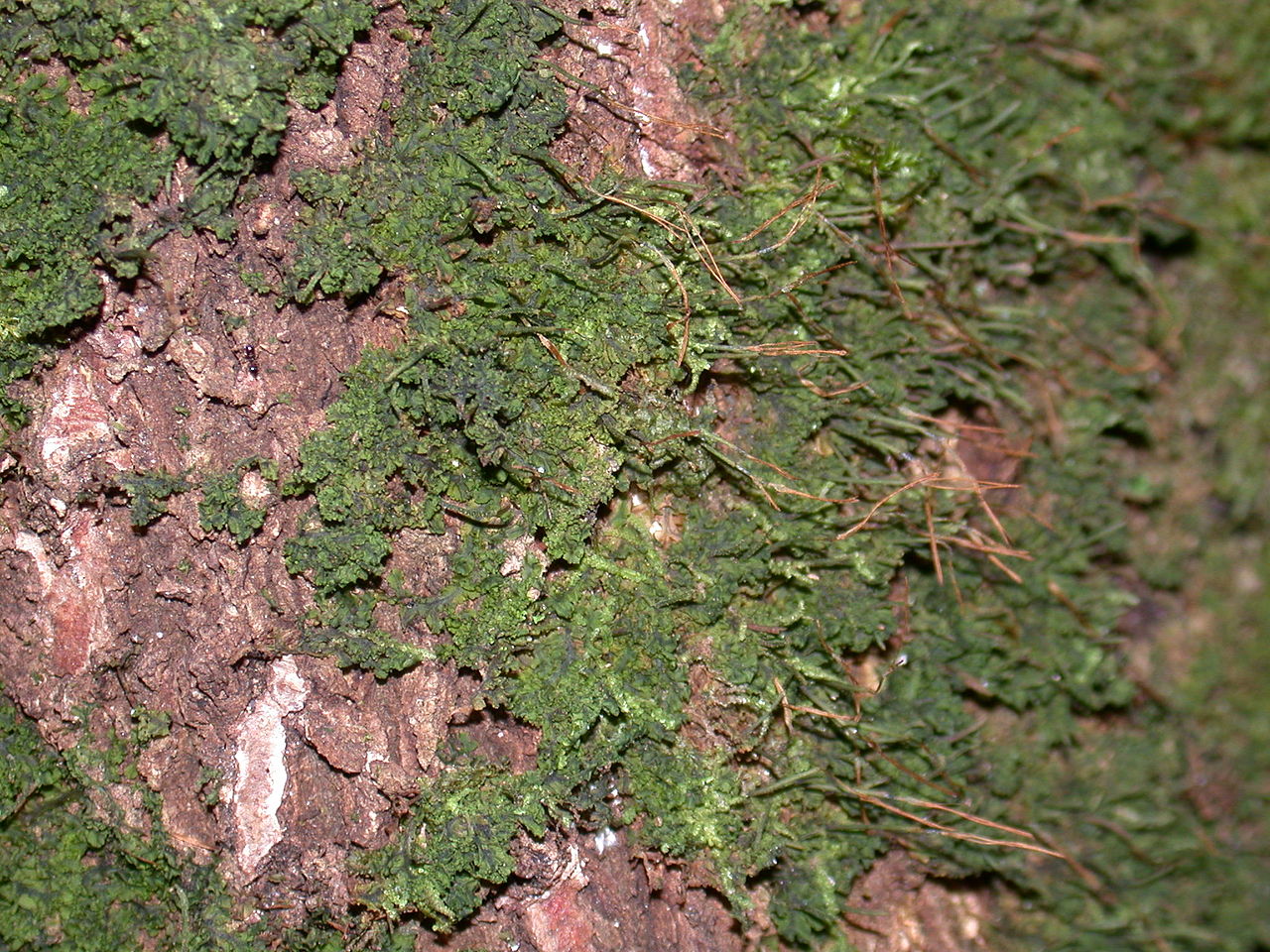
Hornworts occur worldwide, from temperate soils to humid tropical forests. They prefer damp, shaded or periodically moist microsites: soil surfaces, damp rocks, rotting wood, and tree bases. Some species appear as tiny, often ephemeral weeds in disturbed soils; gardeners may find them among seedlings or in lawn patches. Typical habitats include garden soil and agricultural ground where they may thrive as minute weeds in loose soil or in cultivated fields. Other species are epiphytic in humid regions, growing on bark in tropical areas; see notes on tropical species and tree bark.
Taxonomy, evolution and notable facts
The classification of bryophytes has been debated; hornworts are sometimes placed in their own division, the Anthocerotophyta. For discussions of their classification see general resources on taxonomy and the proposed division. Molecular studies suggest hornworts represent an ancient lineage of land plants with unique features, such as their simple sporophyte and frequent partnerships with nitrogen-fixing cyanobacteria. These traits give them an important evolutionary and ecological role despite their modest size.
Ecological role and human relevance
Ecologically, hornworts contribute to soil development, nutrient cycling and microhabitat formation. Their association with cyanobacteria can enrich nitrogen-poor substrates, helping establish plant communities on bare or disturbed ground. While not widely used directly by people, they are of interest to botanists, ecologists, and educators studying plant evolution, symbiosis and simple land-plant organization.
- Overview: Small, thalloid gametophyte with elongating horn-like sporophyte.
- Key features: Single-chloroplast cells in many species, cyanobacterial symbioses.
- Habitats: Soil surfaces, disturbed ground, rocks, bark in humid tropics.
- Importance: Nitrogen fixation, early land-plant evolution, ecological pioneers.
Further reading and general references can be found through introductory resources on bryophytes and specialized pages about hornwort biology and classification (taxonomy, division). Additional practical notes cover their occurrence as small weeds in cultivated fields, their ecology in tropical and temperate zones, and their role in soil and bark microhabitats (soil, tree bark).
Related articles
Author
AlegsaOnline.com Hornwort (non-vascular bryophyte) Leandro Alegsa
URL: https://en.alegsaonline.com/art/45141