
Horsetail (Equisetum): an ancient group of spore-bearing plants
Horsetails are ancient, spore-producing vascular plants once abundant in Paleozoic forests. Today a single living genus, Equisetum, remains. Known for jointed, silica-rich stems, rhizomes and cone-like spore organs.
Overview
Horsetails are a distinctive lineage of spore-bearing plants traditionally placed among the pteridophytes. They are best known today through the living genus Equisetum, but the group has a very long fossil history. As classification shows, horsetails occupy a basal position among vascular plants and are not seed plants, instead reproducing by spores.
Image gallery
9 Images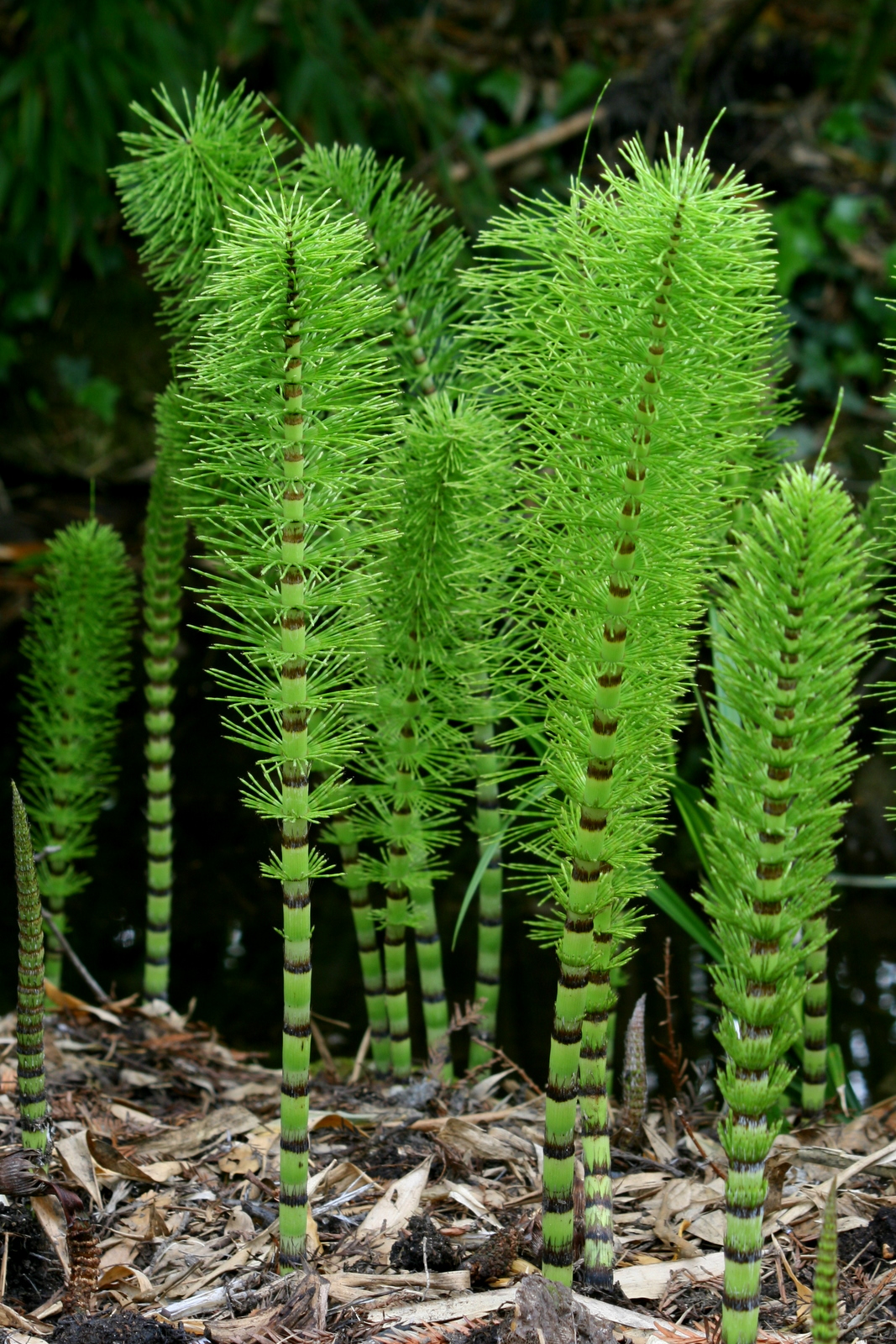


Physical characteristics
Horsetails have a recognizable architecture: hollow, jointed stems with distinct nodes and internodes, often bearing whorls of slender branches or reduced leaves. Many species accumulate silica in their tissues, giving stems a rough, abrasive surface. Below ground they produce extensive creeping rhizomes that allow vegetative spread and persistence.
- Stems: hollow, ribbed, photosynthetic.
- Nodes and internodes: repeating modular construction.
- Rhizomes: long-lived, clonal growth.
- Silica content: abrasive texture, historically used for scouring.
Reproduction and life cycle
The horsetail life cycle alternates between a dominant sporophyte (the familiar stem system) and a small, independent gametophyte. Reproductive structures are cone-like strobili that release spores; these spores germinate into gametophytes that produce gametes. Unlike flowering plants, horsetails do not produce seeds or flowers.
Evolution and fossil record
Horsetails have an ancient lineage that becomes prominent in the Palaeozoic part of the geological column. During the late geological time known as the Carboniferous, large relatives (often called calamites) formed part of wet forest understoreys and canopy communities, and are frequently preserved in coal-bearing strata. Many of those tree-like forms are extinct today; the modern assemblage represents a remnant of that former diversity rather than a new origin.
Ecology, uses and significance
Modern horsetails commonly inhabit wetlands, river margins and disturbed ground where their rhizomes and tolerance of flooding help them persist. They are ecological pioneers in damp, compacted or acidic soils. Humans have used horsetail stems for scouring, polishing and folk medicine; their silica-rich tissues made them useful for abrasive tasks. Ecologically, their ancient relatives contributed to Carboniferous peat and coal formation, making the group important in Earth’s deep-time carbon cycle.
Distinctions and notable facts
Horsetails are notable for being a small surviving branch of a once-diverse group. While most Palaeozoic lineages went extinct, the living genus Equisetum persists and includes several species with broad temperate distributions. They are true vascular plants with specialized conducting tissues and remain an informative group for studies of plant evolution, ecology and the transition from spore-dominated to seed-dominated floras. For further reading on their paleobotanical importance see Carboniferous summaries and resources on extinction and survival dynamics.
Questions and answers
Q: What are horsetails?
A: Horsetails are a class of plants in the fern family.
Q: In which era were horsetails one of the most important plant groups?
A: Horsetails were one of the most important plant groups in the Paleozoic era.
Q: What did horsetails dominate in the late Paleozoic forests?
A: Horsetails dominated the understorey of late Paleozoic forests.
Q: In which period are horsetails seen in the coal measures?
A: Horsetails are seen in the coal measures of the Carboniferous period.
Q: How tall could some horsetail trees reach?
A: Some horsetail trees could reach up to 30 metres.
Q: How do horsetails reproduce?
A: Horsetails reproduce by spores and not seeds.
Q: Why are horsetails named so?
A: Horsetails are named so because the branched species somewhat look like a horse's tail.
Related articles
Author
AlegsaOnline.com Horsetail (Equisetum): an ancient group of spore-bearing plants Leandro Alegsa
URL: https://en.alegsaonline.com/art/45174
Sources
- amjbot.org : online