
Hexagon: Geometry, Properties, and Uses
A hexagon is a six-sided polygon. This article describes its geometric properties, symmetry, types, natural occurrences (like honeycombs), tessellation, and common uses in design and engineering.
Overview
A hexagon is a six-sided polygon commonly encountered in mathematics, nature, and design. As a basic polygonal shape it has six edges and six corners. For general reference see the concept of a six-sided polygon and the notion of vertices. Regular hexagons — those with all sides and angles equal — are especially important because of their symmetry and efficient packing.
Image gallery
7 Images




Key geometric properties
Some essential facts about hexagons: the sum of interior angles of any hexagon is 720° (given by (n-2)×180° for n=6). A regular hexagon has each interior angle equal to 120°. A convex hexagon has nine diagonals (n(n-3)/2), and a simple hexagon can be partitioned into (n-2)=4 triangles by drawing noncrossing diagonals from one vertex; a regular hexagon can also be divided into six equilateral triangles by connecting the center to each vertex.
- Area (regular): A = (3√3 / 2) a², where a is the side length.
- Circumradius: For a regular hexagon the distance from center to a vertex equals the side length.
- Symmetry: Regular hexagons have 6-fold rotational symmetry and reflection symmetry (dihedral group D6, order 12).
Types and distinctions
Hexagons occur in several classes: regular (equal sides and angles), equilateral (equal sides but not necessarily equal angles), equiangular (equal angles but not necessarily equal sides), convex and concave. These distinctions matter in geometric construction and in applications where mechanical fit or stress distribution is relevant.
Occurrence in nature and human uses
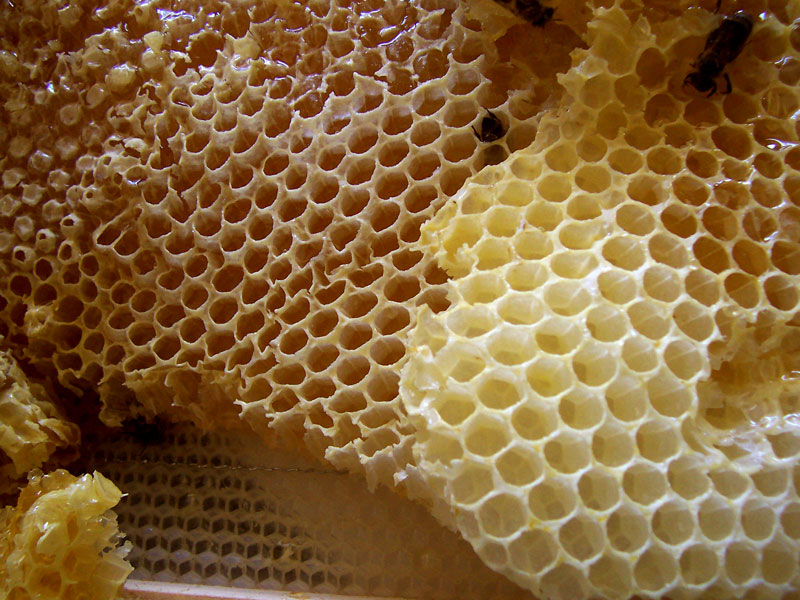
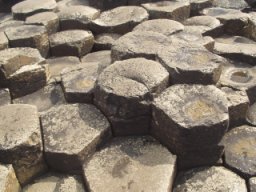
Hexagonal patterns appear frequently because of their efficiency in packing and tiling. Regular hexagons tessellate the plane without gaps, along with equilateral triangles and squares; this property explains their use in paving and tiling (tessellations) and in design where continuous coverage is needed. In nature, the familiar honeycomb is composed of hexagonal cells; see honeycombs in a beehive. Other examples include columnar basalt formations, the hexagonal symmetry of many snowflakes, molecular rings such as benzene in chemistry, and hexagonal lattices like graphene.
History, design, and practical examples
Humans have used hexagonal shapes in mosaics, architecture, and tools because they combine structural strength with efficient use of material. Common mechanical examples include hexagonal bolt heads and nuts, which are easy to grip with wrenches and allow repeated turns. In modern applications hexagonal grids are used in computer graphics, geographic tiling, game boards, and optimization problems where neighborhood connectivity matters.
Notable mathematical facts
Beyond elementary geometry, hexagons appear in tiling theory, crystallography, and graph theory. The ability of the regular hexagon to fill the plane with identical tiles while minimizing perimeter for a given area helps explain its frequent appearance in both natural processes and efficient engineering designs.
Related articles
Author
AlegsaOnline.com Hexagon: Geometry, Properties, and Uses Leandro Alegsa
URL: https://en.alegsaonline.com/art/43995