
Honeycomb
Honeycomb is the wax structure built by honeybees of hexagonal cells used to store honey, pollen and to rear brood. It is notable for its geometry, material properties, and many human uses.
Honeycomb is the name given to the sheetlike array of wax cells produced inside a honeybee colony. It serves as the primary storage and nursery area of the hive: adult bees pack honey and pollen into cells, and the queen lays eggs so larvae develop in brood cells. The familiar regular pattern of six-sided compartments is both practical for bees and widely studied for its geometric efficiency.
Image gallery
10 Images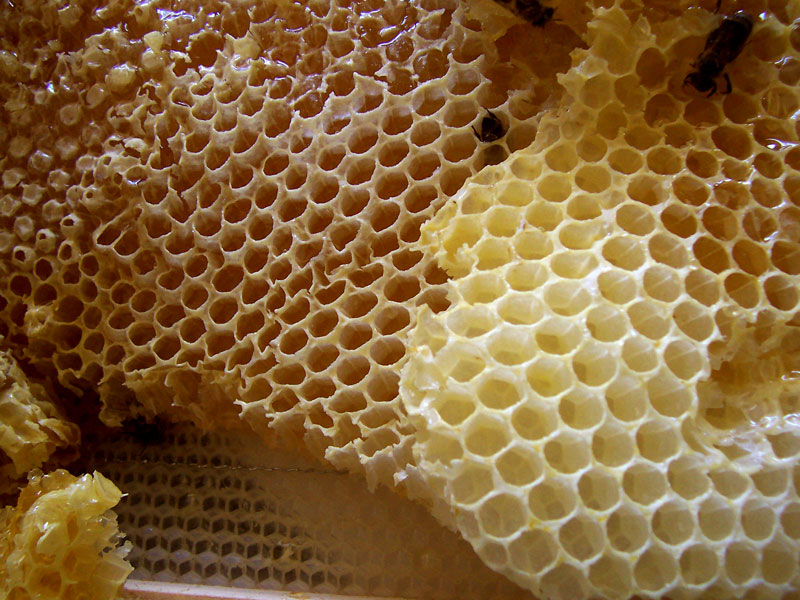


Structure and materials
Individual comb is made from beeswax, a secretion produced by worker bees and shaped by their mandibles. Cells are typically oriented with their openings pointing slightly upward so liquid stores are retained. A single comb contains thousands of hexagonal cells that tessellate without gaps; adjacent layers are supported by pillars and attachment strips. Variations exist: cells used for rearing queens or drones are larger than standard worker cells, and propolis and pollen can alter surface texture.
How bees build and use comb
Construction begins when workers chew wax flakes and deposit them where needed. New comb may form on frames in managed hives or on existing surfaces in wild nests. Bees use cells for several purposes:
- Honey storage: nectar transformed into honey is dehydrated and capped with wax for long-term food reserves.
- Pollen storage: pollen-packed cells provide protein for brood rearing.
- Brood rearing: eggs, larvae and pupae occupy brood cells until maturity.
Further details on bee biology and comb construction are summarized in many beekeeping guides and entomology resources, for example bee anatomy and behavior and practical comb management notes at flower and nectar relationships.
History, human uses and significance
People have harvested honeycomb for millennia. Comb may be eaten directly, pressed for honey, or rendered into beeswax used in candles, cosmetics and polishes. In modern apiculture beekeepers use removable frames so comb can be managed without destroying the colony. Engineers and mathematicians have long admired honeycomb geometry; the idea that hexagons are an efficient tiling for enclosing equal areas with minimal dividing material is a classical result in mathematical optimization.
Notable distinctions and facts
Not all bee species build honeycomb; the term usually refers to the combs of honeybees. Within a hive, combs differ by age and use: older comb tends to darken as it accumulates cocoons and residues. Beekeepers sometimes replace old comb to reduce disease and contamination. For more on wax chemistry and processing see beeswax resources, for methods of harvesting comb consult apiculture guides, and for culinary or conservation perspectives see edible honeycomb information.
Related articles
Author
AlegsaOnline.com Honeycomb Leandro Alegsa
URL: https://en.alegsaonline.com/art/44988