
Hilbert's Grand Hotel paradox: how countable infinity defies finite intuition
A clear explanation of Hilbert's Grand Hotel: its setup, examples, mathematical meaning for countable infinity, historical and pedagogical role, and distinctions from other infinite phenomena.
Hilbert's paradox of the Grand Hotel is a thought experiment that illustrates surprising properties of infinite sets. Framed by the mathematician David Hilbert, it imagines a hotel with rooms numbered by the natural numbers and every room occupied. Despite being "full," the hotel can still accommodate additional guests by using simple reassignments. The scenario is used to explain why infinite quantities behave differently from finite ones and to introduce the notion of one-to-one correspondences in set theory. See a concise discussion of the idea at mathematical paradox.
The setup highlights the difference between finite fullness and infinite cardinality. For ordinary finite hotels, a full house means no more guests can be taken. For a hotel whose rooms correspond to the set of natural numbers, that set is countably infinite: it has the same size as some of its proper subsets. That feature lets the manager create vacant rooms even when each room already holds a guest. For background on the concept of countability, consult countable infinity.
Image gallery
1 Image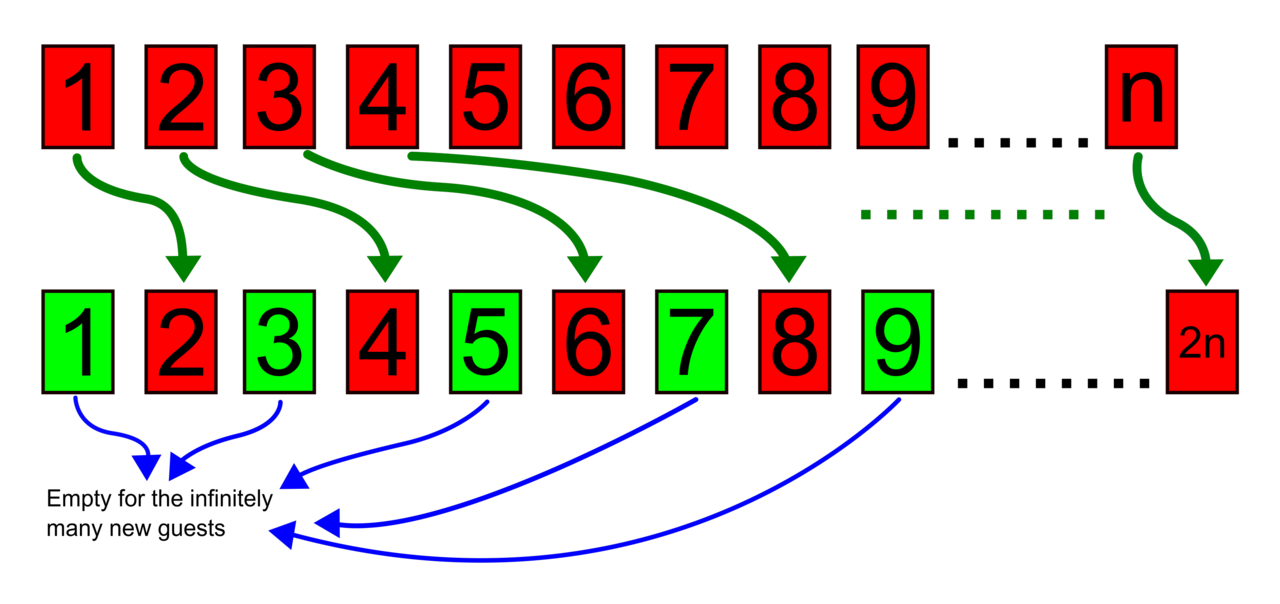
Typical procedures and examples
- One new guest: move each occupant from room n to room n+1, freeing room 1.
- Finitely many new guests: shift every occupant from n to n+k to free k rooms.
- Countably infinite new guests: move occupant n to room 2n (even numbers), leaving all odd-numbered rooms free.
- Infinitely many buses each with infinitely many passengers: enumerate all newcomers by pairs (bus, seat) and assign them to rooms by a standard bijection with the natural numbers.
These maneuvers are concrete demonstrations of bijections between the natural numbers and various infinite collections; they do not rely on paradoxical contradictions but on nonintuitive arithmetic of infinite cardinals. The thought experiment is commonly used in introductions to set theory and to contrast countable sets with larger infinities such as the real numbers, which are uncountable and cannot be placed in one-to-one correspondence with the naturals.
Historically, Hilbert presented the idea as a pedagogical device to make the strangeness of infinity accessible. It remains a standard classroom example because it converts abstract definitions—like injections, surjections, and bijections—into a vivid story. Readers can find accessible expositions and variations at general references on infinity and philosophy of mathematics, for example David Hilbert's educational legacy discussions and surveys of infinite sets at infinity-focused resources.
Important distinctions: Hilbert's hotel illustrates countable infinity specifically. It differs from other famous results about infinity that require additional axioms or counterintuitive decompositions (for example, the Banach–Tarski phenomenon). The hotel relies only on the arithmetic of countably infinite sets and on explicit rearrangements, not on controversial existence statements. For further reading, follow introductory material on infinity and countability at recommended sources: overview, set-theoretic context, and countable examples.
Questions and answers
Q: What is Hilbert's paradox of the Grand Hotel?
A: Hilbert's paradox of the Grand Hotel is a mathematical paradox named after the German mathematician, David Hilbert.
Q: What was Hilbert's purpose for using the paradox of the Grand Hotel?
A: David Hilbert used Hilbert's paradox of the Grand Hotel as an example to show how infinity does not act in the same way as regular numbers do.
Q: Who is David Hilbert?
A: David Hilbert was a German mathematician.
Q: Does infinity act like regular numbers?
A: Infinity does not act in the same way as regular numbers do.
Q: What is the paradox of Hilbert's paradox of the Grand Hotel?
A: The paradox of Hilbert's paradox of the Grand Hotel is that a hotel with an infinite number of rooms can still accommodate more guests, even if all of its rooms are occupied.
Q: What is the significance of Hilbert's paradox of the Grand Hotel?
A: The significance of Hilbert's paradox of the Grand Hotel is that it highlights the differences between finite and infinite sets, and the peculiar ways in which infinity behaves.
Q: What is the mathematical world's view on Hilbert's paradox of the Grand Hotel?
A: Hilbert's paradox of the Grand Hotel is widely known and respected in the mathematical world as a significant example of the paradoxical nature of infinity.
Related articles
Author
AlegsaOnline.com Hilbert's Grand Hotel paradox: how countable infinity defies finite intuition Leandro Alegsa
URL: https://en.alegsaonline.com/art/44187
Sources
- books.google.com : Hilbert's paradox of the Grand Hotel