
Haast's eagle — the giant apex raptor of New Zealand
Haast's eagle (Harpagornis/Hieraaetus moorei) was a very large, forest-adapted raptor endemic to New Zealand’s South Island that preyed on moa and became extinct after human arrival.
Overview
Haast's eagle is the common name for a very large extinct bird of prey often referred to by the scientific name Harpagornis moorei (sometimes placed in the genus Hieraaetus). It was endemic to New Zealand and is widely regarded as the largest eagle known from the fossil record. Unlike most modern eagles, Haast's eagle occupied the role of the top predator in its environment and specialized on large, flightless birds rather than small mammals.
Image gallery
7 Images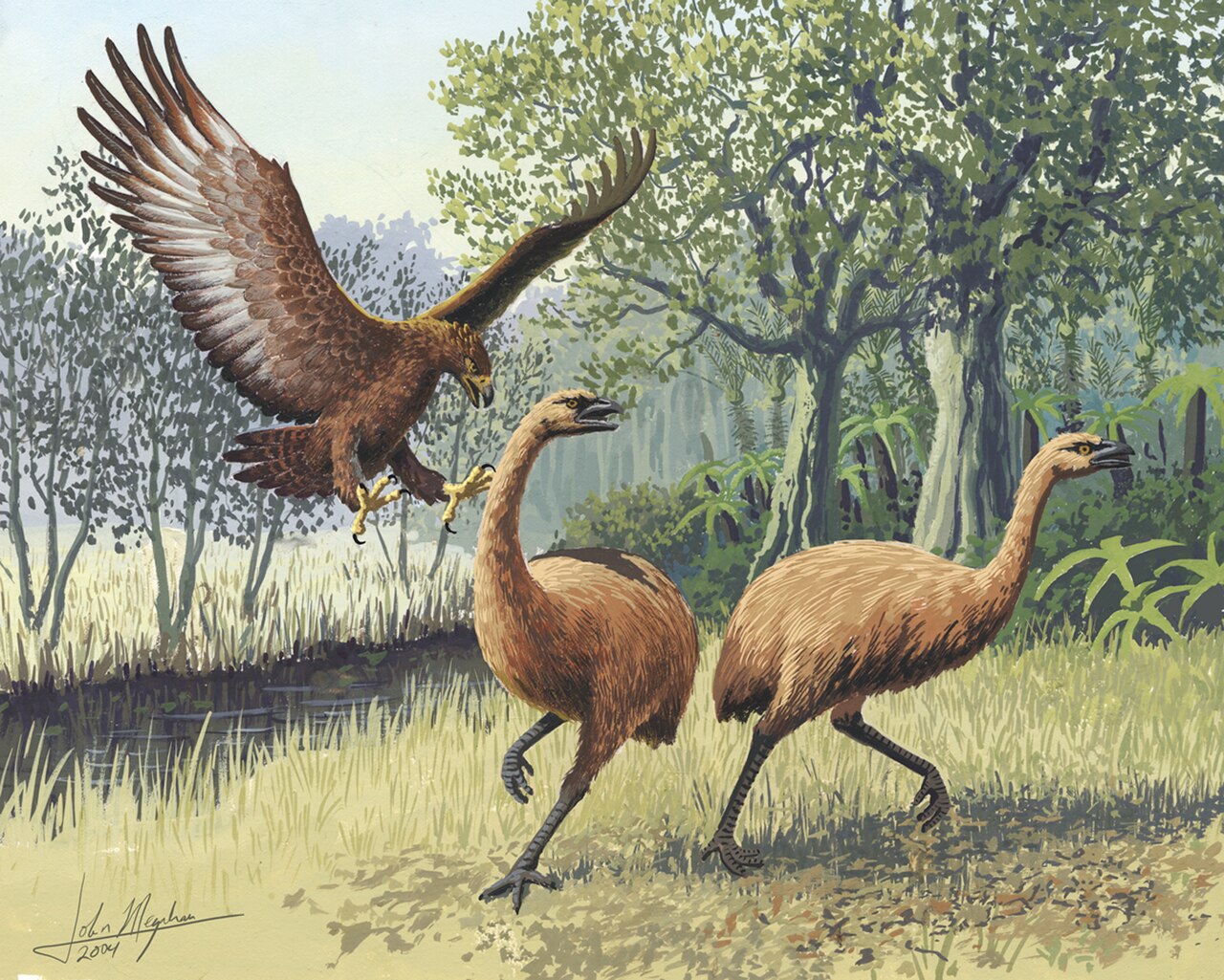


Appearance and adaptations
This eagle possessed a compact, powerful build: a large skull, muscular neck, and stout legs ending in massive talons. Its wings were relatively short and broad compared with soaring raptors, an adaptation that would have aided maneuvering through forested terrain. Paleontological studies suggest it relied on ambush tactics and the force of its feet and beak to kill or incapacitate prey much larger than itself.
Diet and ecological role
Haast's eagle specialized in hunting the island's giant flightless birds. It is the only eagle known to have functioned as the apex predator of its ecosystem; its principal prey were species of moa. This ecological role was possible because pre-human New Zealand lacked terrestrial mammalian carnivores, allowing a raptor to exploit large avian herbivores as a food resource.
Range and habitat
Fossils indicate the species was native to the South Island of New Zealand, where it occupied forests, scrub and floodplain grasslands. Many finds come from deposits that represent woodland and riverine areas, suggesting a preference for habitats that supported large moa populations. The bird’s anatomy—short, broad wings and strong legs—matches an ambush predator adapted to wooded and broken terrain rather than open-ocean soaring.
Discovery, naming and evolutionary context
The eagle was named in the 19th century after the geologist Julius von Haast, who described the first subfossil bones. Researchers interpret its evolution as an example of island gigantism: a raptorial lineage becoming much larger than its relatives in response to abundant large prey and the absence of mammalian competitors. Its closest relatives appear to have been smaller eagles from which it diverged while adapting to New Zealand’s unique fauna.
Extinction and cultural legacy
The arrival of humans led to rapid environmental change. By the time people colonized New Zealand, large tracts of forest habitat were altered or cleared and the eagle’s primary prey were hunted or reduced in number. As forests were burned and moas disappeared, Haast's eagle populations declined and the species became extinct by around the end of the prehistoric period. The story is often cited as a clear example of how human-driven habitat loss and overhunting can eliminate specialized predators.
Notable facts and distinctions
- It is considered the largest eagle known from subfossil remains and one of the few raptors that occupied the ecological niche of an apex terrestrial predator.
- Its presence illuminates how island ecosystems can produce unusual predators when typical mammalian roles are unfilled.
- Subfossil material continues to inform debates about its exact size, taxonomy and hunting behavior, and archaeological study ties its extinction closely to human impacts.
For further reading and specimen records, consult curated databases and museum collections that hold subfossil bones and research papers on New Zealand’s megafauna. Related ecological topics include island gigantism and the consequences of introducing humans to isolated ecosystems. Additional resources: species overview, ecological role, habitat of floodplains, and regional natural history portals at New Zealand sites.
Related articles
Author
AlegsaOnline.com Haast's eagle — the giant apex raptor of New Zealand Leandro Alegsa
URL: https://en.alegsaonline.com/art/41659