
Hallucigenia — Cambrian lobopodian genus
Hallucigenia is an extinct genus of small, soft-bodied Cambrian animals known from Burgess Shale and Chengjiang fossils; once baffling, it is now seen as a lobopodian related to early panarthropods.
Hallucigenia is an extinct genus of small, soft-bodied animals known from exceptionally preserved Cambrian fossil beds. Specimens are best known from the Middle Cambrian Burgess Shale deposits of western Canada, and similar material has been described from Lower Cambrian sites in China. Because of its unusual appearance and preservation, Hallucigenia has been important in debates about early animal evolution and the anatomical experiments of the Cambrian explosion. Genus overview and general context are often summarized in field guides and museum treatments; it is broadly treated as an enigmatic animal rather than a typical arthropod or worm classification note.
Image gallery
10 Images


Morphology and anatomy
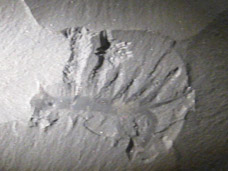
Fossils show an elongated, tubular body bearing a series of repeating units. One side of the body carries a row of rigid, needle-like dorsal spines, while the opposite side bears multiple pairs of soft, lobopodous limbs that end in tiny claws. Each limb was unjointed and fleshy, resembling the lobopods of modern velvet worms in general plan. The spines were likely rigid structures providing deterrence against predators, but their exact composition is uncertain. Many reconstructions emphasize the paired nature of the ventral limbs and the protective function of the dorsal spines.
- Size: generally a few centimeters long in known specimens.
- Appendages: several pairs of clawed, fleshy legs (lobopods).
- Dorsal armature: long, spine-like structures that protruded above the body.
Discovery and reinterpretation
The first well-publicized reconstructions of Hallucigenia presented the animal in a way that later proved to be upside-down: early authors interpreted the spines as legs and the soft appendages as dorsal tentacles. That bizarre reading contributed to its popular name and to discussions by writers such as Stephen Jay Gould, who used the taxon as an example of the strange morphologies of Cambrian animals. Subsequent detailed reexamination of multiple specimens corrected the orientation and clarified that the clawed lobopods were ventral walking limbs and the long spars were dorsal defensive structures. Additional related forms from Chinese Lagerstätten expanded the range of known morphologies in this group and helped confirm the reinterpretation (Maotianshan shale material and related reports).
Relationships and classification
Hallucigenia is now placed among the lobopodians, a paraphyletic assemblage of soft-bodied animals that share similarities with modern onychophorans (velvet worms) and with panarthropods more generally. Modern paleontologists consider it to be part of the early radiation of panarthropods — the broader group that includes arthropods, onychophorans, and tardigrades — rather than an isolated evolutionary experiment unrelated to living lineages. This interpretation rests on characters such as paired, clawed appendages and body segmentation that echo features seen in related Cambrian taxa and in the ancestors of later arthropods and velvet worms. For a general comparison to living taxa, see resources on velvet worms and their anatomy.
Paleobiology and significance
Hallucigenia likely lived on the seafloor as a slow-moving crawler, using its lobopods to navigate soft substrates and possibly to capture small prey or scavenge. The dorsal spines probably functioned as passive protection against predators that were diversifying rapidly during the Cambrian. Its preservation in Burgess Shale-type deposits—where soft tissues are occasionally retained—has allowed paleontologists to study fine anatomical details that would otherwise be lost.
Key points that make Hallucigenia notable include its role as an illustration of how fossil interpretation can change with new specimens and methods, and its contribution to understanding the diversity of lobopodians and the early evolution of panarthropods. Museum exhibits and educational treatments often mention this taxon when discussing the Burgess Shale and the Cambrian explosion; illustrations and specimen photographs are widely available from institutional collections and summaries (Cambrian context, Burgess Shale resources). Further reference material is available through regional geological surveys and paleontological reviews (British Columbia collections, Canadian research), while comparative material from Asia is summarized in papers and catalogs linking to Chinese Lagerstätten sites (additional species notices).
Questions and answers
Q: What is Hallucigenia?
A: Hallucigenia is an extinct genus of animal that was found as fossils in the Middle Cambrian Burgess Shale formation of British Columbia, Canada.
Q: Where else has Hallucigenia been found?
A: Another species of Hallucigenia has been found in the Lower Cambrian Maotianshan shale of China.
Q: What did Stephen Jay Gould think about Hallucigenia?
A: Stephen Jay Gould believed that Hallucigenia was unrelated to any living species.
Q: What do most palaeontologists now believe Hallucigenia was?
A: Most palaeontologists now believe that Hallucigenia was a velvet worm, a relative of modern arthropods.
Q: How does Hallucigenia differ from Aysheaia?
A: Unlike its contemporary Aysheaia, Hallucigenia's elongated and clawed legs bear little resemblance to the paired annulated legs of the Onychophora.
Q: What is unknown about Hallucigenia?
A: It is unknown what the spines on Hallucigenia were made of or how much protection they offered. It is also unknown why 30 or more specimens, each thought to have seven pairs of rather long, flexible legs, do not show even one example of paired legs.
Q: Where can you see a picture of Hallucigenia?
A: A picture of a reconstruction of Hallucigenia as well as a photograph of an actual fossil can be seen on the Geological Survey of Canada's website.
Related articles
Author
AlegsaOnline.com Hallucigenia — Cambrian lobopodian genus Leandro Alegsa
URL: https://en.alegsaonline.com/art/41956
Sources
- geology.cz : "A new species of Hallucigenia from the Cambrian Stage 4 Wulongqing Formation of Yunnan (South China) and the structure of sclerites in lobopodians"
- doi.org : 10.3140/bull.geosci.1280
- discovermagazine.com : "Whose View of Life?"
- gsc.nrcan.gc.ca : Past lives: Chronicles of Canadian Paleontology: the Hallucigenia flip