
Hadrosaurus (Hadrosaurus foulkii)
Hadrosaurus foulkii is an early-discovered duck-billed dinosaur from the Upper Cretaceous of eastern North America, notable for its historical mounted skeleton and for taxonomic uncertainty because the type lacks a skull.
Overview
Hadrosaurus (type species Hadrosaurus foulkii) is a genus of duck-billed dinosaur placed among the hadrosaurid ornithopods. Known primarily from postcranial bones recovered in eastern North America, it exemplifies the heavy-bodied, broad-hipped build typical of hadrosaurs and is interpreted as a herbivore capable of both bipedal and quadrupedal locomotion. The taxon is usually treated as the name-bearing genus for the original material but remains central to debates about early North American hadrosaur diversity.
Image gallery
10 Images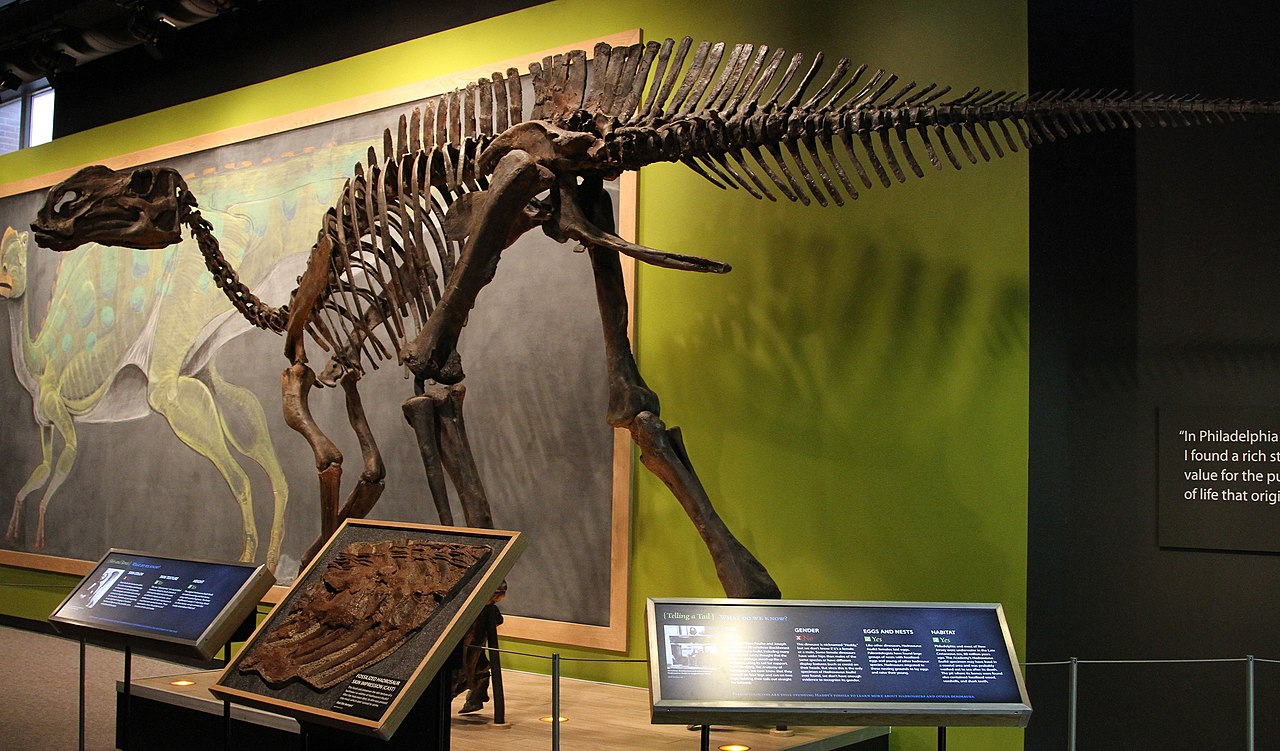


Discovery and historical importance
The principal specimen was discovered in New Jersey in the mid-19th century and described by Joseph Leidy. Its discovery—often associated with Haddonfield and the work of William Parker Foulke—led to one of the earliest public mounts of a dinosaur skeleton, a reconstruction that played a formative role in museum displays and in popular understanding of prehistoric life. The fossils came from deposits of the Upper Cretaceous and were among the first relatively complete dinosaur remains found in the United States.
Anatomy and classification
The known elements include vertebrae, pelvis, limb bones and parts of the shoulder girdle. These show the robust limbs and broad pelvic structure used to infer feeding behavior and locomotion. Like other hadrosaurs, Hadrosaurus is thought to have had complex tooth batteries suited to grinding plant material, although the lack of a complete cranium prevents direct comparison of cranial crest or snout features that commonly diagnose hadrosaur species. For general taxonomic context see broader hadrosaurid summaries and relevant species literature.
Taxonomic uncertainty
Because the type specimen lacks an associated skull, some researchers consider Hadrosaurus difficult to distinguish from closely related genera; in modern reviews it is sometimes treated with caution or described as a nomen dubium. The missing cranial material remains the principal obstacle to resolving its precise relationships—this limitation is discussed in comparative studies of the skull and postcranial anatomy of hadrosaurs.
Cultural legacy
Hadrosaurus has enduring cultural importance: it is the official state dinosaur of New Jersey and a symbol of early paleontological discovery in North America. Reconstructions and casts continue to appear in museums and educational materials, contributing to public interest in Cretaceous ecosystems and the history of science. For regional and institutional resources see state and museum references (state and cultural) and accessible summaries (species pages or genus accounts).
- Type species: Hadrosaurus foulkii
- Age: Upper Cretaceous
- Locality: Eastern North America (New Jersey)
- Significance: Early mounted dinosaur and influence on museum exhibits
- Research caveat: No skull included with the type material; taxonomic status debated (see skull issue)
Related articles
Author
AlegsaOnline.com Hadrosaurus (Hadrosaurus foulkii) Leandro Alegsa
URL: https://en.alegsaonline.com/art/41727