
Group 3 (periodic table)
Group 3 is a column of the periodic table containing scandium and yttrium plus two elements whose placement (lanthanum/actinium or lutetium/lawrencium) is debated.
Overview
Group 3 is one of the 18 vertical groups in the modern periodic table and occupies the left-hand edge of the d-block. It is conventionally associated with early transition-metal chemistry and with the start of the lanthanide and actinide series. For context see the periodic table.
Image gallery
4 Images
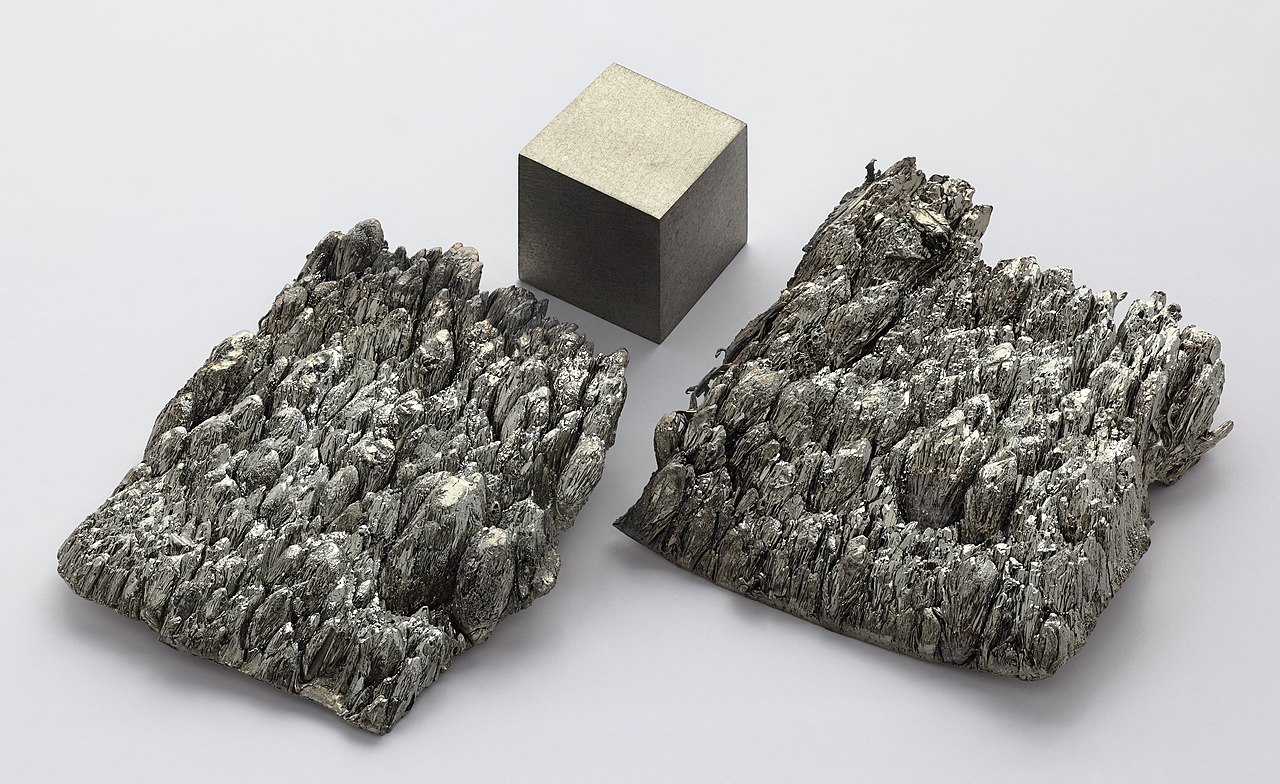


Members and competing placements
All standard representations agree that scandium and yttrium belong to Group 3. The identities of the other two positions are treated differently by different sources. Two alternative sets are commonly listed:
- lutetium and lawrencium (placing the heavy members of the f-block at its end)
- lanthanum and actinium (placing the lighter f-block elements with the group)

Characteristics
Elements assigned to Group 3 are generally metallic with metallic luster, good electrical conductivity and typical oxidation states that include +3. Their chemistry shows links to both the transition metals and to the lanthanide/actinide families: scandium and yttrium behave as small, hard metals often forming X3+ ions, while the contested third and fourth members differ in size and f-electron behavior depending on which pair is chosen.
History and classification issues
The question of whether lanthanum and actinium or lutetium and lawrencium should complete Group 3 is longstanding. The ambiguity arises from how one chooses to arrange the f-block and from differing emphasis on electron configuration, historical convention, and chemical behavior. Various textbooks and periodic-table designs adopt different conventions; international committees have recommended particular placements at times, but variants persist in educational and reference materials.
Uses and significance
Members of Group 3 and the closely related f-block elements are important in industry and technology. Scandium is used in lightweight alloys and some aerospace applications, yttrium appears in phosphors and superconductors, lutetium finds niche use in catalysts and medical imaging, and lawrencium is known only as a synthetic element studied in laboratories. Their economic and scientific roles link fundamental periodic classification with practical applications.
Notable facts and distinctions
The placement debate for Group 3 illustrates wider issues in periodic classification: whether to prioritize electronic configuration patterns, chemical similarity, or pedagogical clarity. Different periodic tables you encounter may therefore list lanthanum and actinium or lutetium and lawrencium alongside scandium and yttrium. 

Related articles
Author
AlegsaOnline.com Group 3 (periodic table) Leandro Alegsa
URL: https://en.alegsaonline.com/art/41048