
Group transfer reaction
A pericyclic process in which a sigma bond migrates as a pi bond is converted to a sigma bond; the ene reaction is the archetype with broad synthetic and mechanistic significance.
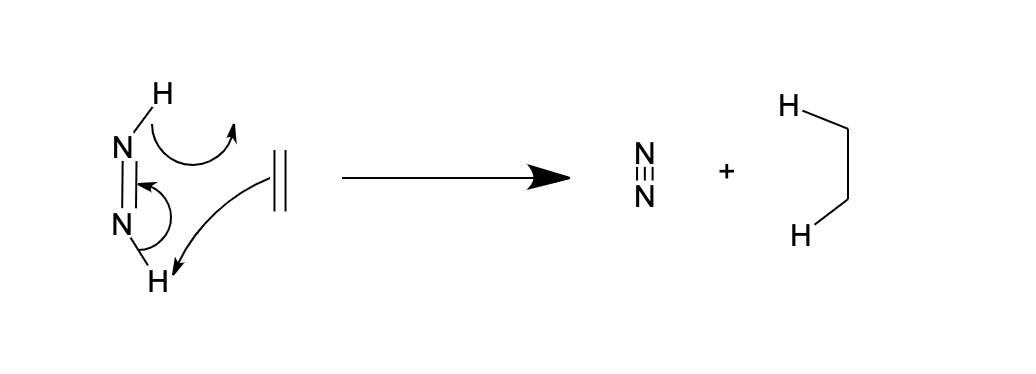
A group transfer reaction is a class of pericyclic process in which timing and orbital interactions allow one pi bond to be converted into a new sigma bond while a different sigma bond migrates to a new position. These reactions proceed through a cyclic, concerted transition state and are governed by the same orbital-symmetry considerations that control other pericyclic reactions. The best-known example of this family is the ene reaction.
Image gallery
4 Images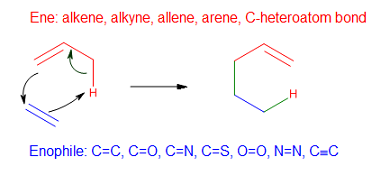


Mechanism and defining features
In a typical group transfer event the migrating unit can be a hydrogen (most common), an alkyl, an acyl or a silyl group. The classic ene reaction involves an alkene bearing an allylic hydrogen (the "ene") and an electron-poor multiple bond (the "enophile"). During the concerted rearrangement the allylic hydrogen transfers to the enophile while a new sigma bond forms between the formerly pi-bonded atoms.
Common characteristics
- Concerted, pericyclic pathway with a cyclic transition state.
- Stereospecific outcomes are typical, reflecting orbital symmetry constraints.
- Thermally allowed in many cases; photochemical or catalyzed variants also exist.
- Can be intra- or intermolecular; intramolecular versions often show higher selectivity.
Applications and examples
Group transfer reactions are useful for constructing C–C and C–heteroatom bonds with good atom economy. The ene reaction and its variants are applied in natural product synthesis, polymer chemistry and functional-group installation. Related processes include retro-ene reactions (the reverse transformation) and metal- or Lewis-acid-catalyzed variants that lower activation barriers and enable enantioselective control.
Distinctions and significance
Although group transfer reactions transfer a sigma-bonded fragment like some sigmatropic rearrangements, they differ in connectivity changes and orbital pathways. Their concerted nature links them closely to other pericyclic classes (cycloadditions, electrocyclic reactions), but the hallmark is the simultaneous conversion of a pi bond into a sigma bond accompanied by migration of a sigma-bonded group. This behavior makes them a distinct and versatile tool in synthetic organic chemistry.
Related articles
Author
AlegsaOnline.com Group transfer reaction Leandro Alegsa
URL: https://en.alegsaonline.com/art/41054