
Scandium: properties, occurrence, uses and history
Scandium (Sc, atomic number 21) is a silvery transition metal found in trace amounts worldwide; valued for aluminium alloys, specialty lighting and niche high-tech uses despite limited supply.
Scandium is the chemical element with symbol Sc and atomic number 21. It lies among the lighter elements of the periodic table and is classified as a transition metal while often being associated with the rare-earth elements because of its geochemical behavior and typical co-occurrence with lanthanides and yttrium. In metallic form scandium is silvery-white, relatively light for a transition metal and develops an oxide layer on exposure to air.
Image gallery
3 Images
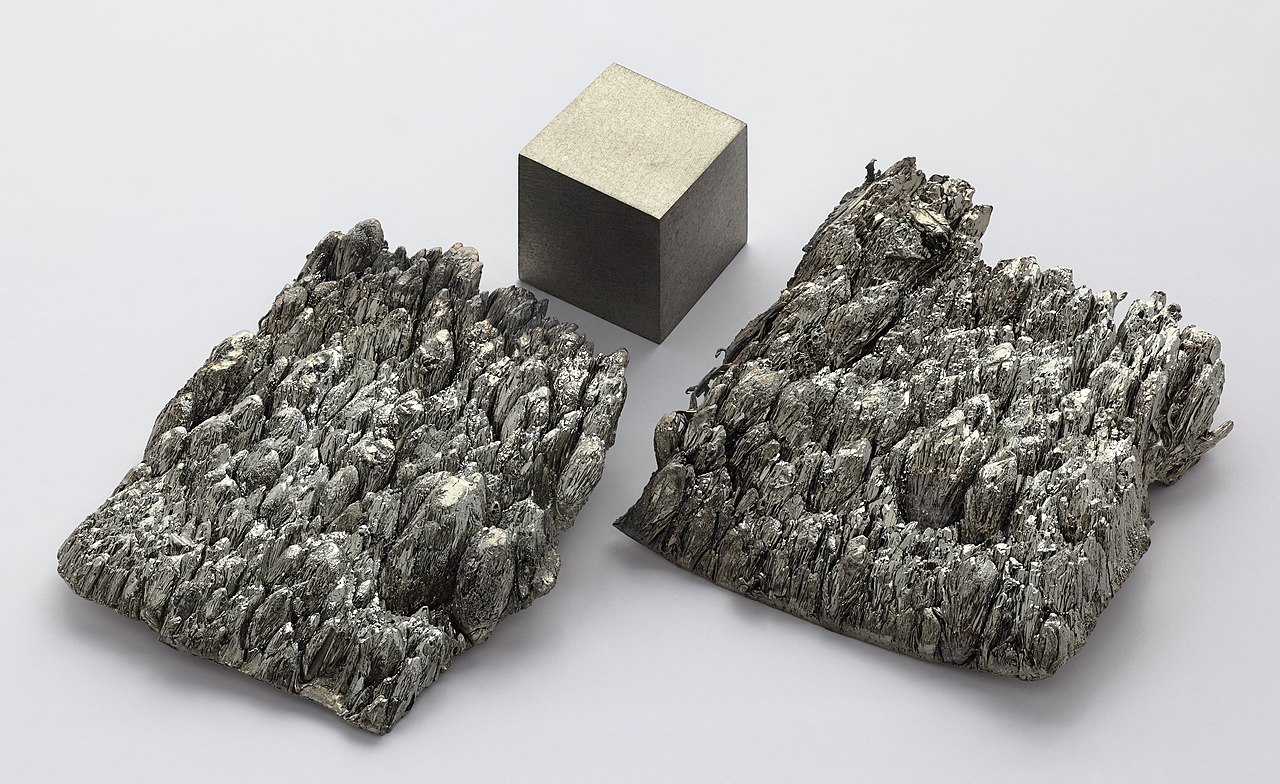

Physical and chemical characteristics
Scandium shows the metallic bonding and general chemistry of transition metals but with notable affinities to the lanthanide series. It commonly forms a stable oxide, scandium(III) oxide, which is an inert ceramic material. The element has a single stable isotope in nature, 45Sc. Chemically, scandium is trivalent in most of its compounds and reacts with nonmetals such as oxygen to form oxides; it also forms halides and complexes in solution.
Occurrence and production
Scandium is widely distributed in the Earth's crust but only in trace amounts and rarely in concentrated ores. It is most commonly recovered as a by-product of processing ores containing uranium, zirconium, titanium or rare-earth elements and occurs in minerals such as thortveitite and in complex rare-earth-bearing minerals. Commercial scandium comes mainly from co-production and from small-scale recovery efforts, which contributes to its relatively limited supply and higher market cost.
History and naming
The element was discovered in the late 19th century from minerals sourced in Scandinavia and named for that region. Early isolations and study established its position in the periodic table and clarified its chemical relationships with neighbouring elements.
Applications
Despite its scarcity, scandium has several specialist applications where small amounts produce disproportionate benefits:
- Aluminium-scandium alloys: Small additions of scandium to aluminium alloys improve strength, resistance to recrystallization and weldability. These microalloys are valued in aerospace components, high-performance sports equipment and other situations requiring a high strength-to-weight ratio.
- Lighting: Scandium compounds are used in certain metal-halide and high-intensity discharge lamps, helping to produce a light spectrum close to natural daylight. Such lamps are used in film and photography, as well as for large-area illumination such as stadiums. Scandium salts have been used in some mercury-vapor lamps and related lighting technologies.
- Electronics and catalysts: Research continues into the use of scandium-containing materials in electronics, laser hosts and as catalysts in specialized chemical reactions. Its role is typically niche and driven by performance rather than volume.
Supply, economics and safety
The limited concentration of scandium in primary ores and its frequent recovery as a by-product mean that supply is sensitive to the economics of related mining industries. Recycling and recovery from industrial wastes are increasingly important to secure supplies. Scandium metal and compounds are handled under standard industrial safety practices; powdered forms can present inhalation hazards, and compounds should be managed to minimize dust and environmental release. Overall, scandium is not a common toxic risk to the general public because of its scarcity.
Further context
For general reference on the element see resources and overview pages on Scandium and the modern periodic table. Its position among the transition metals combined with its rare-earth affinities helps explain both its specialized uses and the challenges of obtaining it in commercial quantities. Ongoing research aims to expand applications while improving methods of recovery and recycling to reduce cost and dependence on co-production sources.
For practical examples of applications and industrial contexts, consult materials on specialty lighting such as mercury-vapor and metal-halide lamps and accounts of large-scale illumination projects like stadiums, which illustrate why certain niche elements remain important despite low natural abundance.
Related articles
Author
AlegsaOnline.com Scandium: properties, occurrence, uses and history Leandro Alegsa
URL: https://en.alegsaonline.com/art/87766