
Gunshot residue (GSR): formation, detection, forensic use, and limitations
Gunshot residue (GSR) consists of particles produced when a firearm is discharged. This article explains its composition, sampling and analytical methods, forensic applications, persistence, and interpretive limits.
Overview — Gunshot residue (GSR) refers to solid particles and vaporized material produced when a firearm is fired. These particles originate from the primer, propellant and the firearm itself and can settle on the shooter, nearby surfaces, clothing and victims. Forensic investigators use GSR to help answer whether a person fired, handled or was close to the discharge of a weapon, but interpretation requires care because residues move, degrade and may come from other sources.
Image gallery
3 Images

Composition and formation
When a cartridge is fired, the primer ignites and the propellant burns, producing hot gases that propel the projectile. Particulates include partially burned and unburned powder, primer-derived metallic and inorganic compounds, and microscopic fragments of the cartridge and barrel. Traditional, widely recognized signature elements in many residues are lead, barium and antimony, associated with conventional primers; however, modern and lead-free ammunition can produce different elemental profiles and organic compounds.
Sampling and laboratory analysis
Common field sampling methods include adhesive stubs applied to the hands or clothing and cotton or polyester swabs. In the laboratory, two main approaches are used: rapid chemical screening tests (for example, colorimetric tests that indicate nitrites or nitrates, or tests for specific metals) and instrumental methods. Scanning electron microscopy with energy-dispersive X-ray spectroscopy (SEM-EDX) is widely regarded as a confirmatory technique because it images individual particles and provides elemental composition data. Other techniques include atomic absorption, mass spectrometry and specialized organic analyses for powder residues.
Persistence and transfer — GSR particles are typically present in highest concentrations immediately after discharge and decline over time. Normal activities (hand washing, rubbing, movement) and environmental factors reduce or remove residues within hours to days. Secondary transfer—picking up particles from contaminated surfaces—can produce deceptive findings, so context, timing and corroborating evidence matter for reliable interpretation.
Forensic applications and limitations
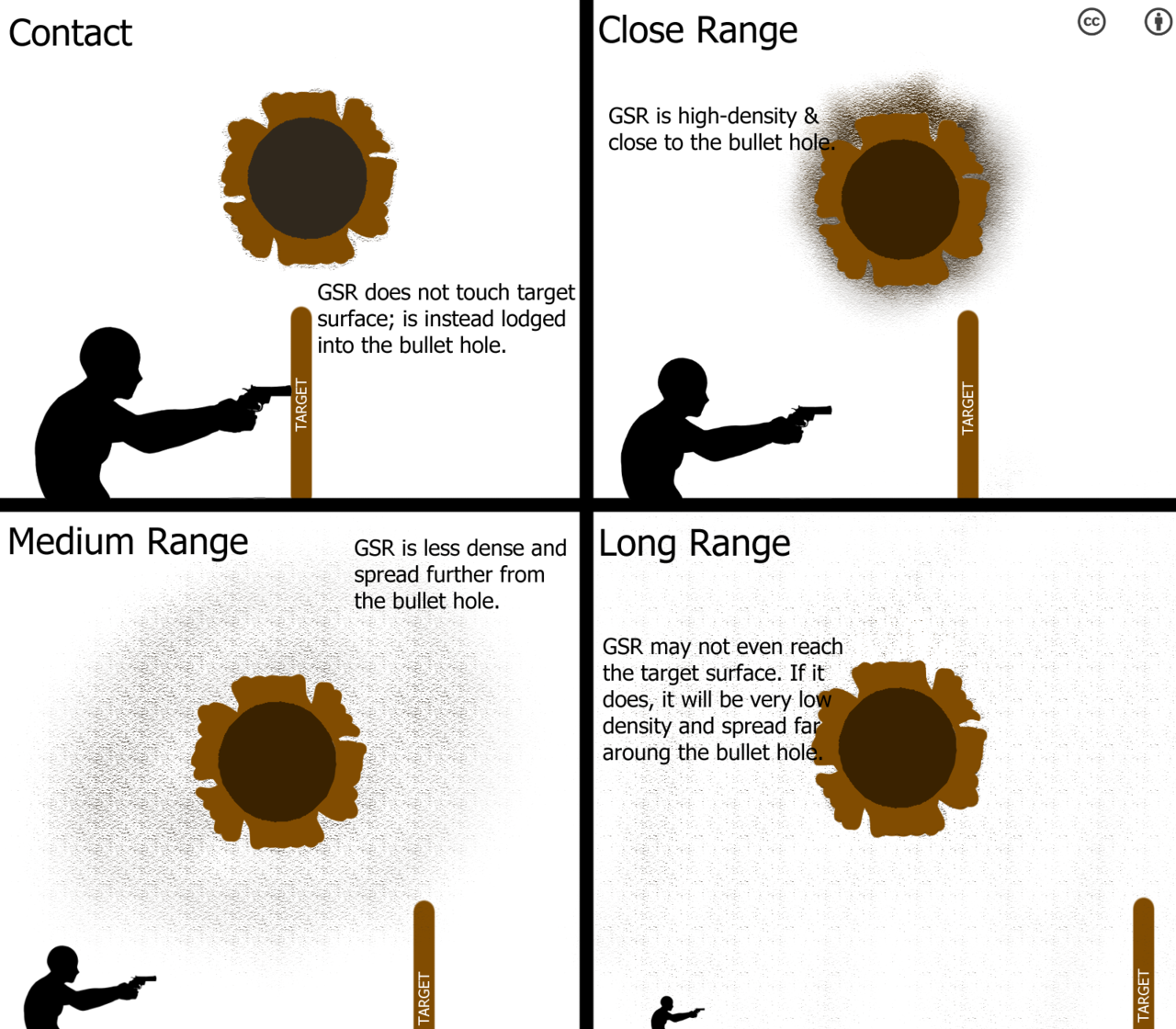
Investigators use GSR evidence to support or refute claims about who fired a weapon, how close a shot was, or whether a person handled ammunition. Patterns such as soot, stippling and residue distribution on clothing or a wound can help estimate range and orientation. Limitations include non-uniqueness of elemental signatures (different ammunition and industrial sources can overlap), the rise of lead-free primers that change expected markers, and the possibility of secondary transfer or contamination during recovery and analysis.
History and practice notes — Early forensic GSR work relied on simple chemical tests; later, SEM-EDX provided particle-level confirmation and became a standard in many jurisdictions. Ongoing developments include methods tuned to modern primer chemistries and improved protocols for sampling, chain of custody and interpretation. Courts and investigators increasingly emphasize combined lines of evidence rather than sole reliance on GSR.
Further reading and resources
- Introduction to gunshot residue
- Projectile and ballistic basics
- Firearm components and barrel behavior
- Gases and combustion products from firearms
- Burned and unburned powder particles
- Ammunition propellants and composition
- Metallic contributions in GSR
- Primer and cartridge case materials
- Lead as a GSR component
- Barium in primer residues
- Antimony and elemental markers
- Sampling the skin for residues
- Clothing evidence and pattern analysis
- GSR in wound analysis and range estimation
- Victim and scene considerations
For practitioners and readers, the key considerations are proper, documented sampling, selection of appropriate analytical methods for the ammunition involved, and cautious interpretation that accounts for transfer, persistence and alternative sources.
Questions and answers
Q: What is gunshot residue (GSR)?
A: Gunshot residue (GSR) is a byproduct of firing a gun that includes burned and unburned particles of gunpowder, as well as traces of metal from the firearm, ammunition, and primer, including lead, barium, and antimony.
Q: Where is GSR typically found?
A: GSR is typically found on the skin and clothing of the person who fired the gun.
Q: Can GSR be found in the entrance wound of a victim?
A: Yes, GSR may also be found in the entrance wound of the victim, depending on how close the victim was to the gun when it was fired.
Q: What are the signature components of GSR?
A: The signature components of GSR are lead, barium, and antimony.
Q: What gases accompany a bullet when it leaves the barrel of a firearm?
A: When a bullet leaves the barrel of a firearm, it is accompanied by gases that include both burned and unburned particles of gunpowder.
Q: What contributes to GSR?
A: Traces of metal from the firearm, ammunition, and primer including the signature components of GSR: lead, barium and antimony contribute to GSR.
Q: Is GSR only found on the skin and clothing of the shooter?
A: No, GSR may also be found in the entrance wound of the victim.
Related articles
Author
AlegsaOnline.com Gunshot residue (GSR): formation, detection, forensic use, and limitations Leandro Alegsa
URL: https://en.alegsaonline.com/art/41449
Sources
- forensicmag.com : "The Science Behind GSR: Separating Fact from Fiction"
- library.med.utah.edu : "Examination of Gunshot Residue"
- dps.mn.gov : "Gunshot Residue Collection"
- crime-scene-investigator.net : "A "Hands On" Approach to Understanding Gunshot Residue"
- leb.fbi.gov : "The Current Status of GSR Examinations"
- acs.org : "Crime Scene Investigations: Gunshot residue analysis on a single gunpowder particle"
- oag.ca.gov : "Gunshot Residue (GSR) Collection"