
George Washington Bridge
A double-deck suspension bridge spanning the Hudson River, linking Manhattan (New York City) to Fort Lee, New Jersey; opened 1931 with a second deck added in 1962.
Overview: The George Washington Bridge is a major vehicular suspension span that crosses the Hudson River. It links the Washington Heights neighborhood of New York City, New York, to Fort Lee, New Jersey. Commonly abbreviated the GWB, the structure serves as a critical link in the regional highway network and is one of the busiest motor-vehicle bridges in the United States. Its prominence stems from both its traffic capacity and its visible position between the Palisades cliffs and Manhattan.
Image gallery
10 Images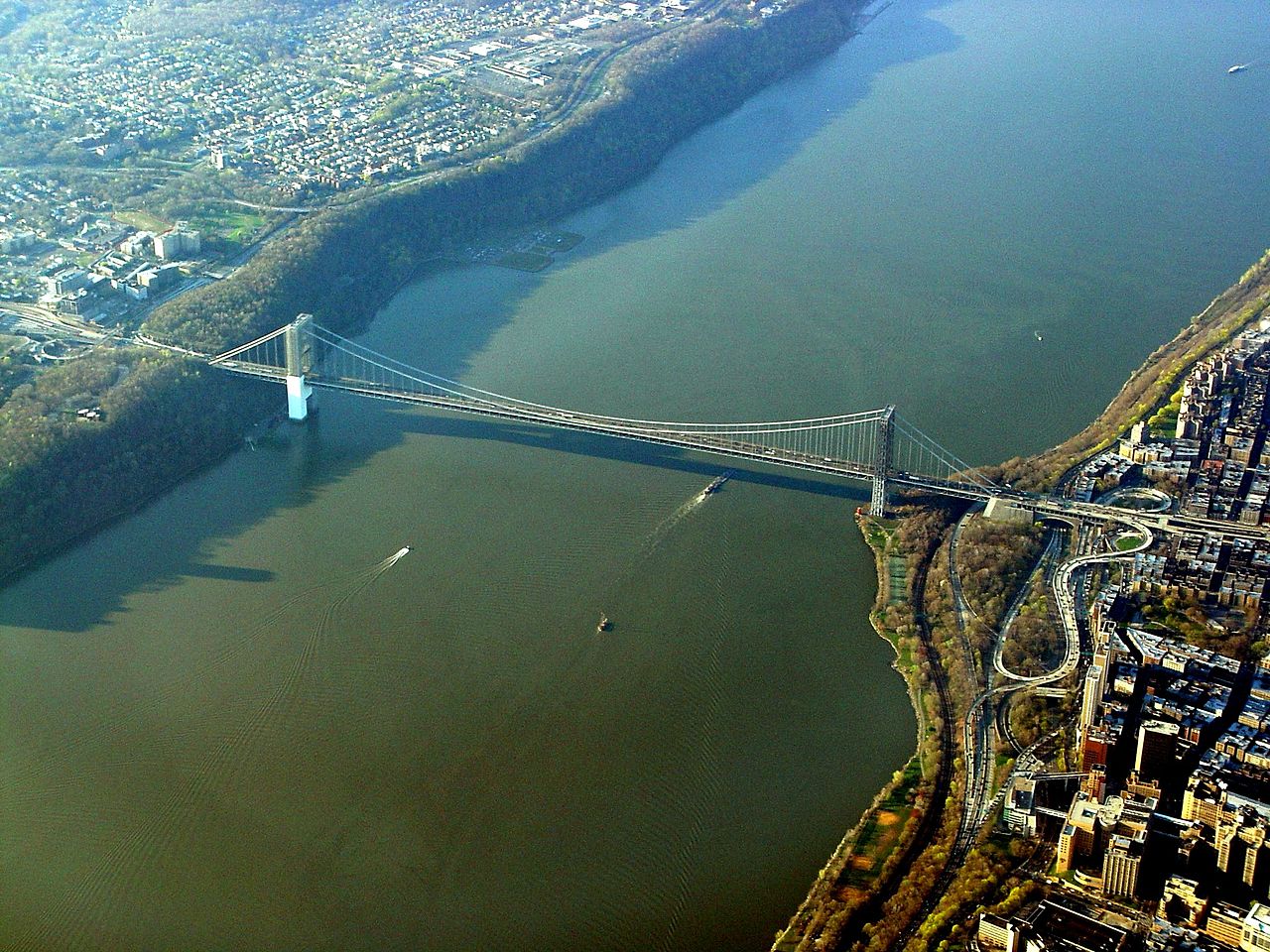


Design and construction
The bridge was designed by the engineer Othmar H. Ammann as a classic suspension bridge; the type is appropriate for long, unobstructed spans and is noted for its towers, main cables and suspended deck system (suspension bridge). Construction began in late 1927 and the first deck opened on October 25, 1931. A lower deck was built beneath the original roadway and opened to traffic on August 29, 1962, creating a double-deck crossing that substantially increased vehicle capacity.
Key milestones and figures are frequently cited: the bridge's total length is approximately 4,750 feet (about 1,450 meters), while its longest unsupported span measures about 3,500 feet. The deck width is roughly 119 feet. The main suspension system comprises four principal cables, each assembled from many individual steel wires; the combined length of those wires has been described in popular accounts as around 107,000 miles of wire (about 172,200 kilometres).
Characteristics and features
- Type: Suspension bridge with twin decks after 1962.
- Spans: Main span ~3,500 ft; total length 4,750 ft (1,450 m).
- Cables: Four main cables formed from many thousands of wires and high-capacity anchorages.
- Pedestrian and bicycle access: Walkways on the north and south sides permit pedestrians and bicyclists to cross with views of both shores.
- Setting: The bridge sits where the Hudson is relatively narrow and the surrounding banks are high — the Palisades geological formation is a notable local landmark (Palisades Sill).
History and context: The choice of the crossing site reflected practical engineering concerns: high banks reduced the length of approach ramps and allowed the roadway to provide adequate vertical clearance for oceangoing vessels. The original project cost, timeline and later addition of a lower deck illustrate how the bridge was planned for growth in traffic. Since opening, it has been integral to interstate commerce and daily commuting between New Jersey and Manhattan.
Usage, importance, and visiting: The George Washington Bridge carries major highways and large volumes of passenger and freight traffic; it also functions as a familiar landmark in the New York metropolitan skyline. Visitors using the pedestrian paths can enjoy elevated views of New York Harbor, the Hudson River, and New Jersey's Palisades. Practical information such as access points, hours and safety advisories are typically provided by regional transportation authorities; casual visitors should consult local guides before walking the spans to confirm conditions and regulations.

Notable facts: The bridge's design and later expansion exemplify 20th-century solutions to urban congestion, combining structural ambition with evolving transportation needs. Its cables, towers and twin decks remain subjects of engineering study and public interest, and the crossing continues to be a defining piece of the region's infrastructure.
For further technical, historical or visitor information consult authoritative resources and transit agencies associated with the bridge and regional highways.
Questions and answers
Q: What is the George Washington Bridge?
A: The George Washington Bridge is a suspension bridge over the Hudson River that connects part of New York City, New York to Fort Lee, New Jersey.
Q: How long is the bridge?
A: The bridge is 4,750 feet (1,450 meters) long.
Q: Who designed the bridge?
A: The bridge was designed by Othmar H. Ammann.
Q: When did building begin and when was it opened?
A: Building began on October 21, 1927 and it was opened on October 25, 1931.
Q: How much did it cost to build the bridge?
A: It cost $59 million to build the bridge.
Q: Is there a second level of the bridge?
A: Yes, a second level was added below the main level and opened to traffic on August 29, 1962.
Q: What are some features of the main span of the bridge?
A: The main span of the bridge is 3,500 feet (1,067 meters) long and 119 feet (36 meters) wide. It is suspended by four cables with each cable weighing 28,450 tons and made from 26,474 individual wires with a total length of all wires being 107000 miles (172 200 kilometres).
Related articles
Author
AlegsaOnline.com George Washington Bridge Leandro Alegsa
URL: https://en.alegsaonline.com/art/38306
Sources
- nyc.gov : "New York City Bridge Traffic Volumes"
- nycroads.com : "George Washington Bridge"