
Palisades Sill
A Triassic diabase sill that forms the steep Palisades cliffs along the Hudson River in New York and New Jersey, valued for its geology, scenic cliffs, recreation, and scientific importance.
Overview
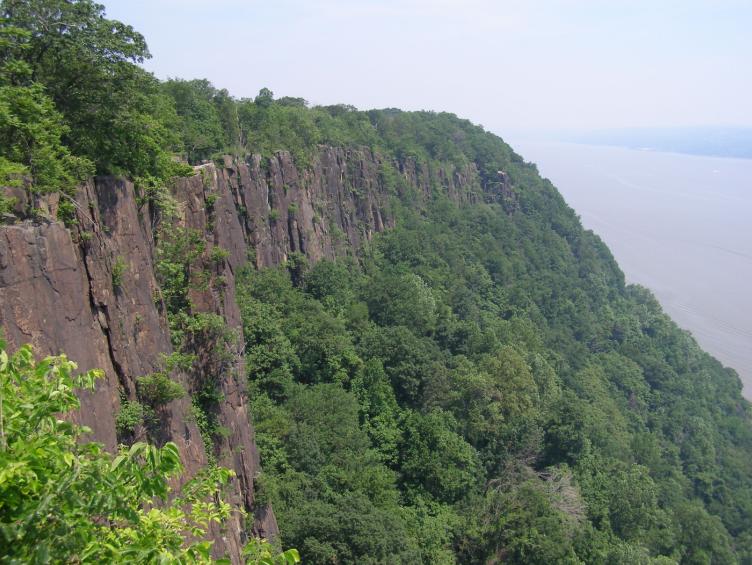
The Palisades Sill is a sheet-like igneous body emplaced during the late Triassic period and exposed as the steep cliffs known collectively as the Palisades. The feature extends along the western bank of the Hudson River and crosses state lines between New York and New Jersey. It is commonly described as a Triassic intrusion made up largely of coarse-grained mafic rock (diabase), and its age is commonly placed at about 200 million years ago.
Image gallery
7 Images


Geologic characteristics
The Palisades Sill is a relatively uniform, tabular body that intruded between older sedimentary strata. Cooling produced jointing and fracture patterns that, in many places, created columnar structures and vertical faces. These physical characteristics make the sill resistant to erosion compared with the surrounding rocks, producing the dramatic cliffs that rise above the river.
Origin and regional context
The sill formed when magma moved laterally into sedimentary layers during the rifting events associated with the breakup of the supercontinent Pangaea. As a type of igneous intrusion, it is part of the larger Newark Basin magmatic province and records an episode of mafic magmatism that affected much of the northeastern United States in the Mesozoic.
Uses, recreation, and human history
For more than a century the Palisades have been a focus for quarrying, recreation, and conservation. Early quarrying removed portions of the face for use as building stone and road material (commonly called "trap rock"). Today the area includes protected lands and parkways that attract hikers, birdwatchers, and rock climbers, while educational groups study the exposed contacts and cooling textures.
Scientific importance and notable features
The sill offers a well-exposed natural laboratory for understanding intrusive processes, cooling histories, and soil–rock relationships where igneous bodies meet sedimentary strata. Geologists use the Palisades to study jointing patterns, thermal metamorphism of adjacent rocks, and the broader tectonic setting of northeastern North America during the Triassic.
Distinctions and conservation
Unlike streams of surface lava, a sill intrudes parallel to the bedding of surrounding layers; this distinction helps separate the Palisades from flood basalts and lava flows elsewhere. The dramatic cliffs that make the sill so visible have led to protective measures, including park designation and land-use controls, to preserve both its scenic value and its scientific exposures. The visibility of the sill from river and roadway viewpoints continues to draw interest, and the formation remains an important landmark for geology and regional natural history.
- Key terms: sill (tabular intrusion), diabase (mafic intrusive rock), columnar jointing.
- States traversed: New York, New Jersey.
- Educational visits and guided trails provide access to classic exposures for learning and research.
Questions and answers
Q: What is the Palisades Sill?
A: The Palisades Sill is a Triassic intrusion that runs through parts of New York and New Jersey.
Q: When was the Palisades Sill formed?
A: The Palisades Sill was formed 200 million years ago.
Q: What is noteworthy about the Palisades Sill?
A: The Palisades Sill is noteworthy for The Palisades, cliffs which rise steeply above the western bank of the Hudson River.
Q: Who is interested in the Palisades Sill?
A: The visibility of the sill, and its unique features, have got much attention from nature enthusiasts, rock climbers, and geologists.
Q: What are The Palisades?
A: The Palisades are cliffs which rise steeply above the western bank of the Hudson River.
Q: What is an intrusion?
A: An intrusion is a geological formation in which molten rock (magma) from inside the Earth's crust is injected into pre-existing rock formations.
Q: How old is the Palisades Sill?
A: The Palisades Sill is 200 million years old.
Related articles
Author
AlegsaOnline.com Palisades Sill Leandro Alegsa
URL: https://en.alegsaonline.com/art/74191
Sources
- 3dparks.wr.usgs.gov : "NYC regional geology: the Palisades"