
GMC Envoy — mid-size SUV produced 1998–2009
Overview, development, variants and legacy of the GMC Envoy, a GM mid-size SUV sold 1998–2009. Covers design, platform, engines, the unusual XUV variant, safety features and its replacement by the GMC Terrain.
Overview
The GMC Envoy was a mid-size SUV sold by GMC, the truck-and-SUV division of General Motors. Introduced in the late 1990s, the Envoy was developed to fill a position between compact crossovers and full-size SUVs, offering family-friendly interior space, towing capability and a range of convenience and safety features. The model line remained in production through the 2009 model year.
Image gallery
8 Images


History and development
The Envoy debuted as part of GMC’s effort to modernize its SUV lineup and to share development costs across General Motors brands. A significant redesign in the early 2000s placed the Envoy on GM’s dedicated mid-size SUV architecture, bringing revised styling, updated suspension geometry and a broader choice of equipment and drivetrains. An extended-wheelbase variant was later offered to accommodate an optional third row and increased cargo capacity.
Design and platform
The second-generation Envoy rode on the GM mid-size platform often identified with the GMT360 family and shared major components with other mid-size SUVs in the company’s portfolio, including the Chevrolet TrailBlazer. This platform-sharing strategy allowed GMC to provide different levels of trim and accessories while keeping engineering costs under control. The Envoy’s body-on-frame construction and suspension tuning emphasized durability and towing over the carlike ride of emerging unibody crossovers.
Engines, drivetrain and performance
Over its production life the Envoy was offered with a selection of gasoline engines and both rear-wheel-drive and four-wheel-drive configurations. Powerplants and transmissions varied by year and market; the lineup prioritized a balance of everyday drivability and modest towing capacity. Later models benefited from refinement to reduce noise and improve ride comfort.
Trim levels and equipment
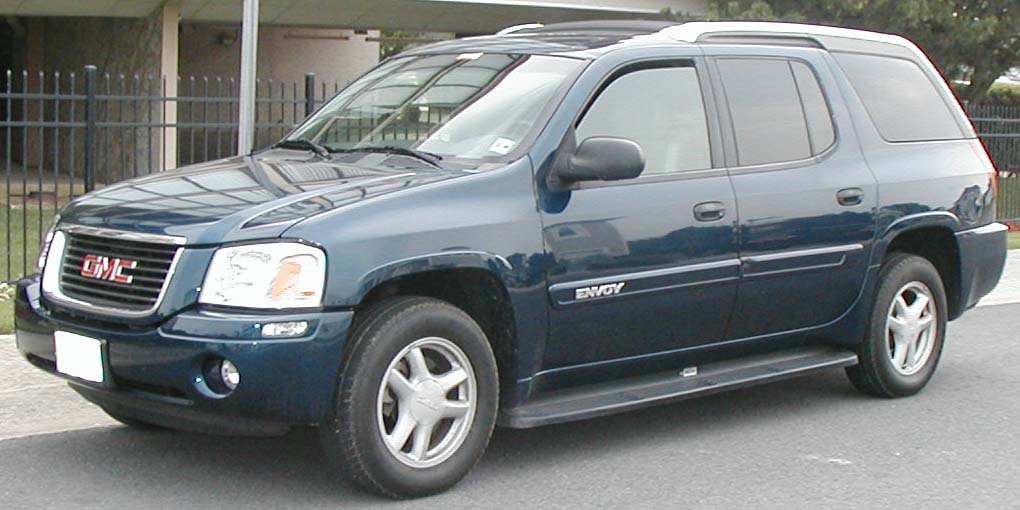
GMC marketed the Envoy in several trim levels and option packages to appeal to a wide range of buyers. A longer-wheelbase Envoy XL added seating for more passengers and extra cargo room, while higher trims focused on comfort and convenience items such as upgraded upholstery, entertainment systems and towing-oriented equipment. Many features that became common in the segment—such as power accessories, upgraded audio and safety bundles—were available across the range.
The XUV experiment
In an unusually ambitious attempt to blend SUV and pickup utility, GMC introduced the Envoy XUV in the mid-2000s. Built on the XL body, the XUV removed the third-row seating and used a retractable roof and tailgate arrangement to open the rear cargo area for carrying taller items. The concept aimed to offer the enclosed passenger comfort of an SUV with the ability to haul exposed cargo like a small pickup. Although it demonstrated innovative thinking, the XUV’s styling and mechanism received mixed reactions and sales were limited.
Safety and technology
The Envoy incorporated a range of active and passive safety systems that evolved over time. Later-model vehicles commonly included features such as daytime running lights, anti-lock braking systems (ABS), traction or electronic stability control and sensors designed to detect rollover conditions. When triggered, these systems could prompt deployment of occupant protection devices, including side curtain airbags tied to a rollover sensor and side curtain airbags. These features reflected industry trends toward integrating electronic controls and supplemental restraints into mid-size SUVs.
Market role, reception and successor
Throughout its run the Envoy competed against both traditional truck-based SUVs and an increasing number of car-based crossovers. Reviewers and buyers often praised the Envoy for its spaciousness and towing capability, while noting the heavier feel and fuel consumption relative to newer unibody competitors. Production ended after the 2009 model year as consumer preference shifted toward more fuel-efficient, carlike crossovers. GMC later introduced the smaller, crossover-oriented Terrain to address that market segment.
Legacy and considerations for buyers
The Envoy is remembered for its shared engineering with the TrailBlazer, for offering both standard and extended-wheelbase bodies (the Envoy XL), and for the distinctive XUV variant that attempted to broaden the vehicle’s utility. Prospective used-car buyers should evaluate maintenance history, typical wear items for aging SUVs and any vehicle-specific service bulletins. Enthusiast and owner communities remain useful resources for common repair tips and parts interchange information; technical details and historical context can also be found through manufacturer archives and specialist publications (platform details).
- Body styles: standard and extended-wheelbase (Envoy XL) — Envoy XL
- Platform sharing: common architecture with the TrailBlazer and other GM mid-size SUVs — platform details
- Notable features: XUV variant that combined a retractable cargo roof with SUV comfort — an attempt at SUV/pickup flexibility (pickup truck)
Related articles
Author
AlegsaOnline.com GMC Envoy — mid-size SUV produced 1998–2009 Leandro Alegsa
URL: https://en.alegsaonline.com/art/39305
Sources
- cars.com : "GMC Envoy"
- edmunds.com : "GMC Envoy Review"
- carfax.com : "GMC Envoy"
- automotive.com : Envoy "GMC Envoy"
- commons.wikimedia.org : GMC Envoy