
Geophone: seismic ground-motion sensor
A geophone is a ground-motion sensor that converts Earth vibrations into electrical signals. Used in seismology, exploration and engineering to record and analyze wave motion, timing and subsurface structure.
Overview
A geophone is an electromechanical sensor that detects and records ground motion. It converts relative movement between an internal element and the housing into an electrical voltage proportional to particle velocity. The resulting time series is recorded at a station for later analysis of amplitude, frequency content and arrival times of seismic waves. Geophones are a standard tool in seismic monitoring, exploration and engineering studies and are commonly deployed in networks and arrays for improved coverage and signal processing. See earthquake monitoring resources via earthquake monitoring.
Image gallery
6 Images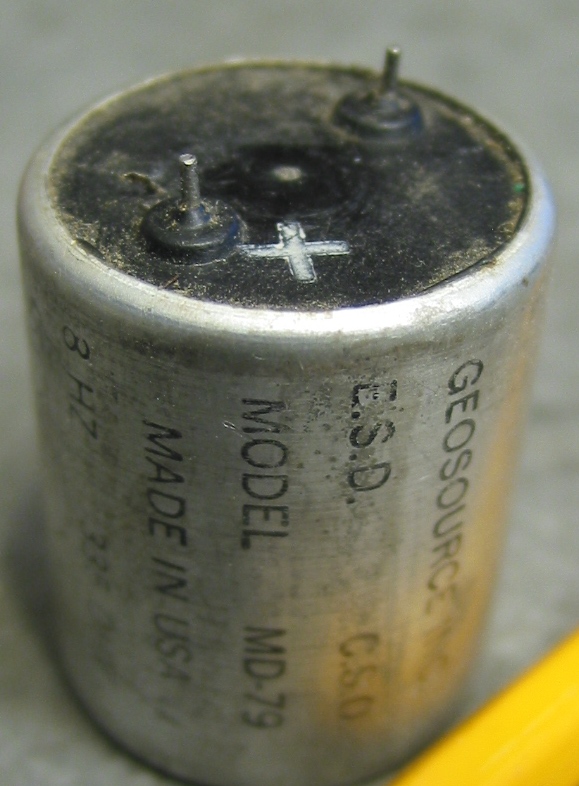


Design and operation
Many land geophones use a moving-coil, spring-mounted mass that moves relative to a magnet when the ground vibrates; electromagnetic induction produces an output voltage. Key characteristics include the device's natural (resonant) frequency, damping, sensitivity and directional response. These define the useful bandwidth and influence whether a geophone is best for low-frequency signals or for higher-frequency surveys. Three-component geophones combine sensors oriented along orthogonal axes to measure vector motion.
Deployment and coupling
Proper installation and ground coupling are essential for accurate recordings. Geophones can be placed on the surface, buried shallowly, or mounted in boreholes to reduce ambient noise and improve fidelity. Arrays of many geophones are used to enhance signal-to-noise ratio and to determine wave propagation direction and subsurface velocities. Field practice includes attention to orientation, grounding, leveling and secure contact with the ground.
Applications
- Exploration seismology for subsurface mapping in mineral, oil and gas surveys.
- Seismological networks that measure natural earthquakes and induced seismicity.
- Near-surface investigations, engineering site characterization and vibration monitoring.
- Passive monitoring of infrastructure, traffic or industrial operations.
Comparison with other instruments
Geophones inherently sense particle velocity; by contrast, accelerometers measure acceleration and broadband seismometers are designed for very low-frequency response and lower noise floors. Outputs from geophones are sometimes electronically conditioned, integrated to estimate displacement or differentiated to estimate acceleration, although these operations affect noise and low-frequency behaviour and require care. For basic principles of signal conversion and conditioning, consult sensor conversion resources at sensor conversion basics.
Calibration and maintenance
Routine calibration verifies sensitivity and frequency response. Practical maintenance includes checking connectors, verifying orientation, and replacing damaged components. In long-term networks, data quality assessment and periodic recalibration help maintain reliable records for research and hazard assessment.
Signal processing and data use
Recorded geophone signals are digitized, time-stamped and processed to remove noise, apply filters and extract parameters such as travel times, amplitudes and spectral content. Processed data support imaging of subsurface structure, earthquake source studies and engineering assessments of site response and shaking intensity.
Related articles
Author
AlegsaOnline.com Geophone: seismic ground-motion sensor Leandro Alegsa
URL: https://en.alegsaonline.com/art/38152